
Complete Water Softener Guide
Content updated
Sources last checked
A water softener removes the calcium and magnesium that make water hard, swapping them for sodium or potassium as water passes through a tank of resin beads. When regeneration is due, it rinses the resin with brine from a salt tank; frequency depends on hardness, water use, usable capacity and controller settings. It does not typically treat other contaminants, so it answers one question: how hard is your water, and does that hardness cause problems you want to fix?
Owning one well comes down to five steps, each covered in depth on its own page:
- Measure your water hardness. EPA considers water above 120 mg/L (about 7 gpg) hard and says softeners are often recommended above 180 mg/L (about 10 gpg).
- Size the softener from hardness and household water use, using its capacity at a stated salt dose.
- Choose a certified, efficient model and a complete installation quote.
- Set the controller with your measured hardness.
- Maintain it: follow the model's salt-fill limits, check salt regularly, and plan the yearly professional service EPA recommends.
The table below maps each decision to the page that answers it.
Start here: Measure your hardness first. Every later decision, from size to settings to salt use, follows from that number and your household's water use.
The evidence-first route
| Step | Decision you must make | Minimum evidence | Go deeper |
|---|---|---|---|
| 1 | What is the system supposed to do? | Ion-exchange and regeneration model | How Water Softeners Work |
| 2 | How hard is the incoming water? | Representative result, unit, point, method, date | Water Hardness Guide |
| 3 | Are the units comparable? | Original value and documented conversion | Water Hardness Calculator |
| 4 | Is the result representative? | Municipal/source record or before/after sampling plan | How to Test Water Hardness |
| 5 | What capacity is actually documented? | Exact model, salt dose, performance sheet, flow data | Water Softener Capacity |
| 6 | What planning capacity does the home need? | Hardness, softened gallons/day, target interval, explicit reserve | Water Softener Sizing Calculator |
| 7 | Which controller fields matter? | Exact model/manual and current values | Water Softener Settings Guide |
| 8 | What hardness input belongs in the control? | Untreated result, controller unit, exact compensation rule | How to Set Water Softener Hardness |
| 9 | Is regeneration behavior explained? | Trigger, stages, frequency inputs, two-cycle record | Water Softener Regeneration Guide |
| 10 | Is performance being maintained? | Manual-first schedule, results, next due dates | Water Softener Maintenance Guide |
| 11 | What symptom needs a safe first triage? | Observable symptom, evidence, and stop condition | Water Softener Troubleshooting Guide |
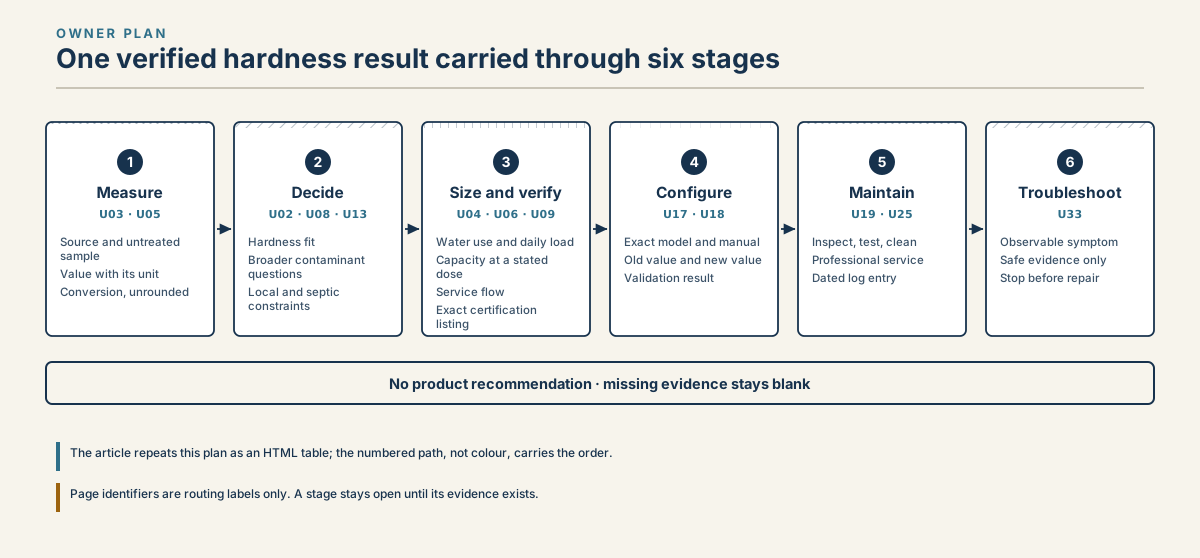
Six-stage water softener decision map covering measurement, treatment fit, sizing and verification, model-specific configuration, maintenance records, and safe troubleshooting.
Read diagram in text
- OWNER PLAN
- One verified hardness result carried through six stages
- 1
- Measure
- Hardness · Testing
- Source and untreated
- sample
- Value with its unit
- Conversion, unrounded
- 2
- Decide
- Basics · Conditioners · City
- Hardness fit
- Broader contaminant
- questions
- Local and septic
- constraints
- 3
- Size and verify
- Units · Capacity · Sizing
- Water use and daily load
- Capacity at a stated
- dose
- Service flow
- Exact certification
- listing
- 4
- Configure
- Settings · Set hardness
- Exact model and manual
- Old value and new value
- Validation result
- 5
- Maintain
- Regeneration · Maintenance
- Inspect, test, clean
- Professional service
- Dated log entry
- 6
- Troubleshoot
- Symptoms and fixes
- Observable symptom
- Safe evidence only
- Stop before repair
- The same hardness result, with its unit, carries through every stage
- The article repeats this plan as an HTML table; the numbered path, not colour, carries the order.
- Each label names the guides for that stage. A stage stays open until its evidence exists.
Start with your water, not a product
Write down the source: municipal supply, private well, community well, delivered water, or another arrangement. Then locate an untreated sampling point before the softener and any other treatment that could alter the result. Record the date, location, method, value, unit, and reporting basis.
A municipal water-quality report can supply context, but distribution zones, blends, seasons, and the age of the report can matter. A home test can be useful for screening and before/after comparison. A qualified laboratory is appropriate when source complexity, well water, iron/manganese, specific contaminants, or treatment design require more than a hardness strip.
Do not start with:
- “We have four people, so we need 40,000 grains.”
- “The fixtures have spots, so the softener failed.”
- “The seller says this handles iron, so hardness is the only test.”
- “The tank is large, so flow and capacity must be sufficient.”
- “A certification logo means the finished water is guaranteed safe.”
Each statement skips evidence or merges separate questions.
The U.S. Geological Survey describes hardness as primarily associated with calcium and magnesium and reports it as an equivalent calcium-carbonate concentration. Its general categories are 0–60 mg/L as soft, 61–120 moderately hard, 121–180 hard, and more than 180 very hard. Those are descriptive ranges, not a universal purchase threshold. (USGS Hardness of Water)
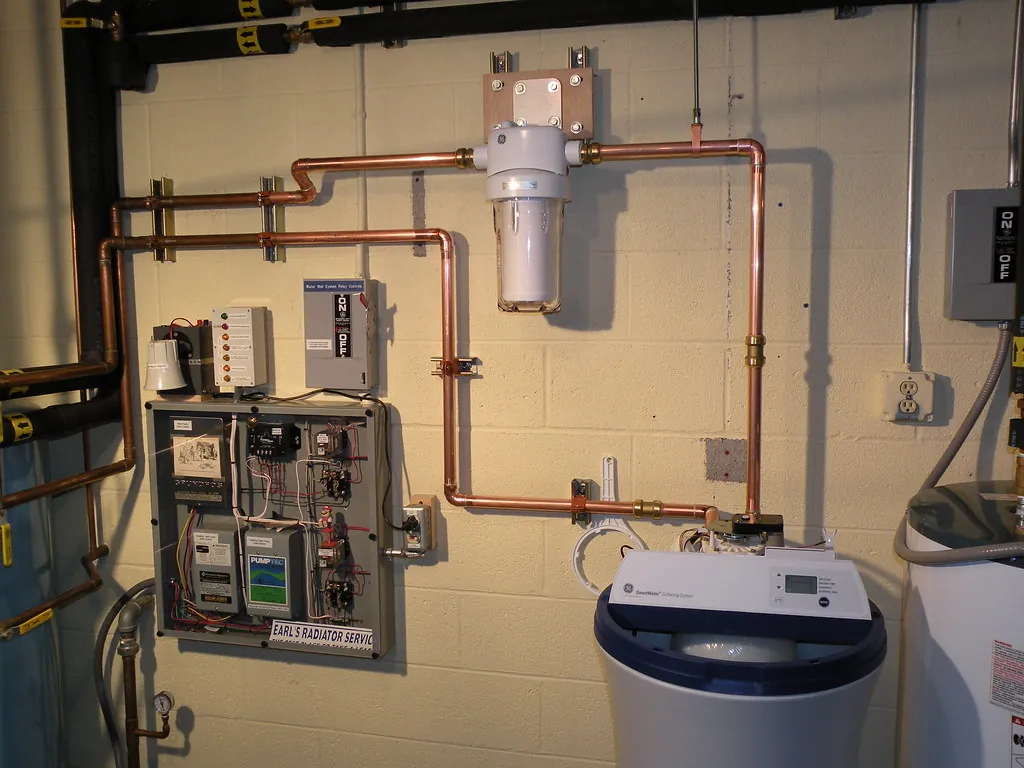
Understand ion exchange and regeneration
A conventional cation-exchange water softener contains resin with exchange sites initially associated with sodium or potassium ions. As hard water passes through, calcium and magnesium are exchanged onto the resin and sodium or potassium enters the treated water. When the available exchange capacity is depleted, regeneration uses salt solution and rinse water to remove accumulated hardness ions and restore exchange sites.
That produces two distinct operating states:
| State | Main input | Main output | What to verify |
|---|---|---|---|
| Service | Incoming hard water through available resin sites | Lower-hardness treated water | Untreated/treated hardness, demand, capacity remaining, flow |
| Regeneration | Regenerant plus rinse water through a model-specific sequence | Restored exchange capacity plus wastewater to drain | Trigger, stage order, salt/water use, drain behavior, return to service |
EPA explains that regeneration is necessary to flush the system and replenish its ion supply, but it also consumes water and salt. EPA currently provides selection and maintenance guidance but does not offer a WaterSense label for water softeners. Do not describe a model as “WaterSense certified.” (EPA cation-exchange overview)
A softener is not a generic filter for every contaminant. Model documentation can contain narrowly defined additional claims, but cation-exchange hardness reduction alone does not establish microbiological safety, broad contaminant removal, or potability.
Measure hardness in a reliable unit
Common hardness units are milligrams per liter (mg/L) as CaCO3, parts per million (ppm) on the same reporting basis, and grains per U.S. gallon (gpg). Preserve the original result before converting.
The project conversion is:
gpg = mg/L as CaCO3 ÷ 17.12
mg/L as CaCO3 = gpg × 17.12
For example, 171.2 mg/L as CaCO3 equals 10.0 gpg. Retain full precision and follow the exact controller manual for any display rounding. Do not substitute total dissolved solids, conductivity, calcium alone, treated-water hardness, or an unlabeled number for total incoming hardness.
Use Water Hardness Guide to interpret the result, Water Hardness Calculator to reproduce the conversion, and How to Test Water Hardness Before and After a Softener to build a representative before/after test record. Apart from a documented conversion, the test result should travel unchanged from source evidence to sizing and controller configuration.
Decide whether softening fits the problem
Separate the stated problem from the technology:
| Observed concern | Does hardness evidence help? | What else must be resolved? |
|---|---|---|
| Scale on heaters/fixtures | Yes; verify hardness and temperature/use context | Equipment condition and cleaning needs remain separate |
| Soap/detergent performance | Yes; compare representative hardness | Product, temperature, and user factors can also matter |
| Clear-water iron staining | Hardness alone is insufficient | Test iron concentration/form; require exact model claim and professional design |
| Odor, color, sediment, taste | Not enough | Appropriate laboratory/utility/professional evaluation |
| Microbial or unknown well-water concern | No | Suitable analysis, disinfection/treatment design, and public-health guidance |
| Lead, arsenic, nitrate, PFAS, pathogens, or another named contaminant | No hardness inference | Contaminant-specific certified treatment and expert guidance |
EPA's May 2026 guide tells owners to check local restrictions because cation-exchange discharge can affect wastewater and local water quality. Homes with onsite septic systems should check compatibility, capacity, and warranty with the septic manufacturer or local service provider. Those questions belong before purchase, not after installation. (EPA WaterSense guide)
Also decide which uses actually need softened water. Irrigation and other high-volume uses may be intentionally bypassed if the model, plumbing, landscape needs, and local guidance support it. Excluding them changes the demand input and may reduce unnecessary treatment.
Size from hardness and observed water use
The core planning relationship is:
daily hardness load = incoming hardness in gpg × softened gallons used per day
Then:
base planning capacity = daily hardness load × target days between cycles
Any planning reserve must be added visibly and must remain separate from the controller's operational reserve. Household head count alone is not an input unless it is used to create a clearly labeled provisional consumption estimate. Bills, meter data, or a controller history are stronger.
Sizing is multi-dimensional:
- hardness-removal capacity at a stated salt dose;
- typical and peak softened-water demand;
- rated service flow and pressure drop;
- regeneration water and drain flow;
- salt efficiency and practical refill/storage;
- local discharge and septic constraints;
- installation space, plumbing, power, drain, and freeze/heat conditions;
- certification and exact claims; and
- service availability and maintenance burden.
The Water Softener Sizing Calculator sizing result is a planning requirement, not a product recommendation. A candidate that meets the calculated grains can still fail flow, pressure, certification, drainage, installation, or service requirements.
Verify usable capacity and certification
A model can show several capacity-and-salt-dose pairs. Keep each pair together:
documented capacity in grains @ stated pounds of salt per regeneration
Higher salt dose may produce more capacity per cycle but lower calculated grains removed per pound of salt. Do not use the largest advertised grain number, tank size, or a product-family name as the controller capacity. Water Softener Capacity supplies the performance-sheet transcription workflow.
NSF says NSF/ANSI 44 covers minimum requirements for residential cation-exchange softeners using sodium or potassium chloride. Its scope includes hardness reduction and specified claims from a known-quality source, material safety, structural integrity, pressure drop, softening capacity, rinse effectiveness, brine-system accuracy, and end-user information. These attributes remain distinct. (NSF/ANSI 44 technical requirements)
For a certification claim:
- identify the named certifier;
- search that certifier's official current listing;
- match the complete model identifier and configuration;
- read the exact claim, limitation, flow, and footnotes;
- record the listing URL and current date; and
- recheck before purchase and publication.
NSF maintains a live Standard 44 product listing for products it lists. Use another certifier's official database when another body is named. A similar model, component certificate, retailer badge, or logo does not replace an exact listing match.
Certification supports the claims within its defined scope. It does not mean this site tested the installed product, guarantees installed performance, or has established that source or finished water is safe for every use.
Configure with the exact model manual
Record every current owner-visible value before editing. Common concepts include hardness, capacity, media volume, salt dose, regeneration type, reserve, day override, regeneration time, and salt type, but the fields, units, dependencies, and permitted user access vary.
Use this evidence map:
| Setting | Evidence source | Never substitute |
|---|---|---|
| Incoming hardness | Representative untreated result and unit | Treated-water result, TDS, neighbor's setting |
| Capacity | Exact model/configuration performance row at selected dose | Marketing grain label or tank dimension |
| Salt dose | Capacity/dose pair and actual build | “Most efficient” generic value |
| Media/valve/flow control | Installed build and service documentation | Guess from cabinet or similar model |
| Reserve/override/type/time | Exact controller manual and intended operation | Planning reserve or internet default |
| Iron/other compensation | Measured condition plus explicit exact-model rule | Factor from another manufacturer/model |
Change one documented input at a time and record old value, new value, unit, evidence, reason, date, reviewer, and validation. Hidden master settings, valve configuration, injectors, brine-line flow, refill, custom cycles, and internal service belong to competent model-specific work.
Water Softener Settings Guide explains the settings vocabulary. How to Set Water Softener Hardness handles the hardness field and carefully limits any compensation example to the cited model. Neither supplies a universal button sequence.
Understand and verify regeneration
Demand-initiated regeneration uses measured demand or a sensor according to the design; time-initiated operation follows a schedule. Immediate and delayed controls can apply capacity and reserve differently. Stage order can also vary: backwash, draw, slow rinse, rapid rinse, refill, pauses, extra backwash, or custom steps may appear in different sequences.
Do not decide that a cycle is “too frequent” from a generic calendar or “too long” from a universal duration. Record at least two naturally occurring cycles:
- trigger/status;
- start and return-to-service times;
- displayed stage order;
- days and gallons since prior cycle;
- water use and hardness load;
- salt trend;
- drain behavior during stages and after service returns; and
- treated-hardness outcome.
Water Softener Regeneration provides the modular timeline and frequency worksheet. Water continuing to drain in normal service, a leak or overflow, a stalled stage, repeated cycling without use, or an error is a stop or service condition. It is not a reason to advance stages from a generic tutorial.
Maintain and record performance
Separate four actions:
- Inspect: salt trend, visible bridging/hardening, floor/connections, drain/overflow, display, clock, alerts, and regeneration history.
- Test: untreated and treated hardness at documented points and manual/event-driven intervals.
- Clean: only with the exact compatible product, procedure, condition, and cadence supported by the model/manual and label.
- Professional service: document scope, measurements, findings, setting/part changes, validation, and next due date.
EPA's current resources supply general maintenance prompts, but exact manuals can differ, and even EPA's current brine-tank cleaning cadences are not identical. Water Softener Maintenance Guide and Schedule preserves those differences rather than inventing an average. The installed manual and observed condition control the work.
A maintenance log should reveal trends: treated hardness, salt additions, days/gallons between cycles, leaks, errors, cleaning, service, and changes. A checkbox without evidence cannot show whether performance changed.
Troubleshoot by observable symptom
Begin with a safety gate. An active leak or overflow, water near electricity, cracked pressurized equipment, constant drain in service, stalled valve, media loss, or broader water-quality concern precedes routine checks.
Then select one symptom:
- treated water tests hard;
- salt level does not change;
- regenerates too often;
- does not appear to regenerate;
- brine-tank level looks abnormal;
- hardness is intermittent; or
- an error, motor symptom, or media loss appears.
Water Softener Troubleshooting Guide gives each branch three levels: a safe non-invasive check, supporting evidence, and a stop/service condition. It does not diagnose a part. Preserve the display, settings, samples, cycle history, demand, and photos before resets or multiple changes.
For a specific symptom, the troubleshooting guide links to pages on salt that is not dropping, salt bridges, frequent regeneration and a softener that does not regenerate.
Know the limits: contaminants, wells, and professional work
This site can help document hardness, calculations, model claims, settings evidence, regeneration observations, and maintenance history. It does not:
- determine whether water is potable;
- diagnose microbial or contaminant risk from hardness;
- claim a softener removes a contaminant without an exact supported model claim;
- certify, laboratory-test, install, commission, or repair a product;
- rank a “best water softener” without a defined, current evidence set;
- promise capacity, flow, salt use, regeneration frequency, lifespan, or savings in an actual home;
- replace local codes, discharge or septic requirements;
- prescribe universal chemicals, sanitation, bypass, shutoff, or controller values; or
- instruct internal valve, pressurized plumbing, electrical, or media work.
Private-well decisions usually need more than hardness. Identify iron and manganese forms/concentrations, microbial quality, pH, turbidity, sediment, and other relevant constituents through suitable testing and professional interpretation. A controller compensation rule is not a full treatment design.
Build your one-page owner plan
Complete the included one-page water softener owner plan. It brings every result from the steps above onto one page:
- system identity and manual;
- water source and untreated/treated test records;
- original hardness value, conversion, and interpretation;
- softened-water demand and hardness load;
- verified capacity-and-dose row, flow, pressure, and certification listing;
- owner-visible settings with old/new/validation records;
- regeneration trigger, stage pattern, and frequency evidence;
- maintenance tasks, last results, and next due dates;
- current symptom and safety gate; and
- unresolved decisions, responsible person, reviewer, and next action.
Start with one verified untreated-hardness result. If a later field cannot trace back to a source, manual, measurement, official listing, or named reviewer, leave it blank and state what evidence is missing. The completed plan should make uncertainty visible instead of hiding it behind a recommended product.
Frequently asked questions
What does a water softener actually do?
A conventional ion-exchange water softener reduces calcium and magnesium hardness by exchanging those ions for sodium or potassium. It does not automatically remove other contaminants or establish that water is safe to drink. Any additional treatment claim must belong to the exact model and appear in reliable performance evidence.
What information should I collect before buying a water softener?
Start with representative untreated hardness, household softened-water demand, the problem you want to solve and local installation constraints. Then compare exact-model capacity at a stated salt dose, service flow, efficiency, certification, warranty and installation scope. A household-size label or nominal grain number cannot replace those inputs.
Does a water softener make drinking water safe?
No. Hardness reduction and drinking-water safety are different questions. A hardness result does not identify lead, arsenic, nitrate, bacteria or other contaminants, and a typical softener does not treat them. Use the proper testing and treatment evidence for each separate water-quality concern.
Why does the exact model manual matter?
Controller fields, reserve logic, regeneration stages, bypass behavior, drain requirements and maintenance procedures differ among products. The exact current manual defines what a setting means and what an owner may safely do. Instructions borrowed from a similar-looking valve can create a wrong setting or unsafe procedure.
Sources
- U.S. Environmental Protection Agency WaterSense, Guide to Selecting and Maintaining a Water-Efficient Water Softener, May 2026; consulted August 27, 2026.
- U.S. Environmental Protection Agency WaterSense, Cation Exchange Water Softeners, updated May 8, 2026; consulted August 27, 2026.
- U.S. Geological Survey, Hardness of Water; consulted August 27, 2026.
- NSF, NSF/ANSI 44 Technical Requirements, March 8, 2025; consulted August 27, 2026.
- NSF, Official NSF/ANSI 44 Product Listings; consulted August 27, 2026.