
Water Softener Regeneration: Frequency, Stages and Checks
Content updated
Sources last checked
Regeneration is how a water softener recharges itself. It rinses the resin with salty brine from the salt tank, which pulls off the calcium and magnesium it has collected, then flushes the brine and debris down the drain. EPA's water softener guide puts a typical cycle at 20 to 70 gallons of water.
Many controllers schedule regeneration at night; 2:00 a.m. is a default in the Whirlpool examples, and a cited Pentair manual describes it as suitable for many households. Those manuals describe cycles of up to about two hours for their models, but actual duration and available water depend on the controller. How often depends on incoming hardness, water use, usable capacity and settings. The formula below provides an estimate to compare with your event record.
Regeneration rule: Work out the expected interval from hardness, water use and capacity before deciding the softener regenerates too often or too rarely. A normal cycle ends with the display back in service and no water running to the drain.
What regeneration restores
During normal service, hard water passes through ion-exchange resin. Calcium and magnesium ions are exchanged for sodium or potassium ions held at resin sites. As those sites become occupied by hardness ions, the available softening capacity is depleted. Regeneration uses a salt solution and rinse water to remove accumulated hardness ions and replenish the resin's sodium or potassium supply. (EPA cation-exchange overview)
Regeneration therefore uses both salt and water and sends wastewater to the drain. It is necessary for continued softening, but more frequent is not automatically better. EPA's May 2026 guide says demand-initiated regeneration helps a system regenerate when needed and warns that unnecessary regeneration wastes water and salt. (EPA WaterSense guide)
An extra regeneration fixes one thing: resin that ran out of capacity, for example after the salt ran out. It will not fix a leaking valve, a blocked drain line or worn resin; if a normal cycle does not bring soft water back, go to the troubleshooting guide.
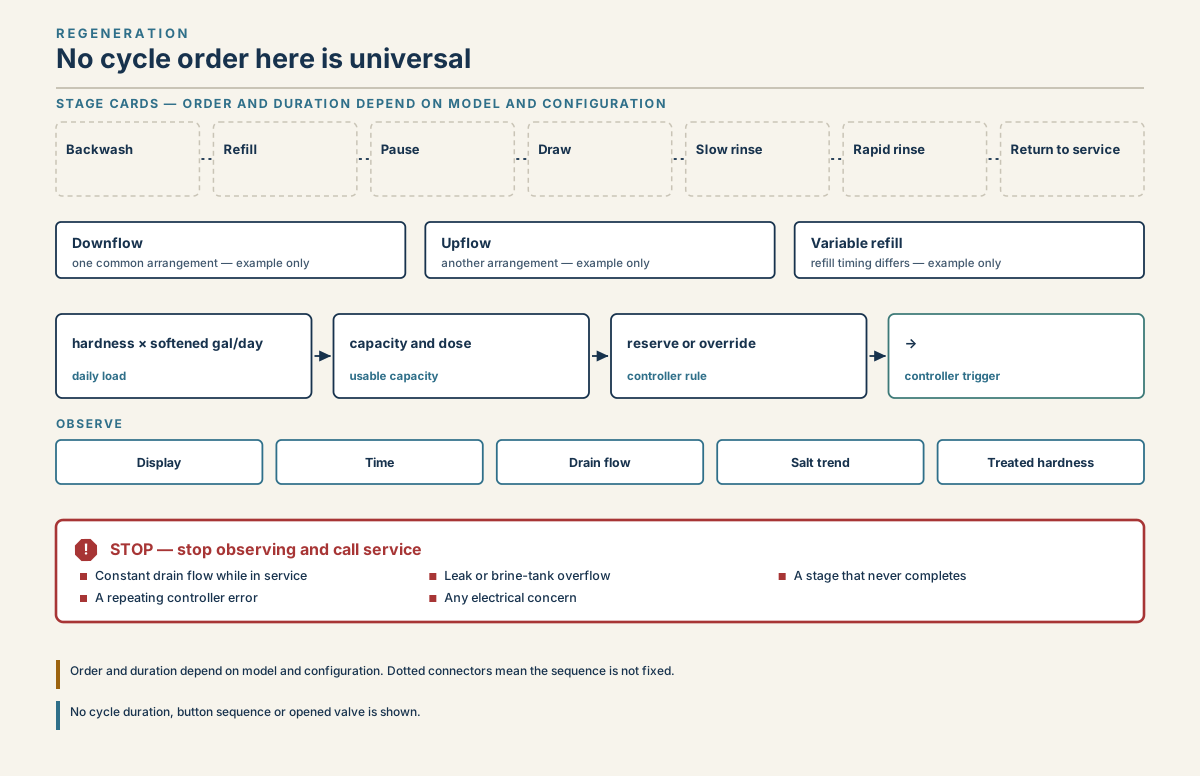
Modular water softener regeneration diagram with rearrangeable stages and a frequency flow based on hardness, water use, capacity, reserve, and controller settings.
Read diagram in text
- REGENERATION
- No cycle order here is universal
- STAGE CARDS — ORDER AND DURATION DEPEND ON MODEL AND CONFIGURATION
- Backwash
- Refill
- Pause
- Draw
- Slow rinse
- Rapid rinse
- Return to service
- Downflow
- one common arrangement — example only
- Upflow
- another arrangement — example only
- Variable refill
- refill timing differs — example only
- hardness × softened gal/day
- daily load
- capacity and dose
- usable capacity
- reserve or override
- controller rule
- →
- controller trigger
- OBSERVE
- Display
- Time
- Drain flow
- Salt trend
- Treated hardness
- !
- STOP — stop observing and call service
- Constant drain flow while in service
- Leak or brine-tank overflow
- A stage that never completes
- A repeating controller error
- Any electrical concern
- Order and duration depend on model and configuration. Dotted connectors mean the sequence is not fixed.
- Stage times and buttons differ by controller; the article gives the Whirlpool and Pentair examples.
Demand-initiated versus time-initiated triggers
Time-initiated regeneration starts after a programmed interval, regardless of the exact volume treated. A day override may also place a maximum interval on a metered system. Those are different uses of time and must not be treated as the same setting.
Demand-initiated regeneration (DIR) uses measured demand, such as metered water use, or a hardness sensor, depending on the design, to trigger a cycle after a defined amount of treatment. EPA recommends DIR over a fixed schedule for water and salt efficiency because it better aligns regeneration with actual need.
Even among metered controllers, the trigger can differ. The cited Pentair IntelliWater manual documents:
- Softener Immediate: measures water use and begins regeneration when calculated capacity is depleted; this mode does not use a reserve volume in the same way as delayed operation.
- Softener Delayed: measures water use, subtracts its configured reserve, and schedules the cycle for the selected regeneration time after calculated capacity is depleted.
- Time Clock: triggers on a timed interval according to its documented day-override and regeneration-time fields.
These are examples from one control family, not universal mode names or logic. Its delayed mode can use fixed-volume, fixed-percentage, variable, or weekly reserve. Copying a reserve or day-override value from another controller can change frequency in ways that are not comparable. (Pentair IntelliWater manual)
Common stages and why the order varies
The modular timeline below explains functions you may encounter. It is not a universal sequence.
| Possible stage | General purpose | Safe external observation | Model variation to expect |
|---|---|---|---|
| Backwash | Reverses or redirects water to expand/rinse the media bed and carry debris to drain | Controller label; audible water movement; documented drain flow | May occur first, later, more than once, or not appear as a separate owner label |
| Brine fill or tank refill | Adds a model-calculated amount of water to prepare brine | Controller label; water entering the brine tank if safely visible | Can occur near the beginning or end; timing may be calculated from salt dose, media, and flow control |
| Brine draw | Pulls brine through the resin to exchange accumulated hardness ions | Controller label; gradual liquid-level change only if the manual identifies a safe observation point | Direction, rate, and pairing with slow rinse vary |
| Slow rinse | Continues controlled flow through the bed while brine is displaced | Display may combine it with brine draw | Often combined as “brine/slow rinse”; not always separately displayed |
| Rapid or fast rinse | Rinses and settles the resin bed before service | Controller label and a documented faster drain flow | Name, direction, duration, and position differ |
| Pause or custom step | Supports a model-defined sequence | Only the displayed label and remaining time | May be absent; advanced controls can have custom steps |
| Return to service | Valve returns to treatment position | Display returns to service; expected drain flow stops | The exact transition and water availability are model-specific |
The variation is concrete. The Pentair IntelliWater manual lists downflow as backwash → draw → rapid rinse → tank refill, while its upflow option starts with draw. A double-backwash option inserts another backwash, and its variable-refill sequence starts with refill and pause. The same manual allows custom sequences. None of those arrangements establishes the sequence for another valve.
Do not assign a duration from a generic chart. Stage times can depend on valve programming, resin or media volume, salt dose, refill control, flow direction, water-saving features, and custom settings. A Pentair Whole House manual says regeneration for its cited control can last up to two hours; that is a model-specific upper statement, not a promise that every softener cycle lasts two hours. (Pentair Whole House manual)
What controls regeneration frequency
Frequency begins with hardness load, not household head count alone.
daily hardness load = incoming hardness in gpg × softened gallons used per day
gross treatment volume before controller reserve = documented capacity in grains ÷ incoming hardness in gpg
Hypothetical calculation: if the selected model-and-dose row documents 32,000 grains, dividing by 15 gpg gives about 2,133 gross gallons before reserve. At 250 softened gallons per day that is about 8.53 days arithmetically. The controller's reserve and override rules still determine the actual event. The regenerating too often guide walks through the checks when the real interval is far off.
| Input | If it increases or changes | Evidence to check before interpreting frequency |
|---|---|---|
| Incoming hardness | More hardness normally consumes capacity faster | Representative untreated-water test, unit, date, sample point |
| Softened-water use | More treated gallons normally increase daily load | Meter/controller history or water bill; exclude known bypassed uses |
| Documented capacity | More usable capacity at the configured dose can extend service | Exact performance-sheet capacity-and-salt-dose pair |
| Reserve | A larger reserve can cause an earlier delayed cycle | Exact controller reserve type and unit |
| Salt dose/configuration | Can change usable capacity and refill behavior | Performance sheet, build configuration, and manual |
| Day override | Can trigger a cycle even before metered capacity is used | Exact field, current value, and manual definition |
| Leaks or unrecognized flow | Can make a meter register more use | Fixture, toilet, meter, or controller evidence |
| Source-water change | Can make the programmed hardness obsolete | New representative untreated-water result |
| Clock or power interruption | Can shift a delayed cycle or queue behavior | Display, outage record, and exact manual |
Use the water softener settings guide to audit these fields and the hardness-setting guide to verify the incoming number. Change one input at a time so you can see its effect.
Is every night or once a week normal
Either can be. A softener that regenerates every night may be a high-efficiency model running small cycles, a demand-initiated unit in a big household, or one with the hardness set too high or a leak adding to the meter count. One that regenerates once every two weeks may be sized generously for a small household, or may have a stalled meter.
Compare the event record with the formula, capacity/dose pair, reserve and override rules. Agreement supports the load estimate; treated-hardness results and completed-cycle behavior are still needed to assess performance. If the interval differs:
- more often than expected: check the hardness setting, look for a leak (EPA's water meter test) and review reserve and day override. See regenerating too often.
- less often, or not at all: check power, bypass, the clock and whether the meter counts water. See not regenerating.
What you will see and hear
If you are up during a regeneration, this is what is normal:
- The display changes to show a cycle or stage and often a countdown (Whirlpool shows "RECHARGE"; the Fleck 5600SXT shows the step number and time remaining).
- Water runs to the drain for most of the cycle, faster during backwash and rinse, slower during brine draw.
- The water level in the salt tank drops noticeably during the brine stage. Whirlpool's manuals use exactly this, seen with a flashlight down the brinewell, to confirm brine draw; it can take 15 to 20 minutes.
- The salt tank refills with water, at the start of the cycle on Whirlpool units and at the end on the Pentair 5600SXT.
- The display returns to the time of day or service screen, and the drain goes quiet.
To start one yourself, see how to manually regenerate a water softener. Pressing buttons during a cycle can skip stages on some controls (on the 5600SXT, Extra Cycle advances to the next step), so leave it alone once it has started.
Can you use water during regeneration?
Yes, but on most single-tank softeners it will be hard. Pentair's Whole House manual says its system sends hard water to the home during regeneration, and that water drawn then can reach the plumbing and the water heater; the Fleck 5600SXT manual also says untreated water bypasses into the building. Whirlpool advises avoiding hot water during a recharge so the water heater does not refill with hard water. (Whirlpool manual)
That is why the regeneration time is set for the middle of the night. Twin-tank softeners switch between two resin tanks (the 5600SXT manual mentions twin-tank systems with soft-water regeneration), so they can keep supplying soft water during a cycle; if you need soft water around the clock, that is the design to ask about.
Normal variation versus warning signs
These are normal:
- water flowing to drain during a documented regeneration stage;
- different drain-flow intensity between stages;
- a delayed cycle waiting until its scheduled time;
- a displayed countdown or remaining stage time;
- temporary bypass hard water on a model designed that way; and
- cycle timing that changes with a model-defined refill or water-saving feature.
These are warning signs:
- water continuing to drain after the controller has returned to its soft-water/service state;
- a leak, brine-tank overflow, wet electrical area, or unsecured drain discharge;
- a controller repeatedly cycling with little or no recorded water use;
- a stalled stage, recurring error, grinding motor sound, blank display, or failure to return to service;
- no salt-level change across multiple documented cycles when the manual says salt should be used;
- unexpected excessive water in the brine tank;
- no treated-hardness improvement after a completed cycle and verified settings; or
- resin or other media appearing in plumbing or at the drain.
Whirlpool's troubleshooting table treats water running to the drain while the unit is in its soft-water cycle as a fault, and lists a plugged nozzle and venturi, a blocked drain hose, pressure problems and internal valve leaks among the causes. The troubleshooting guide goes through them. For a leak or an overflowing tank, put the softener in bypass and call for service.
Tools for tracking regeneration
If you want to check your own numbers, the frequency-input worksheet collects hardness, water use, capacity and settings in one place, and the cycle timeline lets you note each stage and its time during a cycle you watch. The sizing calculator does the capacity math, and the maintenance log keeps a record of cycles and salt over time.
Frequently asked questions
How often should a water softener regenerate?
It depends on hardness, water use and capacity. Divide the capacity in grains by your hardness in gpg for gallons between cycles, then divide by daily softened-water use. A 32,000-grain unit on 15 gpg water in a house using 250 gallons a day regenerates about every 8 days, or sooner with a reserve.
How long does a water softener regeneration take?
About two hours on the units whose manuals give a figure: Pentair's Whole House manual says up to two hours after the start time, and Whirlpool puts a manual recharge at about two hours. Stage times vary by valve and settings, so your manual may list a slightly different total.
Can I use water while the softener regenerates?
You can, but on most single-tank softeners it will be hard water, because the valve sends untreated water to the house during the cycle. Whirlpool advises avoiding hot water so the heater does not refill with hard water. That is why regeneration is usually set for the middle of the night.
When is regeneration behavior a warning sign?
Water running to the drain after the display returns to service, leaks or an overflowing salt tank, a display stuck on one stage, repeated cycles with little water use, a salt level that never drops, or hard water after a completed cycle. Start with the troubleshooting guide, and call for service if the valve seems stuck.
Sources
Sources were consulted on the dates shown. Stage order and times differ by valve, so confirm them in your current manual.
- U.S. Environmental Protection Agency WaterSense, Cation Exchange Water Softeners, updated May 8, 2026; consulted September 24, 2026.
- U.S. Environmental Protection Agency WaterSense, Guide to Selecting and Maintaining a Water-Efficient Water Softener, May 2026; consulted September 24, 2026.
- Pentair, IntelliWater Connected Water Softener Service Manual, Installation and Operation Guide; consulted September 24, 2026.
- Pentair, Whole House Water Softening System Installation and Operation Manual; consulted September 24, 2026.
- Whirlpool Water Solutions, Water Softener Installation and Operation Manual, document 7392301; consulted September 24, 2026.
- Pentair, Pentair 5600SXT manual; consulted September 24, 2026.
- Whirlpool Water Solutions, Whirlpool WHES48 manual; consulted September 24, 2026.