
Water Softener vs. Water Conditioner
Sources last checked
In a water softener vs water conditioner comparison, the mechanism matters more than the label. A cation-exchange softener removes hardness ions, primarily calcium and magnesium, from treated water. A product sold as a conditioner may instead aim to reduce scale formation while leaving those ions in the water. Verify the measurable result and certification for the exact model.
Choose a softener when the required outcome is verified hardness reduction. Consider a certified scale-reduction device when the objective is scale management, you understand that measured hardness may remain, and the documented performance fits your water and equipment. If the concern is a contaminant or drinking-water safety, neither category should be assumed to solve it without the exact certified claim.
Quick verdict: Choose by verified output. A softener should reduce measured hardness. A conditioner may target scale behavior without lowering the hardness result. If a seller cannot state the mechanism, test method and exact certified claim, pause the comparison.
The difference in one sentence
Softening changes the measured hardness concentration; conditioning is a broader commercial term and may describe a technology that changes scale behavior without removing hardness.
That distinction affects testing. A correctly operating ion-exchange softener should produce a lower hardness result at its treated sample point. A scale-reduction conditioner may be working according to its stated purpose even if a conventional hardness test still detects calcium and magnesium.
“Salt-free softener” can therefore be a confusing label. Before accepting it, ask: Does this exact model claim hardness reduction, scale reduction, filtration or something else? What test standard and listing verify that claim?
What a cation-exchange softener does
The EPA WaterSense overview describes cation-exchange softeners as systems that exchange calcium and magnesium ions for sodium or potassium ions. Once the exchange capacity is used, the resin is regenerated with brine and the captured hardness is flushed from the system.
Typical ownership requirements include:
- a mineral tank containing cation-exchange resin;
- a brine or regenerant system using sodium or potassium chloride as allowed by the model;
- periodic regeneration;
- a suitable drain and approved air gap or other code-compliant arrangement;
- hardness, capacity and regeneration settings;
- salt and water use; and
- inspection, maintenance and model-specific service.
NSF explains that NSF/ANSI 44 covers residential cation-exchange softeners regenerated with sodium or potassium chloride. Its scope can include hardness reduction, material safety, structural integrity, pressure drop, softening capacity, rinse effectiveness and brine-system accuracy.
Certification is model- and claim-specific. Search the certifier's current database for the exact manufacturer, trade name and model rather than relying only on a logo in an advertisement. The NSF Standard 44 listings are one official verification route.
What “water conditioner” can mean
“Conditioner” is not one mechanism. Depending on the product, it may refer to a scale-reduction medium, electrically powered device, chemical dosing process, filtration combined with another function or even an ordinary softener marketed under a broader name.
EPA's guide to selecting water treatment systems distinguishes softening from neutralizing or reducing scale-forming behavior. It points consumers to NSF/ANSI 44 for water softeners and IAPMO/ANSI Z601 for scale-reduction devices.
This produces a practical rule:
- If a product claims hardness reduction, verify the reduction claim and how treated hardness will be measured.
- If it claims scale reduction, verify the scale-reduction claim, test conditions, installation requirements and limitations.
- If it claims contaminant reduction, verify every named contaminant against a current product listing under the appropriate standard.
- If it uses only the word conditioner, request the missing mechanism and performance documents before comparing it with anything.
Do not infer that scale control makes water “soft,” that lower scale proves a contaminant was removed, or that one certification covers claims outside its listed scope.
Side-by-side verification table
| Question | Cation-exchange softener | Scale-reduction conditioner | What to verify for the exact model |
|---|---|---|---|
| Primary outcome | Reduces measured calcium/magnesium hardness | Aims to reduce scale formation or adhesion; hardness ions may remain | Written performance claim and applicable standard |
| Expected hardness test | Lower at a correctly selected treated point when operating as specified | May remain similar because scale behavior, not concentration, is the claimed outcome | Manufacturer test method and post-installation acceptance test |
| Main mechanism | Ion exchange using regenerable resin | Varies by device; do not infer from “salt-free” | Technical data sheet naming the mechanism |
| Salt/regenerant | Usually sodium or potassium chloride as specified | Often marketed without regenerant, but verify consumables for the model | Consumable type, quantity, replacement interval and cost |
| Regeneration water and drain | Normally required for brine regeneration | May avoid brine regeneration; other flushing or drain needs can vary | Plumbing diagram, drain requirement and operating water use |
| Settings | Hardness, capacity/dose, reserve and regeneration controls can matter | Controls and commissioning vary by technology | Installation manual and commissioning record |
| Certification route | Look for exact model and hardness-reduction claim under NSF/ANSI 44 or another applicable accredited listing | EPA directs buyers to IAPMO/ANSI Z601 for scale-reduction devices | Current certifier listing, model match and claim scope |
| What it does not prove | Does not automatically reduce every contaminant | Does not automatically remove hardness or contaminants | All exclusions and non-claims in the performance sheet |
The table compares claimed outcomes, not brands. A particular product belongs in a column only after its documentation confirms the mechanism and result.
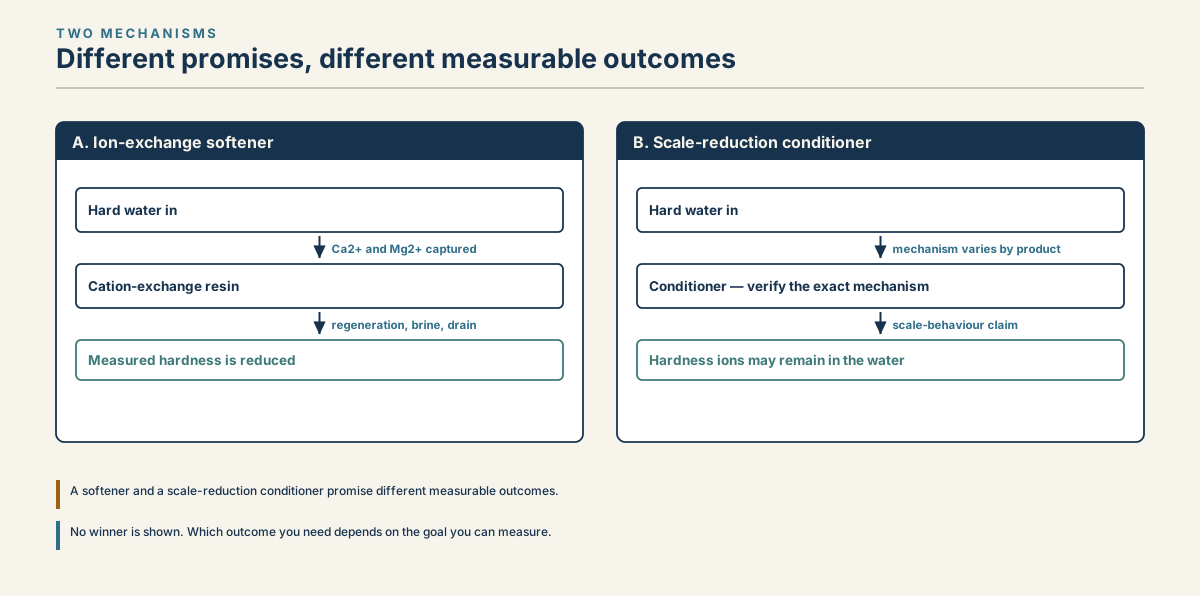
Diagram comparing ion-exchange hardness removal with conditioner scale reduction where hardness minerals may remain.
Read diagram in text
- TWO MECHANISMS
- Different promises, different measurable outcomes
- A. Ion-exchange softener
- Hard water in
- Ca2+ and Mg2+ captured
- Cation-exchange resin
- regeneration, brine, drain
- Measured hardness is reduced
- B. Scale-reduction conditioner
- Hard water in
- mechanism varies by product
- Conditioner — verify the exact mechanism
- scale-behaviour claim
- Hardness ions may remain in the water
- A softener and a scale-reduction conditioner promise different measurable outcomes.
- Choose by the result you can measure: hardness removed, or scale reduced while hardness stays.
Choose by the result you need
You need a lower measured hardness result
Start with a representative untreated hardness test and define which fixtures need treated water. Compare correctly sized, demand-initiated cation-exchange models using certified usable capacity, service flow, water use and salt efficiency, not just a nominal “grain” label.
Plan for the drain, salt storage, refill access, bypass, electrical needs and local rules. EPA notes that softeners use water and salt during regeneration and that some jurisdictions restrict their installation or discharge. Confirm local requirements before purchase.
You want scale management without brine regeneration
Ask the seller to state whether the objective is scale reduction or hardness removal. Obtain the exact IAPMO/ANSI Z601 listing or another applicable independent certification, test conditions, flow range, water-quality limitations, commissioning requirements and expected verification method.
Decide in advance what success means. A hardness test alone may not measure the claimed scale outcome. The provider should identify an appropriate, documented acceptance check rather than promising that spots, feel or soap behavior will disappear.
You are concerned about a contaminant or private-well safety
Do not choose between “softener” and “conditioner” until the concern is identified by appropriate testing or an official water report. NSF's water-treatment standards overview emphasizes that certification to one standard does not mean a device reduces every possible contaminant.
Match each treatment goal to a current product-level reduction claim. Hardness treatment must not be used to declare microbiologically unsafe or unknown water safe.
You need both hardness removal and another treatment goal
A combined or staged system may be appropriate, but sequence, flow, pressure drop, backwash, drain and maintenance interactions require design for the actual water analysis and plumbing. Do not assume that a cabinet labeled “hybrid” carries every claim implied by its marketing name.
Verify certification and model-level claims
Use this seven-step check before comparing prices:
- Copy the complete model and trade name from the data plate or quote.
- Write the exact promised result: hardness reduction, scale reduction or a named contaminant reduction.
- Ask for the applicable standard and certifying organization.
- Find the exact model in the certifier's current public listing.
- Confirm that the listing includes the promised claim, not only materials or structural safety.
- Save the performance sheet, manual, listing URL and date checked.
- Record the test conditions, rated flow, capacity, efficiency, influent limits and maintenance needed to keep the claim applicable.
If the model, claim or conditions cannot be matched, mark the claim “not verified.” That does not prove the product fails; it means the evidence needed for this buying decision is missing.
Also note that water softeners are not currently eligible to carry the WaterSense product label. EPA provides efficiency guidance, but its softener page says the agency did not proceed with a WaterSense labeling specification for this category. A seller should not present general EPA guidance as a model-specific WaterSense label.
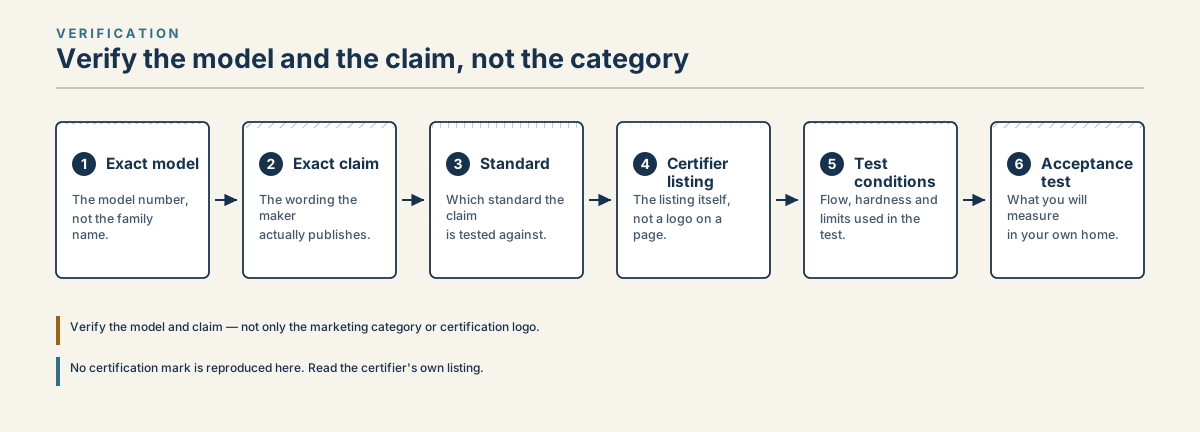
Six-step product verification flow from exact model and claim to certification listing and acceptance test.
Read diagram in text
- VERIFICATION
- Verify the model and the claim, not the category
- 1
- Exact model
- The model number,
- not the family
- name.
- 2
- Exact claim
- The wording the
- maker
- actually publishes.
- 3
- Standard
- Which standard the
- claim
- is tested against.
- 4
- Certifier
- listing
- The listing itself,
- not a logo on a
- page.
- 5
- Test
- conditions
- Flow, hardness and
- limits used in the
- test.
- 6
- Acceptance
- test
- What you will
- measure
- in your own home.
- Verify the model and claim — not only the marketing category or certification logo.
- No certification mark is reproduced here. Read the certifier's own listing.
Ownership, plumbing and local constraints
Compare the complete installation and ownership path:
| Ownership factor | Questions for a softener | Questions for a conditioner |
|---|---|---|
| Pretreatment | Do iron, sediment, chlorine or other conditions exceed model limits? | Which water conditions or pretreatment affect the scale-reduction claim? |
| Plumbing | Where are bypass, drain, air gap, power and untreated branches? | Is a drain, power, grounding/bonding consideration or specific orientation required? |
| Commissioning | Who enters hardness, capacity/dose and regeneration controls? | Who confirms flow, media activation or device setup? |
| Ongoing inputs | How much salt and regeneration water under the quoted assumptions? | What media, cartridge, chemical, energy or replacement input is required? |
| Verification | What untreated/treated hardness result is expected? | How will the stated scale outcome be evaluated? |
| Maintenance | Salt checks, bridge observation, cleaning and service per manual | Inspection, media/device replacement and service per manual |
| Local constraints | Discharge, plumbing, permit and installer requirements | Plumbing, electrical, treatment and installer requirements |
Request written answers. A low-maintenance claim should identify the actual tasks and replacement intervals it excludes and includes.
Questions to put on a quote
- What is the exact make and model?
- What mechanism does it use?
- Does it claim hardness reduction, scale reduction or both?
- Which current certification listing contains that exact claim?
- What untreated-water conditions were used for sizing and eligibility?
- What treated-water result is expected, and how will it be tested?
- What are rated service flow and pressure drop?
- What salt, water, media, filter, chemical or electricity does it use?
- What drain, bypass, electrical and installation work is included?
- What routine maintenance and replacement parts are expected?
- Which conditions void or limit performance and warranty?
- What happens if the post-installation acceptance test does not meet the written result?
The water softener buying checklist turns these questions into a printable quote comparison.
Frequently asked questions
Is a salt-free water conditioner the same as a water softener?
Not necessarily. A device that does not remove calcium and magnesium should not be expected to lower a conventional hardness test, and it may not stop water spots either, because spots depend on dissolved material and use conditions. Verify the exact scale- or hardness-reduction claim the model actually carries.
Is a conditioner always maintenance-free?
No category-wide promise is reliable. Check the exact manual for media, cartridges, power, cleaning, inspection, flow restrictions and replacement intervals. A low-maintenance claim should identify which tasks it includes and which it excludes, together with the type, quantity and cost of every consumable.
Does NSF certification mean the product treats every contaminant?
No. Verify the exact standard, model and listed claim in the certifier's current public database. Certification scope can be limited to specific performance, material or structural requirements, and a listing under one standard establishes nothing about claims that fall outside it.
Which option is better?
The one whose verified output matches the measured problem and the owner's constraints. Hardness removal and scale reduction are different jobs, so price comparisons stay incomplete until the job is defined, the mechanism is documented and the exact model appears in a current certification listing.
Sources
Sources were consulted on August 27, 2026. Certification listings, standards and product claims change, so check the listing for the exact model before you buy.
- U.S. Environmental Protection Agency WaterSense, Cation Exchange Water Softeners, updated May 8, 2026; consulted August 27, 2026.
- NSF, NSF/ANSI 44 Technical Requirements, March 8, 2025; consulted August 27, 2026.
- U.S. Environmental Protection Agency, guide to selecting water treatment systems; consulted August 27, 2026.
- NSF, water-treatment standards overview; consulted August 27, 2026.
- NSF, Official NSF/ANSI 44 Product Listings; consulted August 27, 2026.