
Own a water softener without guessing
Measure first, size second, adjust third. Every figure on this site comes with its unit, its source and its limits.
Start with the complete water softener guide
Four steps, in this order
-
Measure
Water Hardness Guide: GPG, PPM and What to Measure
Understand water hardness levels in gpg, ppm and mg/L. Convert your result, read USGS ranges and choose the right next step before adjusting a softener.
-
Size
Water Softener Sizing Calculator
Estimate usable water softener capacity from measured hardness, daily softened-water use, target days and a visible planning reserve without hidden defaults.
-
Set
How to Set Water Softener Hardness
Set hardness from untreated water, convert mg/L to gpg, follow exact-model rules for rounding, iron or potassium, and verify the result after a completed cycle.
-
Verify
Printable Water Softener Maintenance Log
Download a printable water softener maintenance log to track model details, hardness tests, salt, regenerations, inspections, service and next due dates.
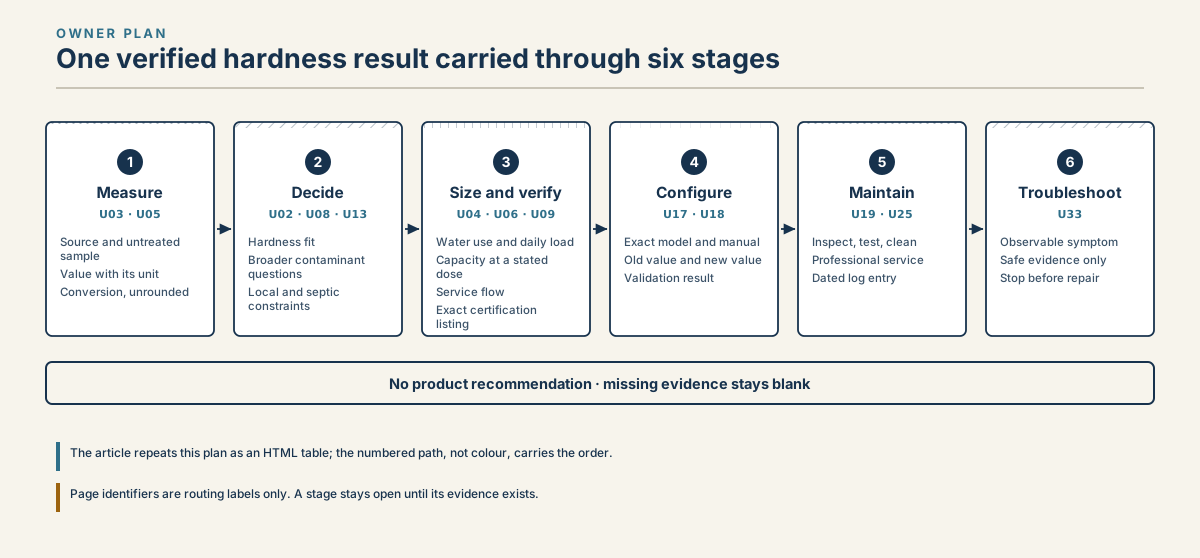
Six-stage water softener decision map covering measurement, treatment fit, sizing and verification, model-specific configuration, maintenance records, and safe troubleshooting.
Read diagram in text
- OWNER PLAN
- One verified hardness result carried through six stages
- 1
- Measure
- Hardness · Testing
- Source and untreated
- sample
- Value with its unit
- Conversion, unrounded
- 2
- Decide
- Basics · Conditioners · City
- Hardness fit
- Broader contaminant
- questions
- Local and septic
- constraints
- 3
- Size and verify
- Units · Capacity · Sizing
- Water use and daily load
- Capacity at a stated
- dose
- Service flow
- Exact certification
- listing
- 4
- Configure
- Settings · Set hardness
- Exact model and manual
- Old value and new value
- Validation result
- 5
- Maintain
- Regeneration · Maintenance
- Inspect, test, clean
- Professional service
- Dated log entry
- 6
- Troubleshoot
- Symptoms and fixes
- Observable symptom
- Safe evidence only
- Stop before repair
- The same hardness result, with its unit, carries through every stage
- The article repeats this plan as an HTML table; the numbered path, not colour, carries the order.
- Each label names the guides for that stage. A stage stays open until its evidence exists.
Calculators
Every input stays in your browser. Nothing is stored or sent.
-
Water Hardness Calculator: PPM, mg/L and GPG
Convert water hardness between ppm, mg/L and grains per gallon. See the formula, USGS class, rounding rules, worked examples and limits of the result.
-
Water Softener Sizing Calculator
Estimate usable water softener capacity from measured hardness, daily softened-water use, target days and a visible planning reserve without hidden defaults.
-
Water Softener Cost: Equipment and First-Year Budget
A water softener costs about $500 to $1,500 for equipment and $1,500 on average installed. See dated prices and build a first-year budget with salt and upkeep.
-
Water Softener Salt Usage Calculator
Estimate monthly and annual softener salt use from completed cycles and documented dose, then cross-check inventory, delivered cost and your own scenarios.
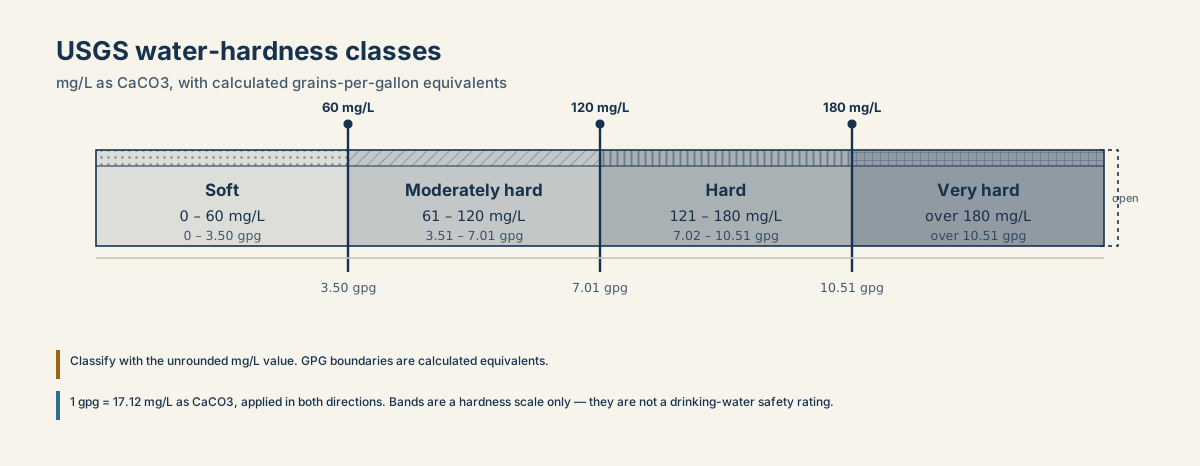
Four water-hardness bands: soft through 60 milligrams per liter, moderately hard above 60 through 120, hard above 120 through 180, and very hard above 180, with approximate grains-per-gallon equivalents.
Read diagram in text
- USGS water-hardness classes
- mg/L as CaCO3, with calculated grains-per-gallon equivalents
- Soft
- 0 – 60 mg/L
- 0 – 3.50 gpg
- Moderately hard
- 61 – 120 mg/L
- 3.51 – 7.01 gpg
- Hard
- 121 – 180 mg/L
- 7.02 – 10.51 gpg
- Very hard
- over 180 mg/L
- over 10.51 gpg
- 60 mg/L
- 3.50 gpg
- 120 mg/L
- 7.01 gpg
- 180 mg/L
- 10.51 gpg
- open
- Classify with the unrounded mg/L value. GPG boundaries are calculated equivalents.
- 1 gpg = 17.12 mg/L as CaCO3, applied in both directions. Bands are a hardness scale only — they are not a drinking-water safety rating.
Printable sheets
Print at 100% on US Letter. No email, no sign-up.
-
Water Softener Buying Checklist
Use a model-neutral water softener buying guide to verify water data, capacity, flow, efficiency, installation, cost, warranty and commissioning before signing.
-
Printable Water Softener Maintenance Log
Download a printable water softener maintenance log to track model details, hardness tests, salt, regenerations, inspections, service and next due dates.
-
Water Softener Service Checklist
Prepare for water softener service with a printable checklist for model, symptoms, hardness, settings, cycles, quotes, repairs, warranties and acceptance.
Budget and quote worksheets
Compare the same scope before comparing totals. Each sheet includes a blank CSV and a clearly labeled illustrative example.
Compare capacity and salt dose for six documented models, or check dated equipment prices and their exclusions.
-
First-year water softener budget worksheet
Printable first-year water softener budget with a blank worksheet, formulas, a worked example with sample numbers, and a CSV download.
-
Water softener installation quote scope worksheet
Printable installation quote scope checklist with responsibilities, acceptance evidence, a worked example with sample numbers, and a CSV download.
-
Repair or replace: decision worksheet
Printable repair-or-replace worksheet with safety gates, comparable cost formulas, a worked example with sample numbers, and a CSV download.
Step-by-step, with the safety limits
-
How to Test Water Hardness Before and After a Softener
Test your water softener: where to take untreated and softened samples, strips vs drop-count kits, when to test, and how to read the before-and-after result.
-
How to Set Water Softener Hardness
Set hardness from untreated water, convert mg/L to gpg, follow exact-model rules for rounding, iron or potassium, and verify the result after a completed cycle.
-
How to Start a Manual Regeneration Safely
Start a water softener regeneration now or queue it for tonight: the button to press on Whirlpool and Fleck controls, how long it takes, and what to check.
-
Water Softener Salt Bridge: Signs, Safe Check and Prevention
How to tell if your water softener has a salt bridge, find it with a broom handle, break it without damaging the tank, and stop it from coming back.
Where to look
-
Fundamentals & Water
Follow an evidence-first path to measure hardness, understand water softeners, size capacity, configure settings, maintain performance, and troubleshoot.
Compare technologies · Learn the system · Measure hardness · Understand capacity · Understand ownership
-
Sizing, Buying & Cost
Use a model-neutral water softener buying guide to verify water data, capacity, flow, efficiency, installation, cost, warranty and commissioning before signing.
Budget installation · Budget ownership · Choose by source · Choose safely · Size the system
-
Settings & Efficiency
Understand owner and installer water softener settings with Whirlpool and Pentair manual examples, documented inputs and checks before changing a value.
Measure salt use · Pause or bypass · Program the controller · Run a cycle · Set hardness · Understand regeneration
-
Salt & Maintenance
A water softener maintenance schedule: check salt monthly, test water twice a year, clean the resin and brine tank, and book yearly service. With steps.
Choose salt · Keep records · Maintain routinely
-
Troubleshooting & Service
Water softener problems by symptom: no soft water, salt not dropping, water in the brine tank, water running to the drain, iron, error codes. Causes and fixes.
Break a bridge · Choose repair path · Correct cycle frequency · Diagnose salt use · Diagnose symptoms · Prepare for service · Restore cycles
How this site works
We begin with primary sources whenever possible, including government guidance, official standards information, certification databases, performance data sheets, and exact manufacturer manuals. Calculations include visible formulas and test cases. Model-specific instructions stay attached to the cited model.
Unless a page explicitly documents otherwise, product details come from manufacturer documents and official certification listings, not from our own testing, and we do not rank or endorse brands. The site does not determine whether water is potable, replace an exact manual or local requirements, or provide electrical, plumbing, medical, legal, or professional water-treatment services.
About · Editorial Policy · Corrections Policy · Contact · Affiliate and Sponsorship Disclosure