
Water Softener Not Regenerating: What to Check
Content updated
Sources last checked
If your water softener appears not to regenerate, first confirm that a cycle was due. Then check the owner-visible items in the exact manual: power, bypass position, clock, settings and whether a metered controller registers flow. Pentair lists power, bypass and meter behavior as useful checks. An abnormal reading is evidence to record, not proof of a particular failed part.
If the manual permits it and there is no leak or other stop condition, request one manual cycle and record whether it is queued, starts, completes and returns to service. A completed manual cycle narrows the question to the automatic trigger and settings, but does not prove which component is sound or that the water is softened. A cycle that fails to start or finish needs model-specific diagnosis and often service.
Event rule: Confirm a cycle was due, record the display and owner-visible checks, then request one manual cycle only if your manual allows it and conditions are safe. If the valve stalls or water runs to the drain continuously, stop and call for service.
How to tell it is not regenerating
Typical signs are hard water (spots on glasses, soap that will not lather), a salt level that has not dropped in weeks, and no regeneration count increase on controllers that show one. Pentair's FAQ suggests checking regeneration when salt is not being used. That is one path to investigate; a bridge, poor brine draw or a cycle not yet due can produce similar salt-level evidence.
Be careful with one false alarm. Regeneration usually runs at night, 2:00 a.m. by default on Whirlpool controls, so you will not see it happen. How often it runs depends on your water hardness, how much water you use and the softener's capacity, as EPA's water softener guide explains. A household that was away for a week may see no regeneration at all.
If the salt is not dropping but you are not sure the softener is at fault, check for a salt bridge first: the not-using-salt guide covers that path.
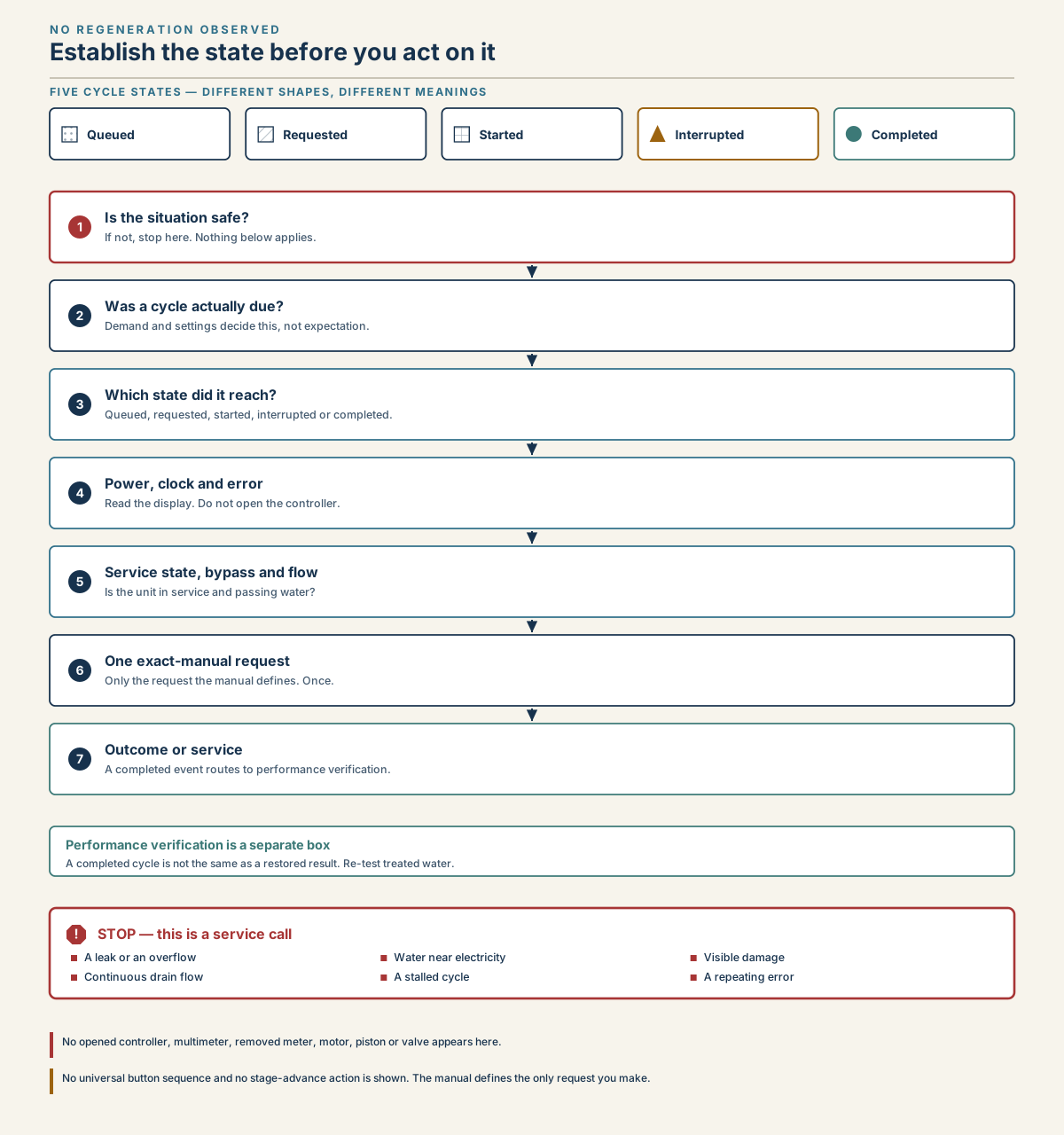
Evidence-first path for a water softener that appears not to regenerate, with cycle states and stop conditions.
Read diagram in text
- NO REGENERATION OBSERVED
- Establish the state before you act on it
- FIVE CYCLE STATES — DIFFERENT SHAPES, DIFFERENT MEANINGS
- Queued
- Requested
- Started
- Interrupted
- Completed
- 1
- Is the situation safe?
- If not, stop here. Nothing below applies.
- 2
- Was a cycle actually due?
- Demand and settings decide this, not expectation.
- 3
- Which state did it reach?
- Queued, requested, started, interrupted or completed.
- 4
- Power, clock and error
- Read the display. Do not open the controller.
- 5
- Service state, bypass and flow
- Is the unit in service and passing water?
- 6
- One exact-manual request
- Only the request the manual defines. Once.
- 7
- Outcome or service
- A completed event routes to performance verification.
- Performance verification is a separate box
- A completed cycle is not the same as a restored result. Re-test treated water.
- !
- STOP — this is a service call
- A leak or an overflow
- Water near electricity
- Visible damage
- Continuous drain flow
- A stalled cycle
- A repeating error
- No opened controller, multimeter, removed meter, motor, piston or valve appears here.
- Start one manual regeneration with your model's button sequence, then watch each stage and retest.
1. Power
Is the display lit? A softener with no power cannot regenerate, and Whirlpool's WHES18 manual notes the display is blank while power is out.
- Check that the transformer is plugged in and the outlet works.
- Make sure the outlet is not controlled by a wall switch. The Pentair 5600SXT manual lists a switch, pull chain, plug or fuse as the first causes of a unit that fails to regenerate.
- The Pentair whole-house manual starts its "fails to regenerate" list with the electrical supply (fuse, transformer).
2. Bypass valve
If the bypass valve is in bypass, water goes around the softener, the meter counts nothing, and a metered unit never reaches the point where it needs to regenerate. Pentair's FAQ lists it second: make sure the unit is not in bypass.
Find the bypass on the pipes at the back of the control valve and set it to service or soft water. It is easy to leave in bypass after watering the lawn or filling a pool, which EPA suggests doing to save salt.
3. Clock and regeneration time
Most softeners regenerate at a set time of day. After a long power outage the clock can be wrong, so the cycle runs in the middle of the day, or appears not to run at all.
- Check that the time of day on the display is correct, including AM and PM.
- Check the regeneration time setting (Whirlpool's default is 2:00 a.m.; on the 5600SXT it is the "RT" setting).
- EPA recommends checking the programming and resetting the clock after any power outage.
4. Water meter
Metered (demand-initiated) softeners count gallons and regenerate when the capacity is used up. If the meter stops counting, the softener never thinks it needs to regenerate. Pentair's FAQ asks: does the meter count gallons remaining?
To check it:
- Open a cold softened tap.
- Watch the display. On the Fleck 5600SXT a flow indicator appears when water is moving; on the Whirlpool WHES48 the Water Flow screen should show a non-zero reading, and it beeps with each gallon on the Water Used Today screen.
- If no flow registers at a verified treated tap, record the screen and test conditions. Confirm bypass, displayed field and manual procedure before blaming the meter or cable. Pentair lists those parts among possible causes; use the exact model's service instructions for any connection check or replacement.
5. Settings
Wrong settings can make the softener regenerate so rarely that it looks broken.
- Hardness: if it is set far below your real water hardness, the softener thinks each gallon uses less capacity than it does. Retest your untreated water and compare. The hardness-setting guide shows how to enter it.
- Capacity: on the 5600SXT the Pentair manual says to verify that the correct system capacity is selected.
- Days between regenerations: timer models and the "day override" setting on metered models force a regeneration after a set number of days. The 5600SXT manual also notes that a day-of-week control needs at least one day set to "on".
Pentair's whole-house manual puts it simply: if the control is not set properly, verify the regeneration schedule and reset it.
6. Error codes
Look at the display for an error code and look it up in your manual. Two examples:
- Fleck 5600SXT, error 2 (regen failure): the system has not regenerated for more than 99 days, or 7 days on a day-of-week control. The manual's fix is a manual regeneration to reset the code, then checks of the meter and settings as above.
- Fleck 5600SXT, errors 0 and 1: the valve drive took too long to reach the next position, or the control saw an unexpected cycle input. These point to the powerhead (motor, cam switches, drive train), and the manual's final step is to contact technical support if the error comes back.
- Whirlpool: the self-diagnostic function shows an error code for electrical faults, and the manual says a service person should be contacted to isolate the problem.
7. Run one manual regeneration
If a cycle was due, the owner-visible checks do not explain it and conditions are safe, the exact manual may allow one manual regeneration request. See how to manually regenerate a water softener for model examples, then confirm the button and sequence in your own manual.
Then watch it:
- It starts and finishes within the time your manual specifies: record the completed event and test treated hardness. Check the next automatic trigger; one successful manual cycle does not isolate the cause.
- It will not start at all: preserve the display or error state and ask for model-specific diagnosis; several electrical, setting or mechanical causes remain possible.
- It starts but stays on one stage far longer than normal, or the valve keeps cycling: Pentair lists a failed drive motor, circuit board, microswitches, or a valve and timer out of sync.
- Water keeps running to the drain after it should have finished: Pentair's table points to the powerhead not completing the cycle or an internal leak.
In the last three cases, stop there and call for service. Starting more cycles will not fix a mechanical fault and each one sends water to the drain.
Faults that need a technician
According to the Pentair troubleshooting tables, these causes of a softener that will not regenerate need parts or tools:
| Fault | What you might notice |
|---|---|
| Drive motor | Display works, but the valve never moves or stalls between stages |
| Circuit board or controller | Blank or frozen display with power present, or error codes that return |
| Microswitches or cam switches | Valve cycles continuously or stops in the wrong position |
| Valve body and timer out of sync | Regeneration runs but in the wrong order, or error 0 or 1 on the 5600SXT |
| Flow meter | No flow indicator with water running |
Pentair's whole-house manual ends its troubleshooting guide with the same advice: if the guide does not resolve the problem, contact the local dealer for service. EPA also recommends having a professional service a softener once a year.
For the visit, write down the model, the error code or stage where it stopped, when it last regenerated normally, and your before-and-after hardness results. The service checklist lists the rest.
Frequently asked questions
How do I know if my water softener is regenerating?
Check your model's event count, status display or documented cycle record. Salt level and hard-water signs are indirect clues and may lag behind an event. A manual request can help when the exact manual permits it and conditions are safe; record whether the cycle actually starts and completes, then test treated hardness separately.
Why would a water softener stop regenerating?
Possible causes include lost power, bypass, an incorrect clock or schedule, a meter that does not register flow, or an internal fault. First check whether an automatic event was due and preserve any error code. A stalled manual cycle does not identify a motor, board or switch by itself; ask for model-specific diagnosis.
Can I force a water softener to regenerate?
Many Whirlpool and Fleck controls allow an immediate or delayed request with different button presses; use the instructions for your exact model. Make one request only when safe. If the cycle completes, document it and check the next automatic event and treated hardness. That result alone cannot identify a failed trigger or clear the valve.
Is it worth repairing a softener that will not regenerate?
Repair may make sense when a qualified diagnosis isolates a serviceable fault and the written quote defines parts, labor and an acceptance test. Also check structural condition, performance and actual warranty coverage. Compare that scope with a complete replacement quote using the repair-or-replace guide.
Sources
Sources were consulted on the dates shown. Error codes and controller behavior differ by model, so confirm them against your current manual.
- U.S. Environmental Protection Agency WaterSense, Guide to Selecting and Maintaining a Water-Efficient Water Softener, May 2026; consulted September 24, 2026.
- U.S. Environmental Protection Agency WaterSense, Cation Exchange Water Softeners, updated May 8, 2026; consulted August 27, 2026.
- Pentair, Pentair support FAQ; consulted September 24, 2026.
- Pentair, Whole House Water Softening System Installation and Operation Manual; consulted September 24, 2026.
- Pentair, Pentair 5600SXT manual; consulted September 24, 2026.
- Whirlpool Water Solutions, Whirlpool WHES48 manual; consulted September 24, 2026.
- Whirlpool Water Solutions, Whirlpool WHES18 manual; consulted September 24, 2026.
- NSF, NSF/ANSI 44 Technical Requirements, March 8, 2025; consulted August 27, 2026.
- U.S. Environmental Protection Agency WaterSense, Home Maintenance — Water Softeners, updated June 16, 2026; consulted September 24, 2026.
- Whirlpool Water Solutions, Whirlpool Water Softener & Filtration System Manuals; consulted August 27, 2026.