
Water Softener Capacity: Advertised vs Usable Grains
Content updated
Sources last checked
Water softener capacity is how many grains of hardness the resin can remove before it has to regenerate. EPA's example: a 32,000-grain softener can remove 32,000 grains of hardness per cycle. Divide capacity by your water hardness in grains per gallon and you get the gallons it can soften between regenerations: 32,000 ÷ 16 gpg = 2,000 gallons.
Six models, compared from their manuals
Each capacity stays paired with its salt dose. “Low” and “high” below mean the lowest and highest dose rows transcribed from the cited manual, not settings recommended for your home.
| Model and source | Low dose | High dose | Calculated grains/lb Low / high | Rated service flow |
|---|---|---|---|---|
| Whirlpool WHES30 Manual 7392301 Rev. H 2025-01-30 p. 3; limitations pp. 3-5 |
12,500 grains @ 2.4 lb |
31,700 grains @ 13.1 lb |
5,208.33 / 2,419.85 | 7.3 gpm 14.8 psi drop |
| Whirlpool WHES40 Manual 7392319 Rev. G 2025-01-30 p. 3; limitations pp. 3-5 |
17,300 grains @ 3.4 lb |
40,000 grains @ 15.5 lb |
5,088.24 / 2,580.65 | 7.6 gpm 14.7 psi drop |
| Rheem RHS32 Manual 7386465 Rev. P 2026-01-20 p. 4; limitations pp. 4-6 |
13,000 grains @ 2.6 lb |
33,000 grains @ 14.1 lb |
5,000 / 2,340.43 | 7.9 gpm 14.9 psi drop |
| Rheem RHW42 Manual 7403518 Rev. E 2026-06-04 p. 4; limitations pp. 4-6 |
12,400 grains @ 2.5 lb |
42,400 grains @ 16.3 lb |
4,960 / 2,601.23 | 9.9 gpm 12 psi drop |
| A. O. Smith AO-WH-SOFT-350C Manual 100365372 AO-WH-SOFT-350C-400T-450T_202301 pp. 19-21; limitations pp. 6-9 |
5,210 grains @ 1 lb |
35,000 grains @ 15 lb |
5,210 / 2,333.33 | 7.5 gpm 15 psi drop |
| A. O. Smith AO-WH-SOFT-450T Manual 100365372 AO-WH-SOFT-350C-400T-450T_202301 pp. 19-21; limitations pp. 6-9 |
6,510 grains @ 1.25 lb |
45,000 grains @ 18.75 lb |
5,208 / 2,400 | 7.5 gpm 15 psi drop |
The calculated ratios use the displayed capacity ÷ dose and are rounded only for display. A manufacturer’s published efficiency rating can differ; the CSV preserves that rating separately. These are laboratory document values, not measurements of installed systems.
This is a comparison of manufacturer documents checked on October 14, 2026, with the exact revisions recorded in the CSV. We have not field-tested these units, and this sample is not a brand ranking. Each capacity stays paired with its salt dose. “Calculated grains/lb” means capacity divided by salt; it is separate from the manufacturer’s published efficiency rating. For example, WHES30’s printed minimum pair gives 5,208 grains/lb, while its manual publishes a rating of 5,094. We retain both figures without assuming why they differ.
A larger maximum capacity does not mean more capacity at a low salt dose. WHES30 moves from 12,500 grains at 2.4 lb to 31,700 grains at 13.1 lb: capacity rises about 2.5 times while salt rises about 5.5 times. For the A. O. Smith units, the minimum laboratory test point also differs from the user-selectable “High Efficiency” setting. AO-WH-SOFT-350C’s latter setting is 13,500 grains at 3 lb, compared with 5,210 grains at 1 lb at the minimum test point.
Flow has its own limit: RHW42 publishes 9.9 gpm at a 12 psi drop, while WHES40 publishes 7.6 gpm at a 14.7 psi drop. These are different rated conditions, not measurements made at one shared pressure drop. Use the matching model’s manual and your household water conditions; an intermittent-flow figure or maximum-capacity label cannot substitute for its rated service flow or selected salt dose.
Download model data and source notes (CSV)
Consultation dates and model limits
- WHES30 — consulted October 14, 2026. Laboratory rating; household efficiency depends on water and use. Iron limit applies to ferrous iron only. Intermittent flow is not rated service flow.
- WHES40 — consulted October 14, 2026. Laboratory rating; household efficiency depends on water and use. Iron limit applies to ferrous iron only. Intermittent flow is not rated service flow.
- RHS32 — consulted October 14, 2026. Laboratory rating; household efficiency depends on water and use. Iron limit applies to ferrous iron only. Intermittent flow is not rated service flow.
- RHW42 — consulted October 14, 2026. Laboratory rating; household efficiency depends on water and use. Iron limit applies to ferrous iron only. Intermittent flow is not rated service flow.
- AO-WH-SOFT-350C — consulted October 14, 2026. Compensated hardness limit; minimum pH 7. Maximum-dose regeneration water not specified. Minimum-dose water per 1000 grains not specified. Rated flow uses a 15 psi drop. Manual pressure limits retained; well-water instructions require greater than 40 psi. Ferrous iron only; Wisconsin claim limited to 5 ppm. Maximum chlorine in chosen manual: 0 ppm.
- AO-WH-SOFT-450T — consulted October 14, 2026. Compensated hardness limit; minimum pH 7. Maximum-dose regeneration water not specified. Minimum-dose water per 1000 grains not specified. Manual gives 20-80 psi; unversioned manufacturer product page lists 120 psi maximum. Confirm applicability before installation. Well-water instructions require greater than 40 psi. Ferrous iron only; Wisconsin claim limited to 5 ppm. Maximum chlorine in chosen manual: 0 ppm.
The catch is that capacity depends on how much salt each regeneration uses. Pentair's Whole House manual rates its 1.0 cubic foot unit at 16,660 grains with 3.9 lb of salt, 24,593 grains with 7.9 lb, and 30,726 grains with 15.8 lb. The largest number needs four times the salt of the smallest for less than twice the capacity. So when a softener is sold as "32,000 grain", ask at what salt dose, and size it using the capacity at the dose you will actually run.
Capacity rule: Use the exact model's documented capacity at the salt dose you intend to run. Keep service flow, pressure drop, reserve and regeneration-water use as separate checks. The biggest grain number on the label is not a complete specification.
What grain capacity measures
One grain of capacity means the ability to exchange one grain of hardness, expressed on the same calcium-carbonate basis used in water-softener calculations. If incoming water is 10 grains per gallon (gpg), every gallon represents a 10-grain hardness load.
The basic relationship is:
gross treated gallons before any reserve = capacity in grains ÷ incoming hardness in gpg
For example, 20,000 grains ÷ 10 gpg = 2,000 gross gallons. That is a unit reconciliation, not a guarantee that exactly 2,000 gallons will be delivered between cycles. The verified capacity must correspond to the selected salt dose, and controller reserve, water-use variation, water conditions, settings, and operating performance still matter.
EPA defines grain capacity as the grains of hardness a softener can remove per cycle and says both incoming hardness and household water use determine the needed size. EPA also warns that oversizing can lead to inefficient water use. (EPA WaterSense guide)
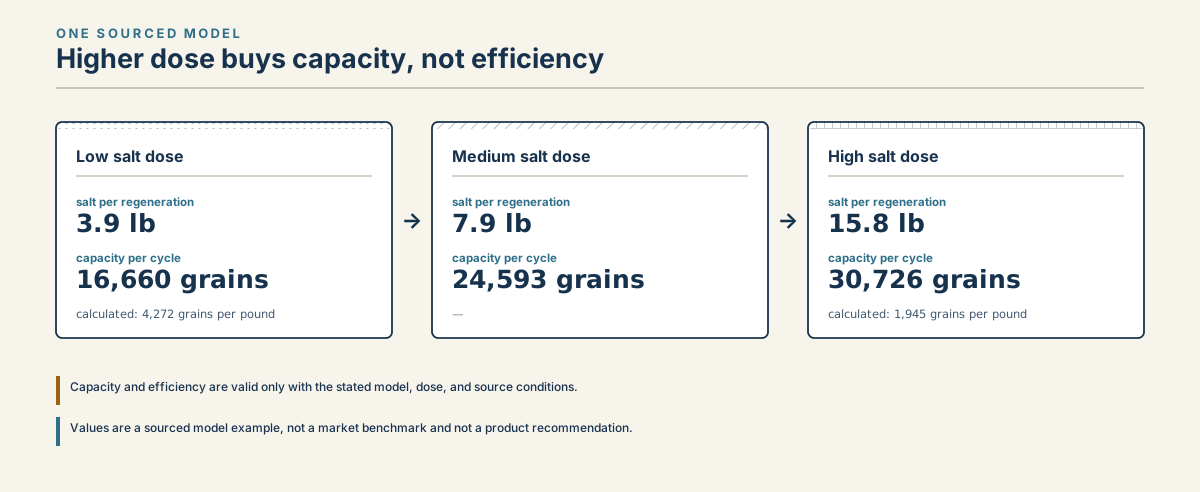
Comparison of one Pentair unit's low, medium, and high salt settings: capacity rises from 16,660 to 30,726 grains while salt dose rises from 3.9 to 15.8 pounds.
Read diagram in text
- ONE SOURCED MODEL
- Higher dose buys capacity, not efficiency
- Low salt dose
- salt per regeneration
- 3.9 lb
- capacity per cycle
- 16,660 grains
- calculated: 4,272 grains per pound
- →
- Medium salt dose
- salt per regeneration
- 7.9 lb
- capacity per cycle
- 24,593 grains
- —
- →
- High salt dose
- salt per regeneration
- 15.8 lb
- capacity per cycle
- 30,726 grains
- calculated: 1,945 grains per pound
- Capacity and efficiency are valid only with the stated model, dose, and source conditions.
- Values are a sourced model example, not a market benchmark and not a product recommendation.
Three capacity numbers you may encounter
| Capacity label | What it may represent | Can it be used for sizing? | Verification needed |
|---|---|---|---|
| Advertised or nominal grain number | A marketing family name, maximum-looking figure, or simplified product label | Not by itself | Find the exact model's performance data sheet and salt-dose row |
| Rated or certified capacity at a stated dose | Capacity produced under the referenced test or certification conditions at a named salt dose | Yes, as the documented model input | Confirm exact model, dose, certifier, test basis, and current listing |
| Programmed or selected usable capacity | The value the installed controller uses between regenerations | Yes, when it matches the manual, selected dose, and system configuration | Confirm installer/master settings, reserve type, and model procedure |
These numbers can match, but you should not assume they do. A tank-size description such as “1.0 cubic foot” is also not a substitute for tested model performance. Valve design, resin, distributor, flow conditions, programming, salt dose, and certification scope can differ.
Read the performance data sheet as a set of pairs
Start with the exact brand, model, and document revision. Then find rows or columns that keep each capacity attached to its salt dose.
Capacity at a stated salt dose
A capacity value without its dose is incomplete. Transcribe the pair together:
capacity (grains) @ salt dose (pounds per regeneration)
Do not compare 30,000 grains at a high dose with 25,000 grains at a low dose as if the 30,000-grain row were automatically more efficient. Calculate or transcribe salt efficiency:
salt efficiency = capacity in grains ÷ pounds of salt
Use the document's rated efficiency when it is explicitly provided, and keep its stated dose attached. A performance-sheet note in the cited Pentair manual says rated efficiency, salt dose, and capacity at that dose are valid together, and that actual installed efficiency can be lower because application conditions differ.
Hardness reduction, flow, and certification claims
NSF's summary of NSF/ANSI 44 says certification scope can include softening capacity, rinse effectiveness, brine-system accuracy, pressure drop, material safety, structural integrity, and accuracy of end-user information. Those are separate evaluated attributes.
Certification also does not turn every optional claim into a universal feature. Confirm the exact model and named claim in the listing maintained by the certifier. A manual that says a system is certified by WQA should be checked in WQA's listing; a model certified directly by NSF should be checked in the NSF Standard 44 listings. Do not treat a search in one certifier's database as a search of every certification body.
Two calculations using sourced model values
The following examples use the Pentair Whole House Water Softening System, unit size 1.0, as shown in the operational-specifications table of its first-party manual. They are calculation examples, not product recommendations.
The table lists:
- 16,660 grains at 3.9 pounds of salt for the low setting;
- 24,593 grains at 7.9 pounds for the medium setting; and
- 30,726 grains at 15.8 pounds for the high setting.
It also lists rated efficiency of 4,272 grains per pound for the low-dose row and states that the systems were tested and certified by WQA according to NSF/ANSI 44 for the claims in the performance data sheet. (Pentair manual, PDF)
Example 1: low salt setting
Source values: 16,660 grains at 3.9 pounds of salt.
Salt efficiency:
16,660 ÷ 3.9 = 4,271.79 grains per pound, which rounds to 4,272 and reconciles with the manual.
At a hypothetical, separately measured hardness of 10 gpg:
16,660 grains ÷ 10 gpg = 1,666 gross gallons before controller reserve.
Example 2: high salt setting
Source values: 30,726 grains at 15.8 pounds of salt.
Calculated salt efficiency:
30,726 ÷ 15.8 = 1,944.68 grains per pound.
At the same hypothetical 10 gpg:
30,726 grains ÷ 10 gpg = 3,072.6 gross gallons before controller reserve.
The high-dose row provides about 84.4% more capacity per cycle than the low-dose row, but it uses about 305.1% more salt and the calculated grains-per-pound efficiency is about 54.5% lower. That comparison applies only to these sourced rows. It is not a universal derating rule and should not be transferred to another model.
Convert verified capacity into gross treated gallons
Use three traceable inputs:
- exact model capacity at the selected salt dose;
- representative incoming hardness in gpg; and
- the model's reserve procedure, applied only after the gross calculation.
The gross-gallons formula is:
gross gallons = documented capacity at selected dose ÷ incoming hardness
| Documented capacity | Incoming hardness | Gross gallons before reserve |
|---|---|---|
| 16,660 grains | 10 gpg | 1,666.0 gallons |
| 16,660 grains | 15 gpg | 1,110.7 gallons |
| 30,726 grains | 10 gpg | 3,072.6 gallons |
| 30,726 grains | 15 gpg | 2,048.4 gallons |
Do not round the hardness before calculating. If the source is in ppm or mg/L, convert it to gpg with the water hardness calculator and retain the unrounded internal value.
Reserve is controller-specific
Reserve protects against running out of working capacity before regeneration can occur. It can be expressed as gallons, a percentage, or an adaptive amount, depending on the control.
The cited Pentair IntelliWater manual illustrates why a universal subtraction is unsafe. Its delayed-regeneration control can use fixed-volume, fixed-percentage, variable, or weekly reserve. Its immediate-regeneration mode does not use a reserve volume in the same way. The manual calculates treatment volume from unit capacity and feed-water hardness, then handles reserve according to the selected regeneration type.
Do not apply a generic “20% derating” to every product. Instead:
- keep the performance-sheet capacity unchanged in your source record;
- record the controller's reserve type and units;
- calculate any planning margin separately and label it;
- follow the exact model procedure when programming; and
- distinguish a sizing margin from the controller's operational reserve.
Reproduce a certification lookup
For a model represented as NSF-certified to NSF/ANSI 44:
- Open NSF's official Standard 44 product listing.
- Search the exact manufacturer or company name.
- Match the full model identifier, including suffixes that affect configuration.
- Read the listed product type, service-flow value, and specific claims.
- Inspect footnotes and limitations.
- Record the listing URL and the “current as of” date displayed by the database.
- Recheck before purchase because certification status can change.
If the manufacturer names another certifier, use that certifier's official current listing instead. Do not replace a missing model match with a similar model, a component certification, or a logo on a retailer page.
Comparison mistakes to avoid
- Comparing only the largest grain number in the product name
- Assuming tank size proves a specific capacity
- Separating capacity from the salt dose that produced it
- Comparing grains per cycle while ignoring grains per pound of salt
- Treating a laboratory-rated value as guaranteed installed performance
- Mixing NSF, WQA, and manufacturer claims without identifying the source
- Assuming certification of a component certifies the complete system
- Treating service flow and grain capacity as the same measurement
- Applying a universal reserve or derating percentage
- Ignoring pressure drop, drain-flow requirements, or local discharge restrictions
- Entering the maximum row into a controller configured for a lower salt dose
Use the normalized transcription template
Use the performance-sheet transcription template. Complete one row for each capacity-and-dose pair rather than placing multiple doses in one cell.
Required fields include model ID, document and revision, certifier, listing URL and date, capacity, salt dose, calculated or listed efficiency, rated service flow, pressure drop, regeneration-water data, reserve type, and limitations. Unknown values stay blank or are marked “not stated”; they are never inferred from a neighboring product.
Carry the verified value into sizing and settings
Use this sequence:
- Measure or otherwise verify incoming hardness.
- Estimate daily softened-water use from bills or meter evidence.
- Calculate the hardness load and planning requirement with the water softener sizing calculator.
- Find a candidate's documented capacity at the intended salt dose.
- Check rated service flow, pressure drop, regeneration-water needs, local rules, and installation constraints separately.
- Program only with the value and procedure supported by the exact manual.
The defensible capacity is a documented model-and-dose value that can be traced from source sheet to calculator to controller. A grain number detached from its conditions is not enough.
Frequently asked questions
What does a 32,000-grain water softener mean?
It can remove about 32,000 grains of hardness before regenerating, according to EPA's definition. On 16 gpg water that is roughly 2,000 gallons. That figure may be the capacity at the highest salt dose, though; at a lower, more efficient dose the same resin removes less, so check the manufacturer's capacity-by-dose table.
Is advertised capacity the same as usable capacity?
Not necessarily. An advertised number may be the maximum, reached at the highest salt dose. Pentair's 1.0 unit, for example, is rated from 16,660 grains at 3.9 lb of salt to 30,726 grains at 15.8 lb. Use the capacity at the dose you will run, then subtract any reserve the controller holds back.
Does a higher salt dose always make a softener better?
No. A higher dose may increase capacity per cycle while reducing grains removed per pound of salt. Compare the paired capacity and dose, calculated or listed efficiency, expected load and regeneration-water data. More salt is not a substitute for matching the model to the documented household requirement.
Is service flow the same as grain capacity?
No. Grain capacity describes how much hardness can be exchanged before regeneration. Service flow describes hydraulic performance under stated conditions and may be tied to pressure drop or a performance criterion. A model must satisfy both checks, but one value cannot be converted into the other.
Sources
Sources were consulted on the dates shown. Ratings are model-specific, so check the current data sheet for the unit you are considering.
-
U.S. Environmental Protection Agency WaterSense, Guide to Selecting and Maintaining a Water-Efficient Water Softener, May 2026; consulted September 24, 2026.
-
NSF, Technical Requirements of NSF/ANSI 44: Cation Exchange Water Softeners; consulted August 27, 2026.
-
NSF, Official NSF/ANSI 44 Product Listings; consulted August 27, 2026.
-
Pentair, IntelliWater Connected Water Softener Service Manual, Installation and Operation Guide; consulted August 27, 2026.
-
Pentair, Whole House Water Softening System Installation and Operation Manual; consulted September 24, 2026.
-
Whirlpool, manufacturer manual for WHES30, document 7392301, Rev. H 2025-01-30, p. 3; limitations pp. 3-5; consulted October 14, 2026.
-
Whirlpool, manufacturer manual for WHES40, document 7392319, Rev. G 2025-01-30, p. 3; limitations pp. 3-5; consulted October 14, 2026.
-
Rheem, manufacturer manual for RHS32, document 7386465, Rev. P 2026-01-20, p. 4; limitations pp. 4-6; consulted October 14, 2026.
-
Rheem, manufacturer manual for RHW42, document 7403518, Rev. E 2026-06-04, p. 4; limitations pp. 4-6; consulted October 14, 2026.
-
A. O. Smith, manufacturer manual for AO-WH-SOFT-350C, document 100365372, AO-WH-SOFT-350C-400T-450T_202301, pp. 19-21; limitations pp. 6-9; consulted October 14, 2026.
-
A. O. Smith, manufacturer manual for AO-WH-SOFT-450T, document 100365372, AO-WH-SOFT-350C-400T-450T_202301, pp. 19-21; limitations pp. 6-9; consulted October 14, 2026.