
How Long Do Water Softeners Last? Check Each Part
Content updated
Sources last checked
Whirlpool, Pentair and Culligan publish the same rough figure: about 10 to 15 years. Whirlpool's softener FAQ gives it as a softener's average lifespan, Pentair gives it for the resin when the system is maintained, and Culligan says 10 to 15 years or more with proper maintenance. Whirlpool adds that very hard water or other impurities wear a softener out faster.
Use the range for planning, not as a verdict on your unit. A ten-year-old softener that still produces soft water, finishes its cycles and has no leaks can stay in service; a newer one with a damaged pressure tank needs prompt assessment. Warranties help with repair costs, but coverage length is not expected service life: the Whirlpool and Pentair terms below differ for tanks, electronics, resin and other parts.
Component rule: Keep a working system when verified service can restore performance safely and economically. Compare replacement when structural safety, repeated failure, unavailable parts, inadequate performance or total repair cost makes continued ownership hard to defend.
Why age alone does not decide it
The 10 to 15 year figure is an average across very different installations. Where one unit lands depends on:
- the exact make, model, valve and media;
- incoming hardness and other water conditions;
- the amount of hardness processed between regenerations;
- salt dose, capacity, reserve and regeneration programming;
- water pressure, temperature and installation environment;
- maintenance and service history;
- long periods without power or use;
- availability and cost of model-specific parts; and
- whether the symptom comes from the softener at all.
A ten-year-old unit that still produces the expected treated hardness, returns normally to service and has no leaks presents a different decision from a much newer unit with a damaged pressure vessel. The calendar alone cannot distinguish them.
Evaluate the softener as separate components
The table below is a decision aid, not a remote diagnosis. Perform only visible, non-invasive checks allowed by the exact manual.
| Component | Observable evidence to collect | What the evidence can support | Stop or service boundary |
|---|---|---|---|
| Mineral/pressure tank | Leaks, bulging, cracks, base condition, model and serial | Whether the vessel appears structurally intact | Stop for leakage, deformation, damage or an unsafe connection; do not open or depressurize it yourself |
| Control valve and seals | Error code, stage, abnormal sound, constant drain, external seepage | Whether the unit completes and exits a normal cycle | Service for a stalled cycle, persistent drain flow, leak or need to enter the valve |
| Controller/electronics | Display, time, outage history, error code, meter readings | Whether power, clock or owner-visible settings may explain behavior | Do not open an enclosure or test live wiring |
| Ion-exchange media | Untreated and treated hardness, verified settings, completed-cycle history | Whether performance remains inadequate after inputs and operation are confirmed | Media condition requires more than age or one symptom; obtain qualified diagnosis |
| Brine system | Dated salt level, visible water level, salt additions, visible bridge, overflow | Whether salt is available and levels change across confirmed cycles | Stop for overflow, leak or any check requiring tubing/component removal |
| Meter, injector, drain and internal parts | Displayed use, regeneration record, drain behavior and exact symptom | Whether the evidence points toward a serviceable subsystem | Internal inspection, cleaning, disassembly and parts selection belong to model-specific service |
| Bypass and installation plumbing | Manual diagram, visible position, leaks and treated sample point | Whether water may be bypassing treatment or sampled incorrectly | Do not move a damaged or leaking assembly; plumbing repair needs qualified help |
The NSF/ANSI 44 technical summary shows why a softener should not be treated as one undifferentiated object: certification can cover structural integrity, pressure drop, softening capacity, rinse effectiveness, brine-system accuracy and information supplied to the user. Those are separate performance questions.
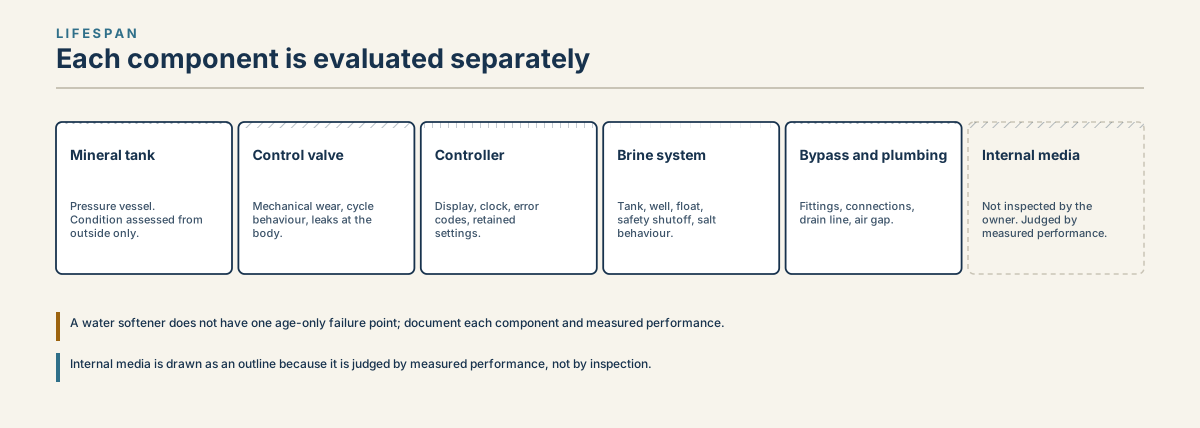
Water softener diagram labelling the mineral tank, control valve, controller, brine tank and bypass for separate condition checks.
Read diagram in text
- LIFESPAN
- Each component is evaluated separately
- Mineral tank
- Pressure vessel.
- Condition assessed from
- outside only.
- Control valve
- Mechanical wear, cycle
- behaviour, leaks at the
- body.
- Controller
- Display, clock, error
- codes, retained
- settings.
- Brine system
- Tank, well, float,
- safety shutoff, salt
- behaviour.
- Bypass and plumbing
- Fittings, connections,
- drain line, air gap.
- Internal media
- Not inspected by the
- owner. Judged by
- measured performance.
- A water softener does not have one age-only failure point; document each component and measured performance.
- Internal media is drawn as an outline because it is judged by measured performance, not by inspection.
What changes service life
Water conditions and treatment load
Cation-exchange resin repeatedly captures calcium and magnesium and is recharged during regeneration. The EPA WaterSense overview describes that operating cycle and notes that regeneration uses water and salt. More hardness processed, changed source water or an incorrectly programmed system can change cycle frequency and operating burden.
Hardness alone does not describe every water condition. Iron, sediment, disinfectants and other constituents may affect treatment choices or maintenance, but their effect cannot be inferred without testing, model limits and competent review. Do not convert a general statement about water chemistry into a prediction for one resin bed.
Configuration and demand
Usable capacity is tied to a documented salt-dose setting and the actual model, not merely the large “grain” number in a product name. Household use, reserve logic, override settings and leaks also affect when regeneration occurs. A system that is oversized, undersized or incorrectly configured can operate inefficiently without being “worn out.”
Installation and environment
Manufacturer manuals specify operating conditions and installation constraints. The cited Pentair manual, for example, supplies model-specific pressure, temperature, electrical, drain and performance information. Use the limits in your own manual. Freezing, flooding, heat, pressure outside the specified range, a restricted drain or unsafe electrical conditions are not ordinary aging.
Maintenance and repair history
EPA WaterSense recommends periodic salt checks, watching for salt bridges, correct programming and professional service. Its home-maintenance guidance recommends professional service once a year. Treat that as a maintenance recommendation, not a guarantee that annual service creates a particular lifespan.
Maintain a dated record of hardness, settings, salt additions, cycles, leaks and repairs. A record makes gradual change visible and prevents a new technician from starting with guesses.
Test performance before blaming a component
When the safe stop conditions are absent, collect a repeatable baseline before deciding that the system is old or that the resin has failed.
- Record manufacturer, complete model, serial number, controller or valve and manual revision.
- Confirm the untreated and treated sample locations.
- Measure untreated and treated hardness with the same method and unit, recording date and cycle context.
- Photograph owner-visible settings before changing them: hardness, capacity/salt-dose pair, reserve, override, regeneration type and time.
- Record recent water demand, leaks, guests, source changes and power interruptions.
- Record at least two regeneration events if it is safe to wait: trigger, start/end, stages displayed and return to normal service.
- Track salt additions and level from the same reference point.
- Note leaks, constant drain flow, error codes, abnormal sounds or an interrupted cycle.
Do not reset the control, increase settings, force repeated regenerations or add a cleaner before preserving the evidence. Those actions can obscure the state a technician needs.
If treated hardness remains wrong after sample location, source hardness, settings, demand and a completed cycle are verified, the result justifies diagnosis. It still does not identify one failed part by itself.
Maintain, service or replace: a decision matrix
| Decision path | Evidence that supports it | What to do next |
|---|---|---|
| Continue normal maintenance | No leak or structural concern; treated result meets the target; cycles end normally; salt use and settings are explainable | Follow the exact manual, keep the log and recheck after a documented interval |
| Correct a verified owner-level issue | Manual confirms an incorrect clock or owner setting; bypass position or sample location explains the result; no safety stop exists | Make one approved change, document it and retest rather than changing several variables |
| Request targeted service | Persistent hard-water result after verified inputs/cycle; error; abnormal drain behavior; control or brine symptom; repairable part appears involved | Send the evidence package and ask for diagnosis, scope, parts, labor and post-service test |
| Compare repair with replacement | Multiple subsystems are affected; parts are unavailable; repeated repairs do not restore measured performance; capacity/flow no longer meets documented need | Obtain itemized repair and replacement quotes using the same treatment goal |
| Stop operation and obtain help | Active leak, overflow, damaged vessel or connection, water near electricity, uncontrolled drain or a condition outside the manual | Follow the exact model's emergency/bypass guidance only if safe; contact qualified service |
Replacement should solve a defined problem. A new unit is not automatically better if hardness was never measured, the plumbing route is wrong or the original symptom came from another water-quality issue.
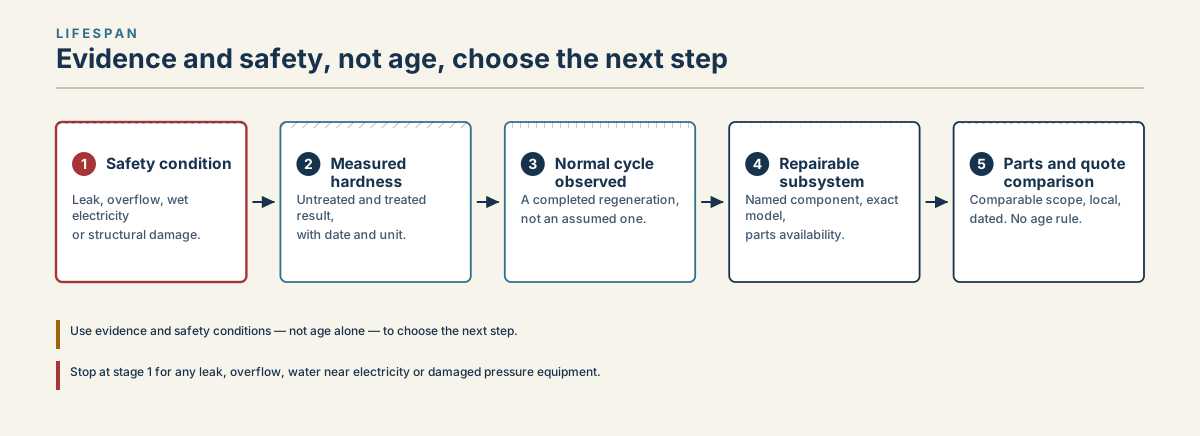
Decision flow from safety check and hardness test to maintenance, service or replacement comparison.
Read diagram in text
- LIFESPAN
- Evidence and safety, not age, choose the next step
- 1
- Safety condition
- Leak, overflow, wet
- electricity
- or structural damage.
- 2
- Measured
- hardness
- Untreated and treated
- result,
- with date and unit.
- 3
- Normal cycle
- observed
- A completed regeneration,
- not an assumed one.
- 4
- Repairable
- subsystem
- Named component, exact
- model,
- parts availability.
- 5
- Parts and quote
- comparison
- Comparable scope, local,
- dated. No age rule.
- Use evidence and safety conditions — not age alone — to choose the next step.
- Stop at stage 1 for any leak, overflow, water near electricity or damaged pressure equipment.
What manufacturers warranty, part by part
A warranty defines limited coverage for specified defects and conditions. It does not rank the expected durability of components. The examples below show why the exact model and purchase terms matter. They are document examples, not current warranty offers: the WHES48 manual is revision J from May 12, 2014. Verify the warranty that applied to your purchase.
| Model | Tanks | Resin | Electronic control | Other parts and labor |
|---|---|---|---|---|
| Whirlpool WHES48 | Lifetime of original owner | Lifetime of original owner | 3 years | 2 years |
| Whirlpool WHES40/44 | 10 years | Not listed separately | 3 years | 1 year |
| Whirlpool WHES30/33 | 10 years | Not listed separately | 3 years | 1 year |
| Whirlpool WHES3T | 10 years | Not listed separately | 3 years | 1 year |
| Pentair Salt Softener and Carbon Rotary Valve Systems | 5 years (tank, valve and electronics) | 5 years on city water, 1 year on well water | Included with tank and valve | 1 year comprehensive |
Sources: WHES48, WHES40/44, WHES30/33, WHES3T, Pentair warranty page.
Two details worth noticing:
- Pentair's media coverage differs by water source (1 year on well water versus 5 on municipal water). The warranty does not explain an individual resin bed's condition or predict its life.
- Maintenance can matter to coverage. Whirlpool's WHES18 warranty extends the one-year parts and labor coverage to five years if you use its WHE-WSC cleaner every four months and keep the receipts. After the first year on the WHES3T, labor to maintain the product is not covered.
Check the exact warranty for your model, the purchase and installation dates, whether it needed registering, and whether it transfers to a new owner. A part can stay serviceable long after its coverage ends.
Build the evidence package for a quote
Provide the same facts to every service company so quotes can be compared:
- model, serial, controller/valve and installation date if known;
- manual and performance-sheet links;
- untreated and treated hardness results with units and sample points;
- settings and salt-dose/capacity pair;
- household use and recent changes;
- regeneration and salt log;
- exact error codes and symptom timeline;
- photos of the installation, display, bypass, drain route and any external leak;
- prior service, parts and invoices; and
- warranty document and status.
Ask the provider to separate diagnosis, parts, labor, plumbing changes, disposal, commissioning and post-service hardness testing. For a replacement quote, require the proposed model, certified performance data, service flow, usable capacity at the quoted salt dose, water/salt efficiency, warranty and expected maintenance.
The repair-or-replace guide walks through a side-by-side quote comparison.
Frequently asked questions
How long does a water softener last?
About 10 to 15 years: that is Whirlpool's stated average, Pentair's figure for resin with proper maintenance, and Culligan's estimate. Very hard water or other impurities shorten it. Treat the range as a planning figure and judge your own unit by treated hardness, completed cycles, leaks, repair history and parts availability.
Is ten years old too old for a water softener?
Not by itself. Compare measured treated hardness, completed cycles, leaks, repair history and parts availability with the current treatment goal. Tank damage needs prompt qualified assessment. Age alone cannot show whether continued maintenance, a repair or replacement is the right next step.
What usually fails first on a water softener?
Warranty periods cannot tell you which part usually fails first. A valve, meter, electronic control, brine system or resin may need attention for different reasons. Record the symptom and test results, then use the exact model's troubleshooting procedure or a qualified technician to identify the fault before buying a part.
Does keeping a maintenance log help with a warranty claim?
A dated log helps you locate service records, settings and receipts, but it does not establish coverage by itself. Read the exact warranty for proof-of-purchase, maintenance and operating conditions, then ask the warrantor what documentation the claim requires. Keep the warranty version that applied when you bought the unit.
Sources
Sources were consulted on the dates shown. Warranties and manuals are model-specific and change over time, so check the current document for your exact product.
- Whirlpool Water Solutions, Hard Water & Water Softening Systems FAQ; consulted October 14, 2026.
- Pentair, Solutions for Water Hardness; consulted October 14, 2026.
- Culligan, How long do water softeners last?, updated June 16, 2026; consulted October 14, 2026.
- U.S. Environmental Protection Agency WaterSense, Cation Exchange Water Softeners, updated May 8, 2026; consulted August 27, 2026.
- NSF, NSF/ANSI 44 Technical Requirements, March 8, 2025; consulted August 27, 2026.
- U.S. Environmental Protection Agency WaterSense, Home Maintenance — Water Softeners, updated June 16, 2026; consulted September 24, 2026.
- Whirlpool Water Solutions, Whirlpool WHES3T manual; consulted September 24, 2026.
- Pentair, Pentair Warranty & Registration; consulted September 24, 2026.
- Pentair, Whole House Water Softening System Installation and Operation Manual; consulted August 27, 2026.
- Whirlpool Water Solutions, Whirlpool WHES48 manual; consulted September 24, 2026.
- Whirlpool Water Solutions, Whirlpool WHES40/44 manual; consulted September 24, 2026.
- Whirlpool Water Solutions, Water Softener Installation and Operation Manual, document 7392301; consulted September 24, 2026.
- Whirlpool Water Solutions, Whirlpool WHES18 manual; consulted September 24, 2026.