
How Water Softeners Work
Content updated
Sources last checked
How do water softeners work? A conventional water softener passes hard water through a tank of ion-exchange resin. Calcium and magnesium ions bind to the resin, while sodium or potassium ions move into the water. When the resin has used much of its working capacity, the softener regenerates: brine recharges the resin, the captured hardness is released, and rinse water carries it to the drain.
The easiest way to understand the appliance is as two different states:
- Service: reduce hardness and send treated water to the home.
- Regeneration: restore the resin and send displaced hardness, excess brine, and rinse water to the drain.
Softened water is not the same as purified water. Softening targets hardness; any other reduction claim must be specific to the model and supported by appropriate certification or test data.
Short version: During service, resin reduces hardness in water sent to the home. During regeneration, brine restores the resin and rinse water carries displaced hardness to the drain. Those two flows should never be confused.
The process in one diagram
SERVICE MODE

Hard water                     Resin tank                    To the home
(calcium + magnesium) ───► [exchange sites] ───────────► Softened water
                                  │                          (more Na+ or K+,
                                  ├─ holds Ca2+ and Mg2+     less Ca2+/Mg2+)
                                  └─ releases Na+ or K+

REGENERATION MODE

Brine tank                 Resin tank                       Drain
(NaCl or KCl solution) ───► [exchange sites] ───────────► Hardness ions,
                                  │                          excess brine,
Rinse water ──────────────────────┤                          and rinse water
                                  └─ Na+ or K+ reloads sites

After the model completes its rinse/refill sequence, it returns to service.
This diagram shows material flow, not a universal plumbing layout or cycle order. Valve paths, cycle names, refill timing, and water availability during regeneration vary by model.
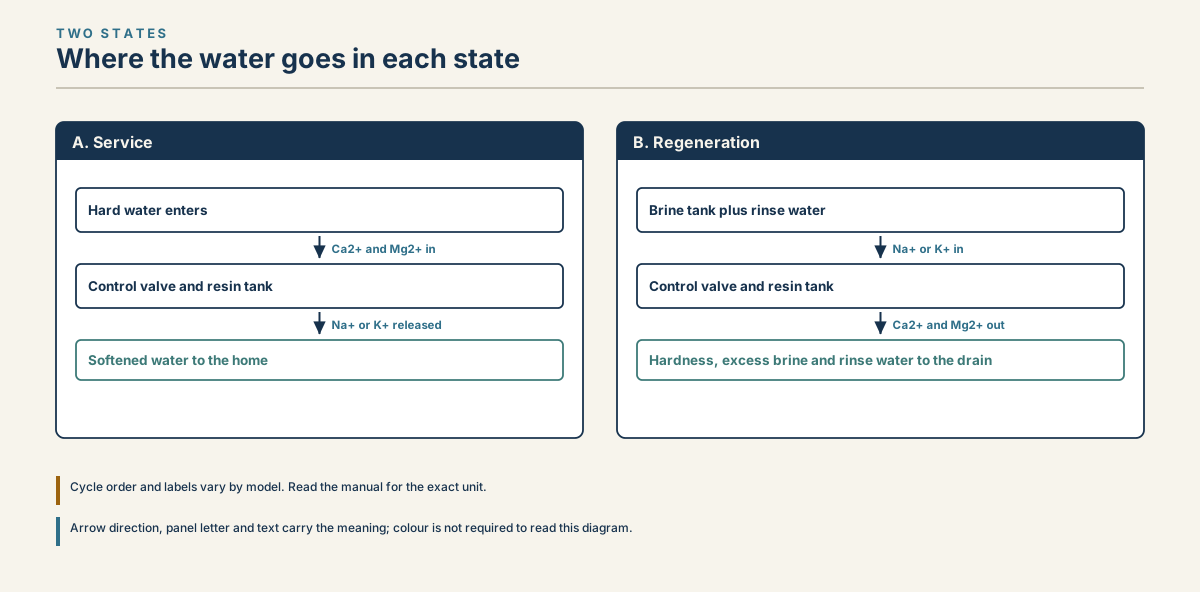
Side-by-side water-softener diagrams show calcium and magnesium exchanged for sodium or potassium during service, then brine restoring the resin and rinse water carrying hardness to the drain during regeneration.
Read diagram in text
- TWO STATES
- Where the water goes in each state
- A. Service
- Hard water enters
- Ca2+ and Mg2+ in
- Control valve and resin tank
- Na+ or K+ released
- Softened water to the home
- B. Regeneration
- Brine tank plus rinse water
- Na+ or K+ in
- Control valve and resin tank
- Ca2+ and Mg2+ out
- Hardness, excess brine and rinse water to the drain
- Cycle order and labels vary by model. Read the manual for the exact unit.
- Arrow direction, panel letter and text carry the meaning; colour is not required to read this diagram.
Service mode: ion exchange reduces hardness
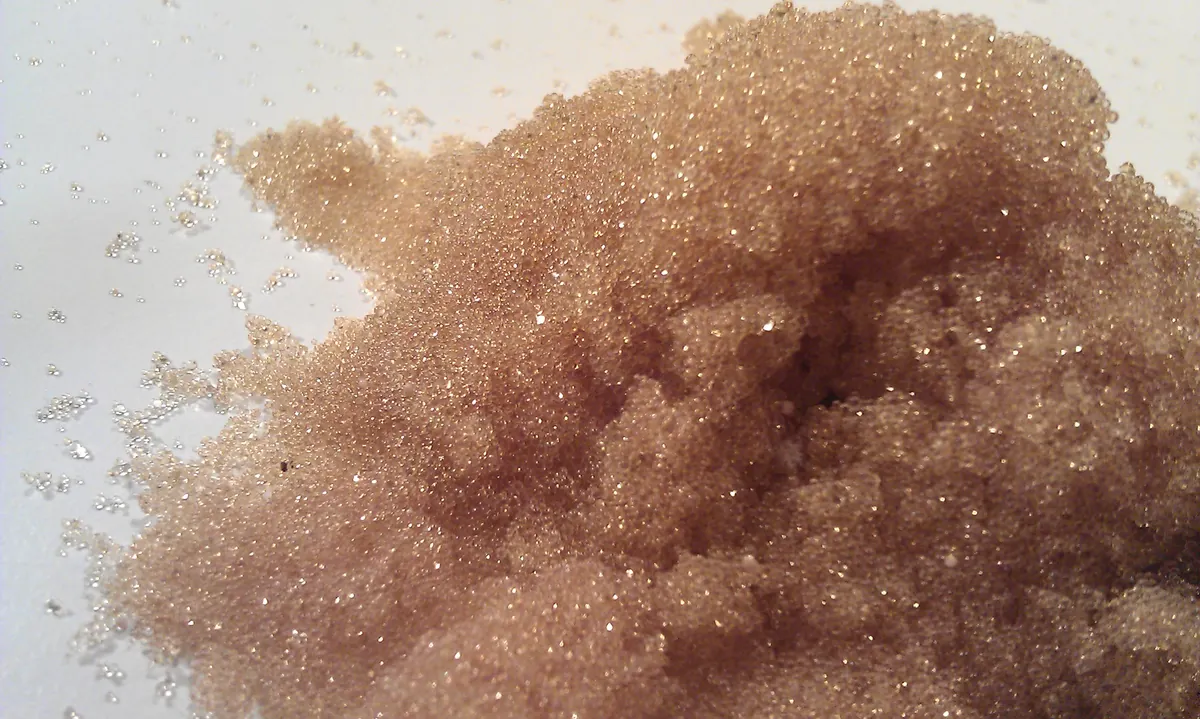
In service mode, the control valve directs incoming water through the resin tank. The resin contains many charged exchange sites. Before service, those sites are loaded mainly with sodium or potassium ions supplied during regeneration.
What the resin captures and releases
EPA describes the exchange this way: calcium and magnesium ions in hard water displace sodium or potassium ions from the resin. The calcium and magnesium remain bound to the resin, and the released sodium or potassium travels with the treated water out of the tank.
The resin does not “filter out” hardness like a screen catching particles. The dissolved ions change places at exchange sites. That distinction explains why the resin can keep working without being replaced after every cycle: regeneration reverses the working exchange and prepares the sites for another service run.
During normal service:
- hard water enters the control valve;
- the valve routes it through the resin bed;
- hardness ions bind to available sites;
- sodium or potassium ions leave those sites;
- softened water exits toward the home's treated plumbing.
The treated water normally contains less calcium and magnesium hardness and more of the regenerant ion. The exact result depends on the incoming water, resin condition, capacity remaining, flow, settings, and equipment design.

Why the resin needs regeneration
The resin has a finite working capacity between regenerations. As more water passes through, more exchange sites hold calcium and magnesium. If the unit continued in service indefinitely, hardness would eventually pass through at an unacceptable level for the intended operation.
Regeneration restores working capacity by exposing the resin to a concentrated sodium-chloride or potassium-chloride solution. NSF's summary of NSF/ANSI 44 says the standard covers cation-exchange resins regenerated with sodium chloride or potassium chloride, and that the hardness minerals are replaced with sodium or potassium ions depending on the regenerant.
During regeneration, the high concentration of sodium or potassium favors reloading the exchange sites. Calcium and magnesium are released from the resin. Water then carries the displaced hardness and excess regenerant to the drain.
Salt is therefore not added directly to the household water as loose pellets. Pellets dissolve in water in the brine tank; the control valve draws the resulting brine through the resin tank during the appropriate cycle. The brine tank is a regenerant supply, not the place where household water is softened.
Regeneration stages and why the names vary
A common residential sequence may include:
- Backwash: water flushes and prepares the resin bed.
- Brine draw and slow rinse: brine passes through the resin, sodium or potassium reloads exchange sites, and calcium and magnesium move toward the drain.
- Fast rinse: water removes remaining regenerant and displaced hardness while preparing the bed for service.
- Brine-tank refill: the valve meters water into the brine tank so salt can dissolve for a future regeneration.
- Return to service: the valve reconnects the normal treatment path.
Do not treat that list as a programming instruction. One cited Pentair manual, for example, labels its cycles “Backwash,” “Brine/Slow Rinse,” and a combined “Fast Rinse and Brine Refill.” Other controls may split, combine, reorder, prefill, or rename stages. The owner's manual is authoritative for the sequence, duration, manual-advance procedure, and whether water should be used during regeneration.
EPA distinguishes two broad ways a control may decide when to regenerate:
- Time-initiated: regeneration occurs on a schedule, whether or not the calculated capacity was used.
- Demand-initiated regeneration (DIR): a meter or hardness sensor triggers regeneration based on water use or detected hardness.
EPA recommends demand-initiated technology because it can avoid unnecessary regeneration and reduce salt and water use. Frequency still depends on incoming hardness, water consumption, usable capacity, and the system's design and settings.
What each component does
| Component | Job during service | Job during regeneration | What it does not establish |
|---|---|---|---|
| Resin tank | Holds resin and provides the exchange path that reduces calcium and magnesium hardness | Receives brine and rinse water so the resin can release hardness and reload with sodium or potassium | It does not prove broad contaminant removal |
| Resin beads | Retain calcium and magnesium at exchange sites and release sodium or potassium | Release accumulated hardness and regain sodium or potassium ions | They are not a disposable particle filter |
| Brine tank | Stores salt and the brine supply for a future cycle | Supplies brine; may receive refill water at a model-specific point | It does not soften the main service flow inside the brine tank |
| Control valve | Routes source water through the resin and tracks or schedules capacity use | Directs backwash, brine, rinse, refill, drain, and return-to-service paths | Its labels and sequence are not universal across models |
| Meter or sensor, when equipped | Measures water use or another trigger used by the controller | Helps determine when regeneration is needed | It does not correct an inaccurate hardness setting by itself unless the design specifically senses hardness |
| Drain connection | Normally has no continuous service flow | Carries regeneration discharge away under applicable plumbing rules | It is not a sampling point or ordinary household outlet |
Service versus regeneration: material-flow table
| State | Material entering | Retained or restored on resin | Released from resin | Destination of output |
|---|---|---|---|---|
| Service | Source water containing calcium and magnesium hardness | Calcium and magnesium accumulate at exchange sites | Sodium or potassium enters the treated water | Treated plumbing; no normal regeneration discharge |
| Regeneration: brine contact | Sodium- or potassium-chloride brine | Sodium or potassium reloads exchange sites | Calcium and magnesium leave exchange sites | Drain with brine and displaced hardness |
| Regeneration: rinse | Rinse water | Reloaded resin is prepared for service | Remaining brine and displaced ions are flushed | Drain |
| Refill, where scheduled | A controlled amount of water | No household softening occurs in this step | Not applicable | Brine tank, to prepare future brine |
This table separates the two destinations readers often confuse: softened service water goes to the home, while regeneration discharge goes to the drain.
What a water softener does and does not treat
The core function is hardness reduction. EPA warns that water softeners are not needed in every home and do not typically treat other contaminants. They should not be described as universal filters, purifiers, or drinking-water safety devices.
NSF/ANSI 44 establishes minimum certification requirements for residential cation-exchange softeners, including material safety, structural integrity, pressure drop, softening capacity, rinse effectiveness, brine-system accuracy, and user information. The standard can also cover specific elective contaminant-reduction claims.
That does not mean every product certified to the standard makes every optional claim. Verify the exact model, certification listing, and named reduction claim. Do not infer removal of lead, arsenic, nitrate, bacteria, odors, total dissolved solids, or any other substance from the word “softener” alone.
Likewise, “salt-free conditioner” and ion-exchange softener are not interchangeable terms. EPA notes that some salt-free devices condition hardness ions or reduce scale rather than remove calcium and magnesium through conventional cation exchange.
Measure your water before choosing or programming
Hardness determines how quickly a given amount of water consumes usable exchange capacity. That is why EPA says both incoming hardness and household water use matter when sizing a softener.
Before buying or changing settings:
- obtain a representative untreated hardness result;
- preserve its unit and “as CaCO3” basis;
- convert it only if the product documentation uses another unit;
- use actual household water-use information when sizing; and
- follow the exact model's capacity, salt-dose, reserve, and regeneration instructions.
Start with the water hardness guide if you need to interpret ppm, mg/L, or gpg. Use the before-and-after hardness test when verifying an existing unit.
If you are diagnosing regeneration, use the regeneration guide to distinguish a normal cycle from a problem. Your valve's manual still controls its cycle table, error messages and service instructions.
Frequently asked questions
What happens inside the resin tank during service?
Hard water moves through ion-exchange resin. Calcium and magnesium ions attach to exchange sites, while sodium or potassium ions move into the water. The treated water then leaves the tank for household service. The exact flow path and operating limits still come from the model manual.
Why does a water softener need salt?
Salt supplies sodium or potassium ions used to restore the resin during regeneration. The brine contacts the resin, displaced hardness leaves the exchange sites, and rinse water carries it to the drain. Salt is part of resin recovery; it is not added simply to make service water salty.
Does softened water go down the drain during regeneration?
Regeneration discharge goes to the drain, but household service behavior varies by system design. Some single-tank units may send bypass hard water to the home during a cycle, while other configurations behave differently. Check the exact manual instead of assuming one universal flow path.
Does a water softener filter every contaminant?
No. Its core job is hardness reduction. A product may have other tested claims, but each one must be verified for the exact model and certification listing. Do not infer removal of lead, arsenic, nitrate, bacteria, odors or dissolved solids from the word “softener.”
Sources
- U.S. Environmental Protection Agency WaterSense, Cation Exchange Water Softeners, updated May 8, 2026; consulted August 27, 2026.
- U.S. Environmental Protection Agency WaterSense, Guide to Selecting and Maintaining a Water-Efficient Water Softener, May 2026; consulted August 27, 2026.
- NSF, Technical Requirements of NSF/ANSI 44: Cation Exchange Water Softeners; consulted August 27, 2026.
- Pentair, Whole House Water Softening System Installation and Operation Manual; consulted August 27, 2026. Used only as a labeled example of one model family's cycle terminology and layout.