
Water Hardness Guide: GPG, PPM and What to Measure
Sources last checked
Water hardness levels tell you how much dissolved calcium and magnesium your water contains. In the United States, the result usually appears as milligrams per liter (mg/L), parts per million (ppm), or grains per gallon (gpg). For ordinary hardness reporting, ppm and mg/L are numerically equivalent. One gpg equals 17.12 mg/L.
So the basic job is simple: confirm that the number is total hardness as calcium carbonate (CaCO3), convert it to mg/L if needed, and classify the unrounded result with the U.S. Geological Survey (USGS) ranges. Do that before you buy equipment or change a softener setting.
Quick answer
- 0–60 mg/L: soft
- More than 60–120 mg/L: moderately hard
- More than 120–180 mg/L: hard
- More than 180 mg/L: very hard
If the result is in gpg, multiply it by 17.12 before applying these ranges.
Quick interpretation of your hardness result
| USGS classification | Hardness as CaCO3 | Calculated gpg equivalent | Sensible next step |
|---|---|---|---|
| Soft | 0–60 mg/L | 0–3.50 gpg | Keep the result as a baseline. Do not choose treatment from the class alone. |
| Moderately hard | More than 60–120 mg/L | More than 3.50–7.01 gpg | Check whether the value is current and representative of your address. |
| Hard | More than 120–180 mg/L | More than 7.01–10.51 gpg | If you are considering a softener, confirm incoming hardness and household water use. |
| Very hard | More than 180 mg/L | More than 10.51 gpg | Confirm the result, then check equipment needs and local requirements. |
The mg/L bands come from the USGS water-hardness classification. The gpg bands are calculated with 1 gpg = 17.12 mg/L and rounded to two decimal places. They are not separate USGS thresholds.
The U.S. Environmental Protection Agency (EPA) uses two practical reference points in its May 2026 WaterSense guide: water above 120 mg/L, about 7 gpg, may benefit from softening; softeners are often recommended above 180 mg/L, about 10 gpg. Those are guidelines, not orders to install equipment. EPA also says a softener is not needed in every home and recommends checking local requirements. (EPA WaterSense guide, PDF)
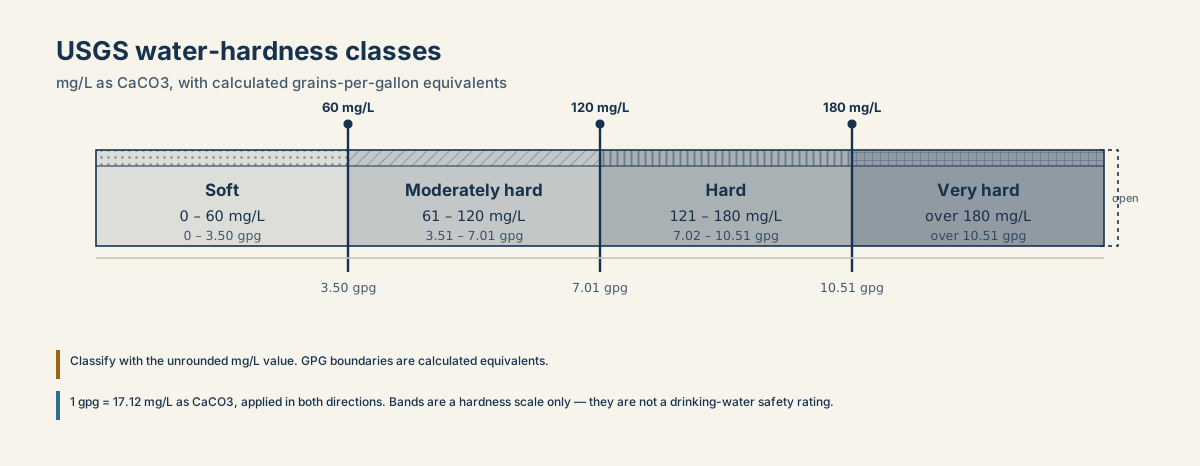
Four water-hardness bands: soft through 60 milligrams per liter, moderately hard above 60 through 120, hard above 120 through 180, and very hard above 180, with approximate grains-per-gallon equivalents.
Read diagram in text
- USGS water-hardness classes
- mg/L as CaCO3, with calculated grains-per-gallon equivalents
- Soft
- 0 – 60 mg/L
- 0 – 3.50 gpg
- Moderately hard
- 61 – 120 mg/L
- 3.51 – 7.01 gpg
- Hard
- 121 – 180 mg/L
- 7.02 – 10.51 gpg
- Very hard
- over 180 mg/L
- over 10.51 gpg
- 60 mg/L
- 3.50 gpg
- 120 mg/L
- 7.01 gpg
- 180 mg/L
- 10.51 gpg
- open
- Classify with the unrounded mg/L value. GPG boundaries are calculated equivalents.
- 1 gpg = 17.12 mg/L as CaCO3, applied in both directions. Bands are a hardness scale only — they are not a drinking-water safety rating.
What water hardness measures
Water hardness is primarily the amount of dissolved calcium and magnesium in water. Laboratories and utilities commonly report total hardness as an equivalent concentration of calcium carbonate, written as mg/L as CaCO3. That common reference lets you compare results even though calcium carbonate is not the only mineral involved.
Hardness is not an overall water-quality score. It does not tell you whether water contains lead, arsenic, nitrate, bacteria, or another contaminant. An ion-exchange softener reduces hardness minerals but, according to EPA, does not typically treat other contaminants.
USGS describes hardness as a nuisance rather than a health concern. This page interprets a hardness measurement and what it can mean for equipment. It does not determine whether water is safe to drink.
GPG, ppm and mg/L explained
Are ppm and mg/L the same for water hardness?
For ordinary water-hardness reporting, yes. EPA's current WaterSense guide treats ppm as equivalent to mg/L. A report showing 120 ppm hardness can therefore be read as 120 mg/L hardness for this purpose.
Check the label before converting anything. The number should be total hardness as CaCO3. A calcium-only result, total dissolved solids result, or conductivity reading is not a substitute.
How to convert gpg vs ppm or mg/L
Softener controls and product documents often use grains per gallon. The conversion is:
gpg = mg/L ÷ 17.12
mg/L = gpg × 17.12
The water hardness calculator converts either direction and applies the USGS class to the unrounded mg/L value.
Two checked examples
For 120 mg/L to gpg:
120 ÷ 17.12 = 7.0093, displayed as 7.01 gpg. The source value is exactly 120 mg/L, so it remains in the USGS moderately hard range.
For 10 gpg to mg/L:
10 × 17.12 = 171.2 mg/L, which is in the hard range.
Keep the unrounded mg/L value for classification. For example, 180.01 mg/L is very hard even if a display rounds it to 180 mg/L. The rounded display is for reading; the original number decides the class.
USGS water-hardness ranges
USGS publishes four general classes:
- Soft: 0 through 60 mg/L as CaCO3
- Moderately hard: more than 60 through 120 mg/L
- Hard: more than 120 through 180 mg/L
- Very hard: more than 180 mg/L
The source lists whole-number bands as 0–60, 61–120, 121–180, and more than 180 mg/L. This guide uses continuous decimal boundaries so values such as 60.5 or 120.4 are not left without a class.
These classes describe the result. They do not predict exactly what will happen in every home. Water temperature, use, appliance design, detergent dose, and sample location can change what you notice. A number near a boundary is a reason to keep the original result, not a reason to rush into a purchase.
Hard water scale: symptoms are clues, not measurements
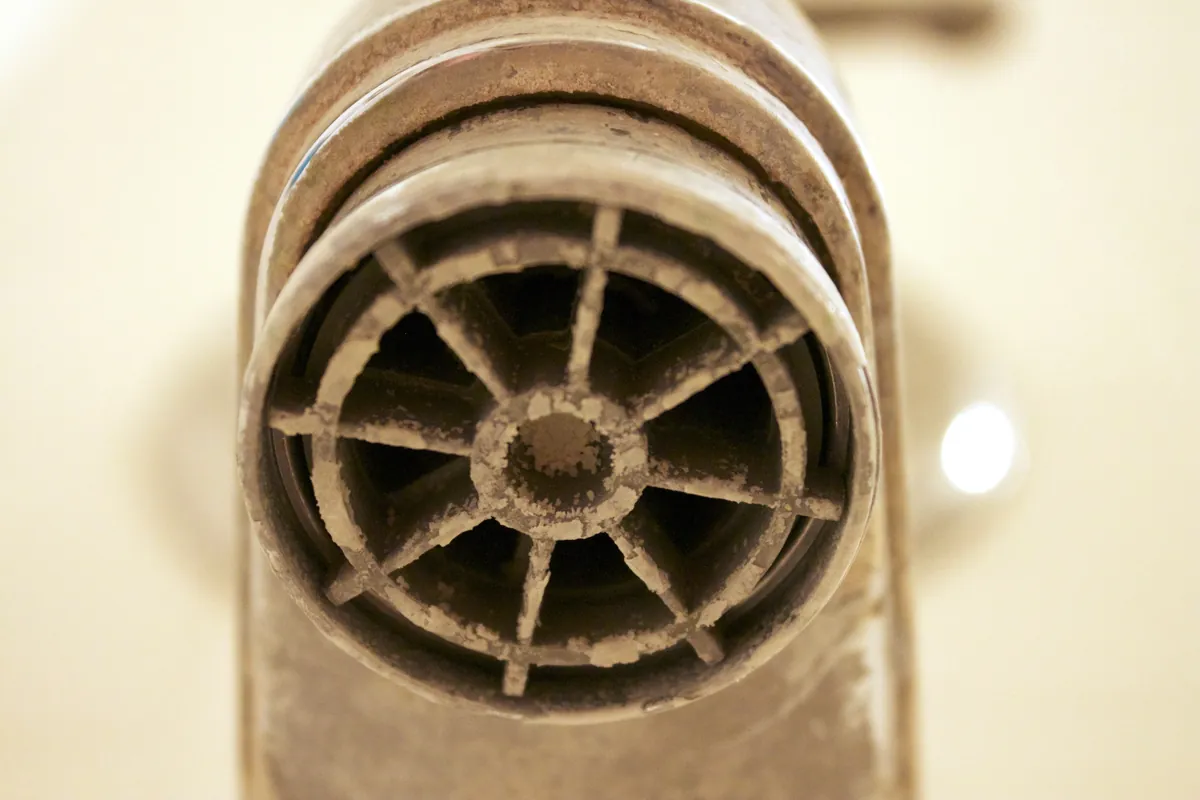
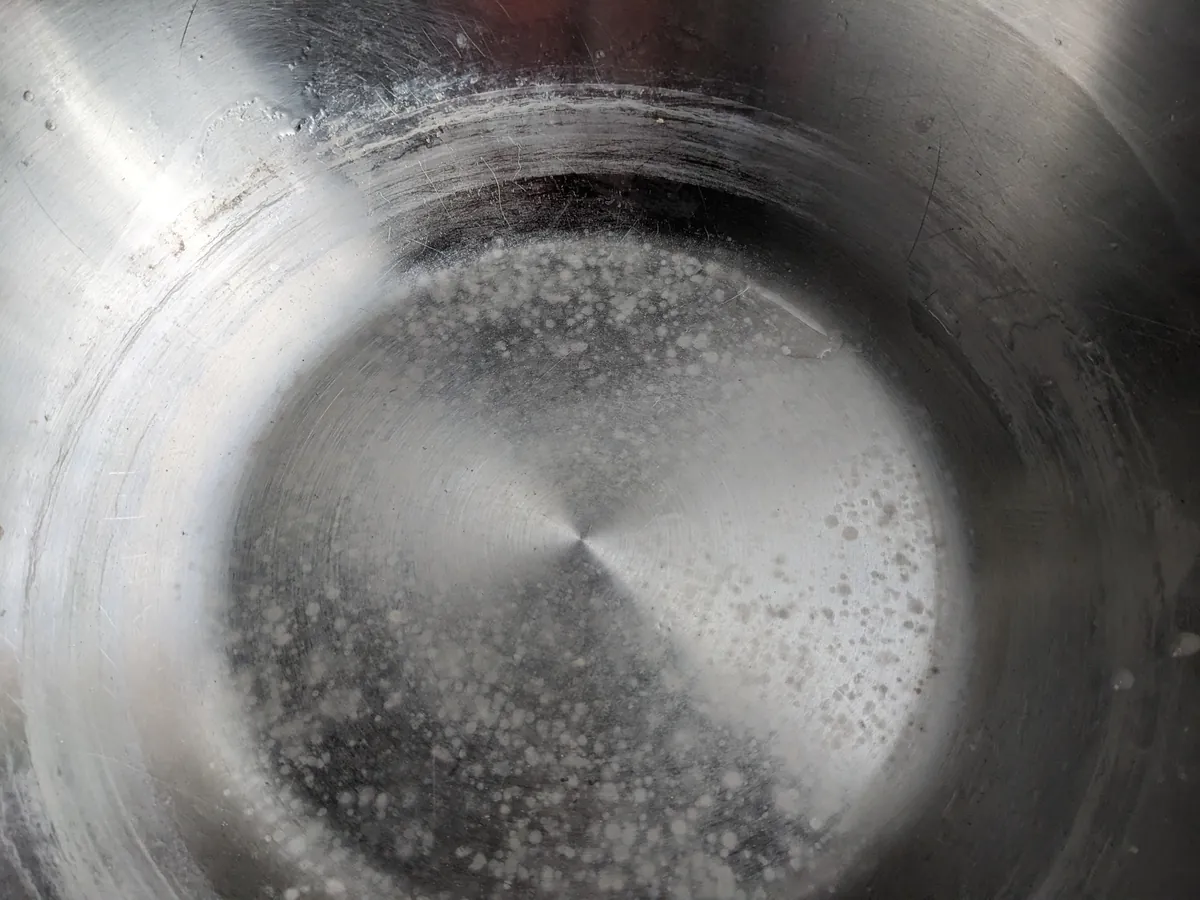
A white ring around a faucet is a clue. It is not a test result.
Hard water can contribute to scale on fixtures and heated surfaces, film on glassware, soap scum, and poor lather. USGS explains that heating hard water can form calcium carbonate deposits, while EPA notes that scale can affect fixtures and appliances.
But appearance cannot tell you the mineral composition or the correct softener setting. Poor lather may also depend on the soap and washing conditions. And measurable hardness can exist before scale becomes obvious.
Use symptoms to decide whether to investigate. Do not turn them into a made-up number.


How to get a reliable hardness number
The best source depends on the decision you are making.
| Evidence source | Useful for | What to verify | Next action |
|---|---|---|---|
| Recent utility report or utility confirmation | Understanding the local baseline | Date, unit, distribution area, and whether sources change | Confirm that the value applies to your address. |
| Current result from the untreated supply | Sizing or changing an equipment setting | Sample point, method, date, unit, and CaCO3 basis | Keep the original record before converting it. |
| Home hardness test | Screening or checking operation | Kit instructions, readable range, and repeatability | Repeat a surprising result or obtain a more precise test. |
| Scale, spots, or poor lather | Recognizing a pattern worth checking | Nothing numeric can be inferred from appearance | Test instead of guessing. |
If you receive public water
Start with your current utility information. EPA provides a Consumer Confidence Report finder, but a report that omits hardness does not mean the hardness is zero. Ask the utility for total hardness as CaCO3, the unit, the distribution area that serves your address, and whether the source changes seasonally.
A current untreated-water test at the home can resolve uncertainty when you need to size equipment or enter a control setting. Record where and when the sample was taken. “Kitchen faucet” is not enough if that faucet may already receive treated water.
If you use a private well
A national hardness map cannot give you the value at one well. USGS says its national data should be interpreted at national or regional scale, not used for an individual property decision. Test the untreated water at the home and keep the result with its date, unit, method, and sample location.
If your concern goes beyond scale or softener operation, ask a qualified local laboratory or agency which analysis fits that concern. A hardness test does not replace contaminant testing.
How hardness affects softener sizing and settings
Hardness is one input for sizing and programming an ion-exchange softener. It is not the whole calculation.
For sizing, you generally need:
- verified incoming hardness in gpg;
- actual household water use or a defensible estimate;
- usable equipment capacity tied to its salt dose and efficiency data;
- a manufacturer-specified adjustment for iron or another substance, but only when testing and the exact manual support it; and
- local rules for installation or discharge.
For an existing unit, follow the exact manufacturer's procedure. A display labeled “hardness” often expects gpg, but models differ. Copying a neighbor's setting is quick. It is also unsupported.
EPA warns that oversizing can waste water and recommends demand-initiated regeneration over fixed-time regeneration when selecting equipment. A hardness conversion by itself cannot choose capacity, salt dose, or a regeneration schedule.
Frequently asked questions
What water hardness level is considered hard?
USGS classifies water above 120 through 180 mg/L as hard and water above 180 mg/L as very hard. In gpg, those boundaries are approximately above 7.01 through 10.51 gpg and above 10.51 gpg. Classify the unrounded mg/L result rather than a rounded gpg display.
Is 120 ppm the same as 120 mg/L for hardness?
Yes, for ordinary water-hardness reporting. EPA treats ppm as equivalent to mg/L in this context, so 120 ppm can be read as 120 mg/L. Confirm that the reported value is total hardness as CaCO3 before converting or using it for equipment decisions.
What is the difference between gpg and ppm?
Gpg and ppm are different units for expressing the same hardness concentration. One U.S. grain per gallon equals 17.12 ppm for ordinary hardness reporting. Divide ppm by 17.12 to get gpg; multiply gpg by 17.12 to get ppm or mg/L.
Does a hardness result show whether water is safe to drink?
No. A hardness result measures mainly calcium and magnesium; it does not establish whether lead, arsenic, nitrate, bacteria, or other contaminants are present. EPA also notes that a typical ion-exchange softener does not treat most other contaminants. Use the appropriate water-quality test for a safety concern.
How to use water hardness levels without guessing
- Confirm that the result is total hardness as CaCO3.
- Record the original value, unit, date, method, and sample location.
- Convert to mg/L with 1 gpg = 17.12 mg/L if needed.
- Apply the USGS class to the unrounded mg/L value.
- Match the quality of the evidence to the decision. A local baseline may explain the range; sizing or changing a setting deserves a current untreated-water result.
- Keep contaminant and drinking-water questions separate from hardness.
If you already have a measured value, enter it in the ppm, mg/L and gpg calculator. If you do not, stop there and get a traceable result before choosing equipment or changing a control. Useful water hardness levels come with a unit, date, method, and sample location.
Sources
- U.S. Geological Survey, Hardness of Water, updated August 24, 2026; consulted August 28, 2026.
- U.S. Environmental Protection Agency WaterSense, Guide to Selecting and Maintaining a Water-Efficient Water Softener, May 2026; consulted August 28, 2026.
- U.S. Environmental Protection Agency, Cation Exchange Water Softeners, updated May 8, 2026; consulted August 28, 2026.
- U.S. Environmental Protection Agency, Consumer Confidence Reports, updated June 24, 2026; consulted August 28, 2026.
- U.S. Geological Survey, Conversion Factors and Miscellaneous Tables, Open-File Report 65-82, 1964; conversion table rechecked August 28, 2026.