
Water Softener Not Using Salt: Causes and Fixes
Content updated
Sources last checked
When the salt level in a softener stops going down, first establish whether a regeneration was due and completed. If cycles have occurred, possibilities include a salt bridge hiding an empty space above the water or poor brine draw. If cycles have not occurred, check owner-visible power, bypass, clock and settings before seeking diagnosis. The same symptom can have more than one cause.
Work through visible checks in the order your manual supports. Cleaning an injector or venturi is model-specific and may require service. Record what you observed before changing a setting or opening a component.
One case needs no fix at all: if the household used little water, a demand-initiated softener simply has not needed to regenerate yet.
Check rule: Confirm whether a regeneration was due and completed, then use the manual's visible checks for salt availability, bypass, power and brine draw. If there is a leak, an overflowing brine tank or water near the power supply, stop and call for service.
Is it really not using salt
Salt only disappears when the softener regenerates. How often that happens depends on your water hardness, how much water you use, the softener's capacity and how it decides to regenerate, as EPA's water softener guide explains. A demand-initiated unit in a house where two people were away for a week may skip several days.
Before troubleshooting, get a fair measurement:
- Mark the salt level on the outside of the tank with tape, or measure down from the rim with a ruler.
- Note how many regenerations the controller reports, if it shows a count (Whirlpool's diagnostic screens show total recharges; the Fleck 5600SXT diagnostic mode shows volume used).
- Check again after a week of normal water use.
If recorded completed cycles should have used salt but no change is visible, compare the observation window and measurement resolution with the documented dose. An unchanged visible level warrants investigation; it does not identify a fault by itself. Continue below.
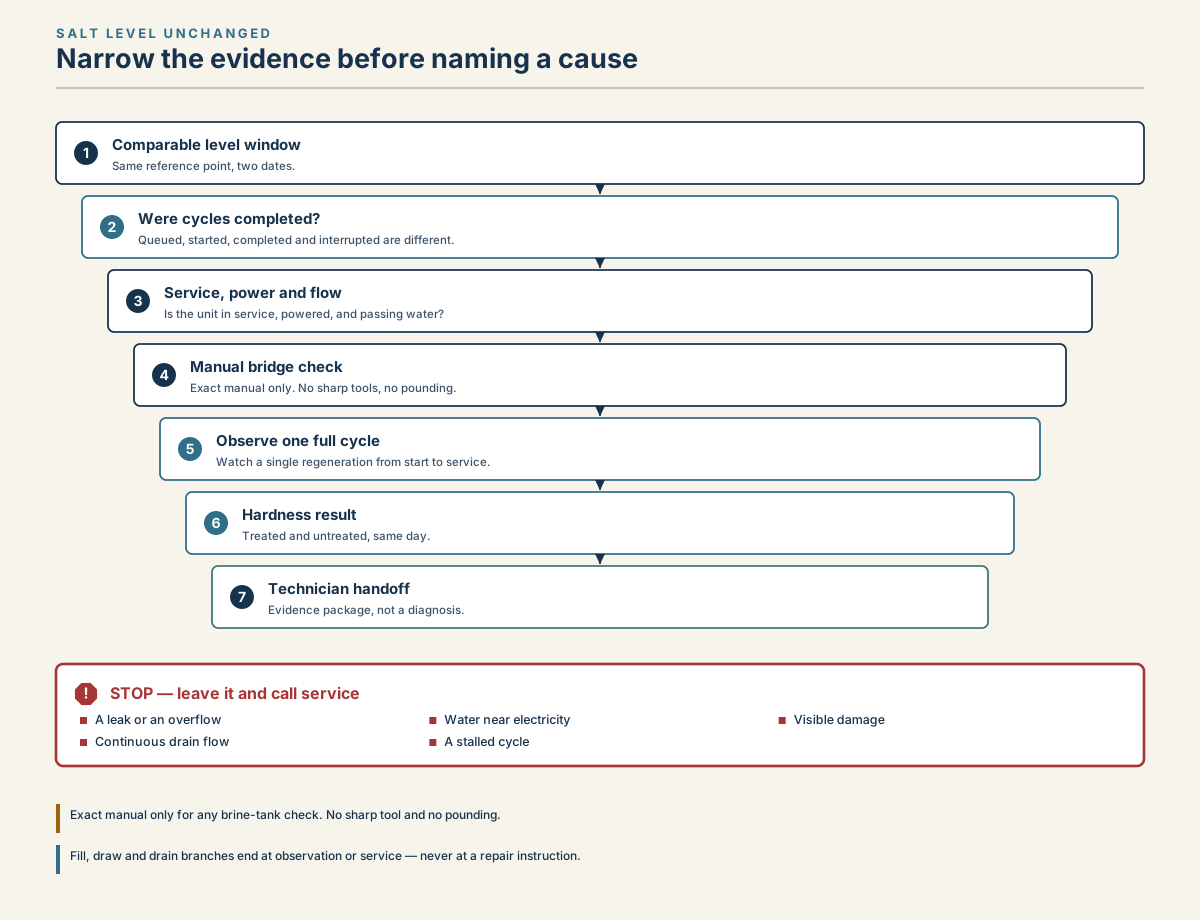
Evidence-first checks for a water softener whose salt level appears unchanged.
Read diagram in text
- SALT LEVEL UNCHANGED
- Narrow the evidence before naming a cause
- 1
- Comparable level window
- Same reference point, two dates.
- 2
- Were cycles completed?
- Queued, started, completed and interrupted are different.
- 3
- Service, power and flow
- Is the unit in service, powered, and passing water?
- 4
- Manual bridge check
- Exact manual only. No sharp tools, no pounding.
- 5
- Observe one full cycle
- Watch a single regeneration from start to service.
- 6
- Hardness result
- Treated and untreated, same day.
- 7
- Technician handoff
- Evidence package, not a diagnosis.
- !
- STOP — leave it and call service
- A leak or an overflow
- Water near electricity
- Visible damage
- Continuous drain flow
- A stalled cycle
- Exact manual only for any brine-tank check. No sharp tool and no pounding.
- Fill, draw and drain branches end at observation or service — never at a repair instruction.
1. Check for a salt bridge or clogging
EPA says a salt level that is not going down over time may be due to salt bridging or clogging. Check for these visible conditions without assuming they are the cause.
- Bridge: a hard crust across the tank with a gap underneath. Mark a broom handle at the tank rim, push it straight down, and if it hits something hard well before the mark, gently push through the crust in several places. The salt bridge guide has the full steps from the Whirlpool and Pentair manuals.
- Clogging: salt hardened around the openings of the brinewell tube, so water cannot move between the tanks. EPA suggests pouring about a gallon of hot tap water into the brine tank, waiting about 10 minutes, then breaking the salt up with a broom handle.
After clearing either one, run a regeneration. EPA recommends it, and Pentair's 5600SXT manual adds that you should wait about two hours after loosening the salt so brine can form first.
2. Check the bypass valve
Bypass can send water around the softener and prevent a treatment meter from recording that household demand. A timer or day override may still schedule a cycle; bypass alone does not prove that no salt is used. The Pentair 5600SXT manual lists an open bypass as a cause of hard water. People often bypass the softener to water the lawn or fill a pool, which EPA encourages, and then forget to switch it back.
Find the valve on the pipes behind the control head (a push-pull knob, a lever, or a three-valve loop) and set it to service or soft water, following the arrows or labels on the valve.
3. Check power, clock and error codes
A softener without power does not regenerate. The WHES18 manual states plainly that while the power is out the display is blank and the unit will not regenerate.
- Is the display on? Check the outlet, and make sure it is not controlled by a wall switch. Pentair's manual lists interrupted electrical service (fuse, plug, pull chain or switch) as the first reason a unit fails to regenerate.
- Is the time right? After a long outage, the clock may be wrong. Whirlpool notes regenerations can then happen at the wrong time of day until you reset it; the Pentair table says "reset time of day" after a power failure. EPA also suggests checking the programming after any outage.
- Is there an error code? On the Fleck 5600SXT, error 2 means the unit has not regenerated for more than 99 days. The manual's fix: start a manual regeneration to clear it, then check that the meter registers flow when you run water (a flow indicator appears on the display).
To start a cycle by hand, see how to manually regenerate a water softener.
4. Check the settings
If the hardness setting is too low or the capacity too high, the softener thinks it has plenty of capacity left and regenerates rarely. You will usually notice hard water before you notice the salt.
- Compare the hardness setting with a current test of your untreated water. The hardness-setting guide shows how to convert and enter it.
- On timer-based units, check how many days are set between regenerations.
- On the Fleck 5600SXT, the manual's regen-failure fix includes checking the capacity, the day override and the meter type in programming. Those are installer settings; change them only with the manual in hand.
5. Watch a regeneration for brine draw
If the softener regenerates but the salt still does not go down, check whether it is actually pulling brine from the tank. Whirlpool's manuals describe a simple check:
- Start a regeneration.
- When the valve reaches the brine stage, lift the brinewell cover and shine a flashlight inside.
- Watch the water level. It should drop noticeably; Whirlpool says this can take 15 to 20 minutes.
If the level drops, the softener is drawing brine, and the salt should start going down over the next few cycles. If it does not drop, the problem is in the brine path. Continue with steps 6 and 7.
6. Clean the injector or venturi screen
The injector (Pentair's term) or nozzle and venturi (Whirlpool's term) is a small part that creates the suction that pulls brine out of the salt tank. When it clogs with sand, silt or iron, brine draw stops. Whirlpool lists a dirty or plugged nozzle and venturi first among the reasons a softener does not draw brine, and the Pentair table lists a plugged injector and injector screen.
Whirlpool treats this as routine owner maintenance. The WHES48 manual's steps, in short:
- Put the bypass valve in bypass and make sure the softener is in service, not regenerating, so there is no pressure at the venturi.
- Remove the softener's top cover, hold the venturi housing, and unscrew the cap. Keep the O-ring.
- Lift out the screen support and screen, then the nozzle and venturi disc, gasket and flow plug.
- Wash the parts in warm soapy water, rinse, and clear dirt or iron with a small brush, taking care not to scratch or bend them.
- Reassemble in order, with the numbers facing up and the small hole in the gasket centered over the hole in the housing. Tighten the cap by hand only.
- Return the bypass to service and run a regeneration. Whirlpool says to then check that the water level in the tank drops; if it does not, call for service.
On other brands the injector may sit inside the valve body and need tools. If your manual lists it as a service task, leave it to a technician.
7. Check the brine line and drain hose
- Brine line: the tube from the salt tank to the valve must be tight and free of air leaks. Pentair's IntelliWater manual warns that even a small leak can let the line drain, and then the softener will not draw salt. Check that both ends are hand-tight and the tubing is not cracked.
- Drain hose: Whirlpool's manuals say a drain hose that is too long or raised too high can create back pressure that stops brine draw when water pressure is low. They advise keeping it under 30 feet and no more than 8 feet above the floor. Also look for kinks.
- Water pressure: Pentair lists line pressure below 20 psi as a cause of failed brine draw. If your whole house has weak pressure, especially on a well, that is worth checking.
8. When to call for service
Call the manufacturer or a water-treatment technician if:
- the brinewell level still does not drop during the brine stage after cleaning the venturi and checking the lines;
- water keeps running to the drain after a regeneration should have ended;
- the brine tank is overfilling with water, or the tank or valve is leaking;
- an error code returns after you clear it;
- the valve seems stuck on one stage.
Pentair's table traces these to parts like the brine valve, seals, piston or powerhead, which are service items. Bring the model number, your salt-level notes, the regeneration count, and before-and-after hardness results; the service checklist lists the rest.
Frequently asked questions
How long should it take for the salt level to go down?
It depends on your hardness, water use and softener, so there is no fixed schedule. As a reference, EPA suggests checking salt every 4 to 6 weeks and adding more once the salt drops below the water level. If a week of normal use and several logged regenerations leave the level unchanged, start troubleshooting.
Does a full tank mean there is a salt bridge?
Not necessarily, but it is the first thing to check. A bridge can sit under loose salt, so the tank looks full while the salt no longer touches the water. Push a marked broom handle straight down; a hard stop well above the bottom usually means a bridge. EPA recommends filling only about half full to prevent them.
Should I force several regenerations?
After clearing a bridge, one manual regeneration may be appropriate if the exact manual recommends it and conditions are safe. Several cycles waste water and may obscure the fault. If the brine level does not change as your model's manual describes, document the observation and follow its maintenance procedure or request service.
What if the water is hard and the salt is not going down?
That combination warrants a check of the sample point, salt bridge, bypass, power, clock and cycle record. If the manual permits observation during the brine stage, record the level without opening the valve. A lack of brine draw has several possible causes; use the exact maintenance instructions or ask a technician to diagnose it.
Sources
Sources were consulted on the dates shown. Controller behavior differs by model, so confirm each check against your current manual.
- U.S. Environmental Protection Agency WaterSense, Guide to Selecting and Maintaining a Water-Efficient Water Softener, May 2026; consulted September 24, 2026.
- U.S. Environmental Protection Agency WaterSense, Cation Exchange Water Softeners, updated May 8, 2026; consulted August 27, 2026.
- Whirlpool Water Solutions, Whirlpool WHES48 manual; consulted September 24, 2026.
- Whirlpool Water Solutions, Whirlpool WHES18 manual; consulted September 24, 2026.
- Pentair, Pentair 5600SXT manual; consulted September 24, 2026.
- Pentair, IntelliWater Connected Water Softener Service Manual, Installation and Operation Guide; consulted September 24, 2026.
- Whirlpool Water Solutions, Whirlpool troubleshooting manual; consulted August 27, 2026.
- U.S. Environmental Protection Agency WaterSense, Home Maintenance — Water Softeners, updated June 16, 2026; consulted September 24, 2026.
- NSF, NSF/ANSI 44 Technical Requirements, March 8, 2025; consulted August 27, 2026.