
Estimate the usable grain capacity needed for a water softener from four visible inputs: incoming hardness in grains per gallon (gpg), daily softened-water use, target days between regenerations, and a planning reserve percentage.
Calculator
Values are processed in your browser. Nothing you enter is stored or transmitted.
The calculator returns a calculation band:
- base capacity: the hardness load for the target interval; and
- planned capacity: the base plus the reserve percentage you entered.
Use the planned figure to screen a candidate's documented capacity at a stated salt dose. The result is not a product recommendation, a guaranteed regeneration interval, or proof that the candidate can meet household flow demand.
Sizing interface
Enter hardness in gpg, identify it as measured or estimated, enter daily softened-water use and its evidence source, choose a target interval, and enter a planning reserve from 0% to 100%. Every formula and assumption is shown, and the tool never fills in a gallons-per-person default for you.
Enter measured inputs
The quality of the result cannot exceed the quality of the inputs. Preserve source, unit, date, and scope for each number.
1. Incoming hardness in gpg
Use a representative untreated-water result. If your report uses ppm or mg/L, convert it with the water hardness calculator and keep the original record.
Label the input:
- Measured: current utility, laboratory, professional, or suitable home-test result representative of incoming water.
- Estimated: an older value, broad test band, regional value, or other provisional input.
An estimated input can support a planning scenario but should not drive a final purchase or controller setting without verification. The before-and-after testing guide explains how to preserve sample point and method.
2. Daily softened-water use
Use actual bills or meter evidence before a per-person assumption. EPA recommends reviewing recent water bills to understand typical household consumption and considering uses that do not require softening, such as irrigation.
Calculate:
daily softened gallons = (billing-period gallons − known unsoftened gallons) ÷ billing-period days
If you cannot separate outdoor or bypassed uses, enter total daily use only as a clearly labeled upper estimate. That can overstate the load on the softener. Do not silently subtract water or invent a household default.
Use more than one representative bill if use is seasonal. Record whether the chosen value is average, upper observed, or estimated.
3. Target days between regenerations
This is a planning input, not a universal recommendation. A longer interval raises the required capacity; a shorter interval lowers it. The actual controller may regenerate based on demand, a delayed schedule, a sensor, a day override, or another model-specific rule.
Enter a positive whole number and compare it with the candidate manual. Do not use the calculator to override a manufacturer limit.
4. Planning reserve percentage
Reserve in this calculator is a transparent planning margin for variability:
reserve factor = 1 + (reserve percent ÷ 100)
It is not automatically the reserve setting for the controller. The cited Pentair IntelliWater manual, for example, documents fixed-volume, fixed-percentage, variable, and weekly reserve for delayed regeneration, while immediate regeneration handles reserve differently. Do not stack the planning margin and a controller reserve without checking the exact procedure.
The calculator does not choose a default. Enter 0% if you want to see base load only, or enter a deliberate margin and preserve the reason.
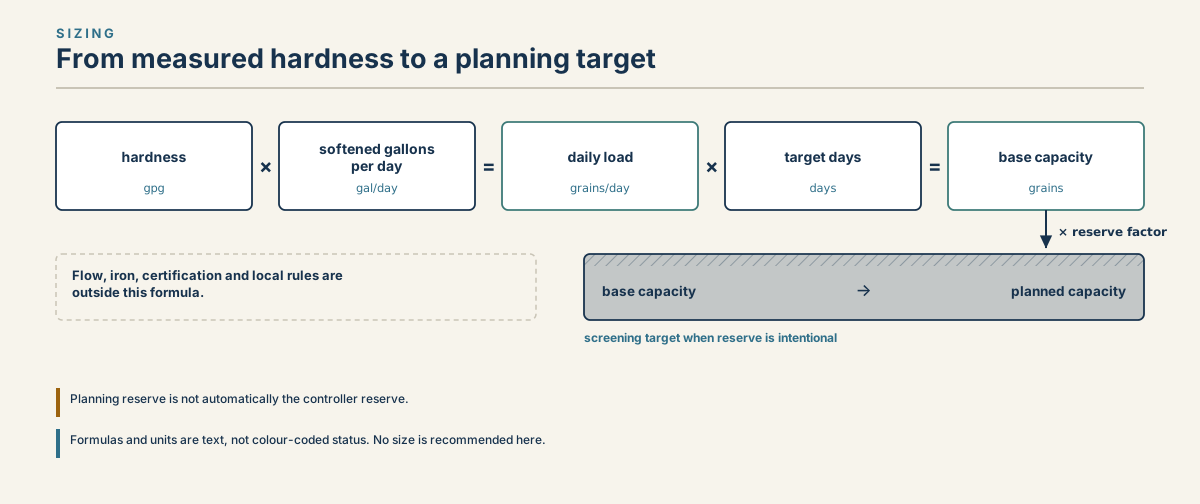
Formula flow multiplies hardness by daily softened-water use and target days, then applies a user-entered reserve to produce base and planned grain-capacity values.
Read diagram in text
- SIZING
- From measured hardness to a planning target
- hardness
- gpg
- ×
- softened gallons
- per day
- gal/day
- =
- daily load
- grains/day
- ×
- target days
- days
- =
- base capacity
- grains
- × reserve factor
- base capacity
- →
- planned capacity
- screening target when reserve is intentional
- Flow, iron, certification and local rules are
- outside this formula.
- Planning reserve is not automatically the controller reserve.
- Formulas and units are text, not colour-coded status. No size is recommended here.
Your estimated usable-capacity band
The output should show:
| Output | Meaning |
|---|---|
| Daily hardness load | Grains placed on the softener per day at the entered use and hardness |
| Base capacity | Daily load × target days |
| Planning reserve | Additional grains created by the entered reserve percentage |
| Planned capacity | Base capacity × reserve factor |
| Calculation band | Base through planned capacity; not a product-size label |
| Input confidence | Measured or estimated hardness; bill/meter/estimate water use |
When screening a candidate, its documented capacity at the intended salt dose should meet or exceed the planned capacity if you intend to keep that planning margin. A capacity between base and planned meets only the no-margin calculation. Capacity below base does not meet the entered target interval arithmetically.
That comparison still does not approve the product. Flow, pressure drop, operating limits, certification, regeneration water, local rules, and installation must be checked separately.
Formula and worked example
Formula
daily hardness load (grains/day) = hardness (gpg) × softened water (gallons/day)
base capacity (grains) = daily hardness load × target days
planned capacity (grains) = base capacity × [1 + reserve percent ÷ 100]
Unit check:
gpg × gallons/day = grains/day
grains/day × days = grains
Worked example
Assume these hypothetical user inputs:
- measured hardness: 12 gpg;
- daily softened-water use: 240 gallons/day;
- target interval: 7 days; and
- planning reserve: 20%.
Daily load:
12 × 240 = 2,880 grains/day
Base capacity:
2,880 × 7 = 20,160 grains
Planned capacity:
20,160 × 1.20 = 24,192 grains
Result: 20,160–24,192 grains, with 24,192 as the screening target if the 20% planning reserve is intentional.
The daily-use input can be reproduced from a hypothetical 30-day bill showing 9,000 gallons minus 1,800 known gallons on unsoftened outdoor lines:
(9,000 − 1,800) ÷ 30 = 240 softened gallons/day.
Those numbers are a transparent example, not a household default.
Match the result to a performance data sheet
Do not round 24,192 up to a marketing class and stop. Open the exact candidate's performance data sheet and find capacity at the salt dose you intend to use.
For illustration, the cited Pentair Whole House manual lists 24,593 grains at 7.9 pounds of salt for its unit size 1.0 medium setting. That sourced row is 401 grains above the hypothetical 24,192-grain planning target.
This arithmetic says only that the row exceeds the calculated capacity target. It does not recommend the model or prove adequate flow, installed efficiency, water quality compatibility, certification status, local compliance, or a seven-day interval in actual operation. The same manual lists different capacities at other salt doses, so the 24,593 value must stay attached to 7.9 pounds.
Use the water softener capacity guide and its normalized transcription template to verify:
- exact model and configuration;
- named certifier and current model listing;
- capacity at the selected salt dose;
- rated service flow and pressure drop;
- regeneration-water and drain-flow data;
- water-condition limits; and
- controller capacity and reserve procedure.
Flow rate and household constraints are outside the grain calculation
Grain capacity answers “How much hardness load can this row exchange before regeneration?” It does not answer “Can the system maintain pressure when several fixtures run?”
Check rated service flow and pressure drop against the household's simultaneous demand and plumbing conditions. Also check inlet pressure, available drain, electrical requirements, space, temperature limits, and any continuous or high-flow loads described by the manufacturer.
Two models with the same grain capacity can have different flow performance. A larger capacity number cannot compensate for inadequate service flow.
Iron and private-well boundary
This calculator does not apply a universal “iron compensation” factor. Iron form, concentration, water chemistry, pretreatment, resin, and controller instructions can change the appropriate approach.
If a test detects iron or another substance that could affect capacity or treatment:
- retain the laboratory or qualified test result and units;
- check the exact model's performance limits and instructions;
- use only a manufacturer-supported adjustment; and
- involve a qualified water-treatment professional when the interaction is unclear.
Do not add an assumed number of hardness grains per ppm of iron. Do not treat the sizing result as evidence that private-well water is safe. Hardness sizing and drinking-water safety are separate decisions.
Avoid oversizing and undersizing
Oversizing risks
EPA warns that oversizing can lead to inefficient water use. A large nominal capacity may also tempt a buyer to select a high capacity row without noticing the associated salt dose or installed operating conditions.
Reduce oversizing risk by using observed softened-water demand, not an inflated per-person default; excluding known unsoftened irrigation; and matching the result to a documented low- or moderate-dose row rather than the largest label.
Undersizing risks
A capacity below the base calculation cannot cover the entered hardness load and interval arithmetically. Underestimated hardness, omitted water use, an unrealistically small reserve, or capacity copied from the wrong dose can also shorten the actual interval.
The answer is not automatically “buy larger.” Recheck inputs, target interval, dose efficiency, flow needs, and whether all water in the bill actually passes through the softener.
Local discharge and septic checks stay separate
EPA notes that some jurisdictions restrict or prohibit cation-exchange softeners because of discharge impacts. EPA also recommends checking with the septic-system manufacturer or local service provider when a home uses onsite wastewater treatment.
The calculator cannot determine local legality, sewer charges, septic compatibility, or drain requirements. Complete those checks before purchase, regardless of the grain result.
Save the assumptions for setup
Download or copy the input worksheet and keep it with the candidate performance sheet:
- hardness value, unit, evidence type, sample point, and date;
- billing-period gallons and days;
- known unsoftened uses and subtraction method;
- chosen daily softened-water value and whether it is average or upper estimate;
- target interval and reason;
- planning reserve percentage and reason;
- base and planned capacity;
- candidate model, capacity, and salt dose;
- flow and pressure data;
- certification-listing URL and date; and
- unresolved iron, local, septic, or installation questions.
Saving the assumptions makes the result auditable. If household use or source hardness changes, update the inputs rather than treating the original calculation as permanent.
Frequently asked questions
What size water softener do I need?
Calculate the hardness load from representative incoming hardness and daily softened-water use, then multiply by a chosen interval and visible planning reserve. Match that result to an exact model's documented capacity at a stated salt dose. Flow, pressure, local rules and other water constituents remain separate checks.
Why does the calculator avoid gallons-per-person defaults?
A universal per-person value can hide irrigation, guests, occupancy patterns, efficient fixtures and water that bypasses the softener. Use bills, a meter or another documented household source when possible. If the input is estimated, label it and test more than one scenario instead of presenting it as measured.
How much planning reserve should I add?
This tool does not choose a universal percentage. Enter and document a planning assumption that fits the evidence and compare more than one scenario when uncertain. The calculator's reserve is for planning; it is not the same as the exact controller's reserve volume, percentage or variable reserve logic.
Does the calculated grain capacity select a product?
No. It creates a transparent capacity screen. A candidate must still document usable capacity at the intended salt dose, rated service flow, pressure drop, efficiency, certification, installation conditions and local compatibility. Recheck the inputs rather than automatically buying the next larger nominal size.
Sources
- U.S. Environmental Protection Agency WaterSense, Guide to Selecting and Maintaining a Water-Efficient Water Softener, May 2026; consulted August 27, 2026.
- NSF, Technical Requirements of NSF/ANSI 44: Cation Exchange Water Softeners; consulted August 27, 2026.
- NSF, Official NSF/ANSI 44 Product Listings; consulted August 27, 2026.
- Pentair, IntelliWater Connected Water Softener Service Manual, Installation and Operation Guide; consulted August 27, 2026.
- Pentair, Whole House Water Softening System Installation and Operation Manual; consulted August 27, 2026.