
Convert a water-hardness result between parts per million (ppm), milligrams per liter (mg/L), and grains per gallon (gpg). The calculator also assigns the U.S. Geological Survey (USGS) hardness class using the unrounded mg/L value as calcium carbonate (CaCO3).
Calculator
Values are processed in your browser. Nothing you enter is stored or transmitted.
Calculator interface
Enter a nonnegative hardness value, choose ppm, mg/L, or gpg, and select Convert. The result shows all three units, the USGS class and the formula used.
The conversion is:
gpg = mg/L ÷ 17.12
mg/L = gpg × 17.12
For ordinary water-hardness reporting, EPA treats ppm as equivalent to mg/L. Make sure your source result is total hardness as CaCO3. Calcium alone, total dissolved solids, and conductivity are different measurements and should not be entered as hardness.
Convert your water-hardness result
The calculator should return four items:
- hardness in mg/L as CaCO3;
- the numerically equivalent ppm value;
- hardness in gpg; and
- the USGS class: soft, moderately hard, hard, or very hard.
Results may display two decimal places, but the calculator must retain full precision internally. Classification happens before display rounding.
Why the original unit matters near a boundary
Suppose a report gives 120 mg/L. The conversion is 7.0093 gpg, displayed as 7.01 gpg, and the USGS class is moderately hard because 120 mg/L is the top of that band.
If someone instead enters 7.01 gpg, the raw conversion is 120.0112 mg/L. That is just above the boundary, so the technical class is hard. Both screens can display 7.01 gpg, but the source values are not identical. This is why the calculator keeps the unrounded converted value and why you should preserve the unit and precision of the original measurement.
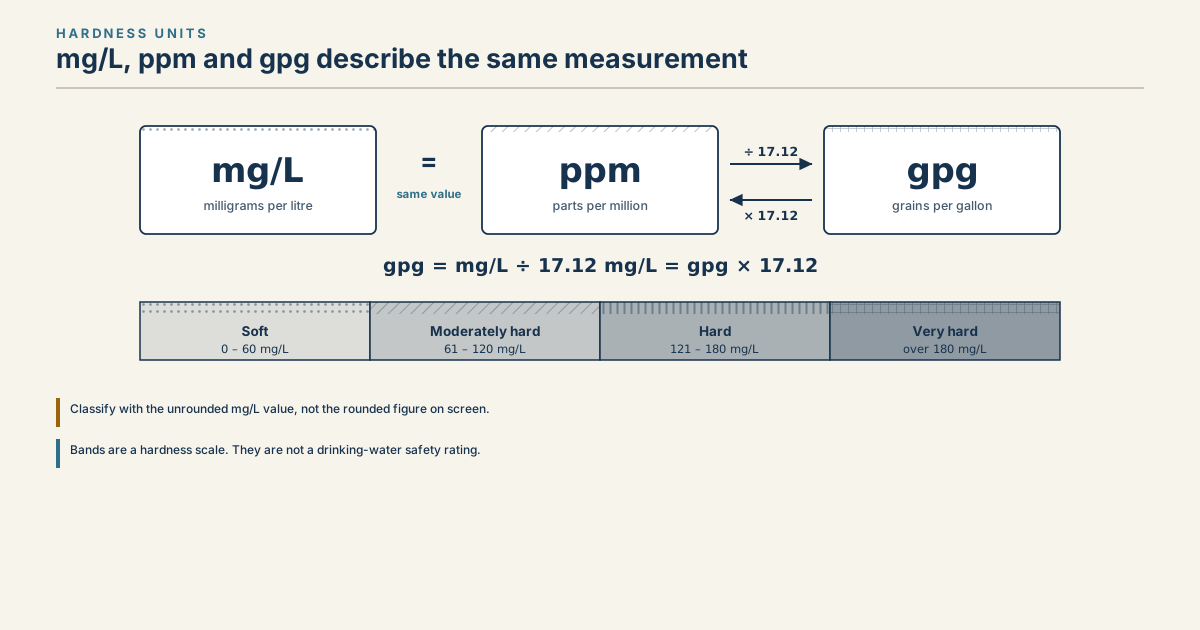
Diagram showing equivalent water-hardness units and the formulas for converting milligrams per litre and grains per gallon.
Read diagram in text
- HARDNESS UNITS
- mg/L, ppm and gpg describe the same measurement
- mg/L
- milligrams per litre
- ppm
- parts per million
- gpg
- grains per gallon
- =
- same value
- ÷ 17.12
- × 17.12
- gpg = mg/L ÷ 17.12 mg/L = gpg × 17.12
- Soft
- 0 – 60 mg/L
- Moderately hard
- 61 – 120 mg/L
- Hard
- 121 – 180 mg/L
- Very hard
- over 180 mg/L
- Classify with the unrounded mg/L value, not the rounded figure on screen.
- Bands are a hardness scale. They are not a drinking-water safety rating.
Formula and rounding rules
Convert mg/L or ppm to gpg
Divide by 17.12.
Example: 150 mg/L
150 ÷ 17.12 = 8.7617 gpg
Displayed result: 8.76 gpg, classified as hard.
Convert gpg to mg/L and ppm
Multiply by 17.12.
Example: 12 gpg
12 × 17.12 = 205.44 mg/L
Displayed result: 205.44 mg/L and 205.44 ppm, classified as very hard.
Rounding policy
- Calculate with the raw input, not a rounded intermediate value.
- Classify the raw mg/L value.
- Display mg/L, ppm, and gpg to two decimal places.
- Preserve the user's entered value and unit in the calculation details.
- If a value is close to 60, 120, or 180 mg/L, show a boundary note rather than implying false certainty.
The conversion does not add accuracy to the original test. A strip reported only as a broad range remains a broad estimate after conversion.
USGS hardness classes
USGS publishes its general classification in mg/L as CaCO3. The calculator uses these exact conditions:
| USGS class | Rule in mg/L as CaCO3 | Calculated gpg boundary |
|---|---|---|
| Soft | 0 through 60 | Through 3.5047 |
| Moderately hard | More than 60 through 120 | More than 3.5047 through 7.0093 |
| Hard | More than 120 through 180 | More than 7.0093 through 10.5140 |
| Very hard | More than 180 | More than 10.5140 |
The gpg values are calculated equivalents, shown to four decimals here to make the boundaries clear. USGS states the classes in mg/L, so the calculator always converts to mg/L before classifying.
EPA's May 2026 WaterSense guide offers complementary equipment guidance. It says water above 120 mg/L (about 7 gpg) is generally considered hard and may benefit from softening, and that softeners are often recommended above 180 mg/L (about 10 gpg). EPA also says softeners are not needed in every home and do not typically treat other contaminants. (EPA guide, PDF)
Common hardness conversions
| mg/L or ppm | gpg | USGS class |
|---|---|---|
| 0 | 0.00 | Soft |
| 30 | 1.75 | Soft |
| 60 | 3.50 | Soft |
| 90 | 5.26 | Moderately hard |
| 120 | 7.01 | Moderately hard |
| 150 | 8.76 | Hard |
| 180 | 10.51 | Hard |
| 200 | 11.68 | Very hard |
| 250 | 14.60 | Very hard |
| 300 | 17.52 | Very hard |
Values are rounded for display; classes were assigned before rounding.
Worked examples
A utility report says 85 ppm
For hardness reporting, use 85 ppm as 85 mg/L.
85 ÷ 17.12 = 4.9649 gpg
Result: 85 mg/L, 85 ppm, 4.96 gpg, moderately hard.
A test kit says 14 gpg
14 × 17.12 = 239.68 mg/L
Result: 239.68 mg/L, 239.68 ppm, 14.00 gpg, very hard.
A result says “less than 60 mg/L”
Do not turn the inequality into a single exact value. The result supports a soft classification if it truly means the value is no higher than 60 mg/L, but the calculator cannot recover a more precise number. Record it as a range or qualified result.
A report lists 70 mg/L calcium
Do not enter it unless the report explicitly identifies the value as total hardness expressed as CaCO3. A calcium concentration is not automatically the same as total hardness.
What this calculator cannot decide
A unit conversion can interpret a valid hardness measurement. It cannot establish that the measurement is representative, diagnose a water problem, or determine drinking-water safety.
The result alone cannot tell you:
- whether a sample was collected before or after existing treatment;
- whether hardness changes with a utility's water source or season;
- whether a private well has contaminants unrelated to hardness;
- which softener capacity or salt dose is correct;
- whether local rules restrict softener installation or discharge; or
- whether a softener will solve color, odor, bacteria, lead, nitrate, arsenic, or other non-hardness concerns.
If your goal is equipment sizing, combine verified incoming hardness with household water use and the manufacturer's usable capacity and efficiency information. EPA cautions that oversizing can waste water.
Test, size, or adjust: choose the next step
Use the converted value according to the decision you are making:
- Learning what the number means: Read the water hardness levels guide for evidence sources, symptoms, and city-versus-well guidance.
- Confirming a rough or old result: Use a current test representative of the untreated supply. The home-testing guide explains method and sample-location choices.
- Sizing a softener: Keep the unrounded incoming gpg value and gather actual water-use data. The sizing calculator combines those inputs.
- Adjusting an existing unit: Verify what unit the control expects and follow that model's manual. The hardness-setting guide covers the workflow for common controllers.
Keep the original report or test record. The most useful entry includes the numeric value, unit, “as CaCO3” basis, sample location, method, and date.
Frequently asked questions
How do I convert ppm or mg/L to gpg?
Divide the hardness value by 17.12. For example, 120 mg/L divided by 17.12 equals 7.0093 gpg, displayed as 7.01 gpg. Keep the unrounded mg/L result for the USGS classification, and confirm that the source value is total hardness as CaCO3.
Are ppm and mg/L the same in this calculator?
Yes, for ordinary water-hardness reporting. EPA treats ppm as equivalent to mg/L in this context. That equivalence does not make every water result a hardness value: calcium, total dissolved solids and conductivity must not be entered unless the source specifically reports total hardness as CaCO3.
Why can two results display 7.01 gpg but have different classes?
Displayed gpg is rounded, while the class uses the unrounded mg/L value. Exactly 120 mg/L converts to 7.0093 gpg and remains moderately hard. An entered value of 7.01 gpg converts back to 120.0112 mg/L, which is just inside the hard range.
Can this calculator tell me what size softener to buy?
No. It converts and classifies a valid hardness result. Sizing also needs representative incoming hardness, softened-water demand, target interval, reserve assumptions, documented model capacity at a stated salt dose, flow requirements and local constraints. Preserve the converted value, then use it as one input in that larger calculation.
Sources
- U.S. Geological Survey, Hardness of Water, updated August 24, 2026; consulted August 26, 2026.
- U.S. Geological Survey, Conversion Factors and Miscellaneous Tables, Open-File Report 65-82, 1964; conversion reference consulted August 26, 2026.
- U.S. Environmental Protection Agency WaterSense, Guide to Selecting and Maintaining a Water-Efficient Water Softener, May 2026; consulted August 26, 2026.