
Water Softener Maintenance Guide and Schedule
Content updated
Sources last checked
A water softener needs recurring checks. EPA recommends checking salt every 4 to 6 weeks, following the manual for resin cleaning, cleaning the brine tank at least every few years and arranging professional service yearly. A cited Pentair manual recommends testing treated hardness at least twice a year. Use the exact manual where its maintenance interval or procedure differs.
The schedule below shows what to do and when, and each task links to the source that recommends it. Allow time for testing, cleaning and any service visit; the work is not interchangeable across models.
Routine rule: Look, test and record on a schedule. Clean with the products and steps your manual names. Leave anything that means opening the valve, working on pressurized lines or wet electrics to a technician.
The schedule at a glance
| When | Task | Source |
|---|---|---|
| Every month, or every 4 to 6 weeks | Check the salt level, add salt if it is below the water line, break up any crust | EPA checklist and guide |
| Every month | Glance for leaks at the valve, tanks and drain; listen for water running to the drain between cycles | EPA guide |
| At least twice a year | Test softened water with hardness strips | Pentair Whole House manual |
| Every 4 months (Whirlpool) or yearly (EPA) | Clean the resin with the cleaner your manual names | Whirlpool manuals, EPA guide |
| Every year, or at least every few years | Empty and clean the brine tank | EPA home maintenance page and guide; Pentair 5600SXT says every three years |
| Every year | Professional service | EPA home maintenance page and checklist |
| After a power outage | Check the clock and settings | EPA guide |
| Before a long trip | Vacation mode, bypass, unplug or turn off the water | EPA guide |
The intervals differ between sources because models differ. Where your manual gives a shorter one, follow it.
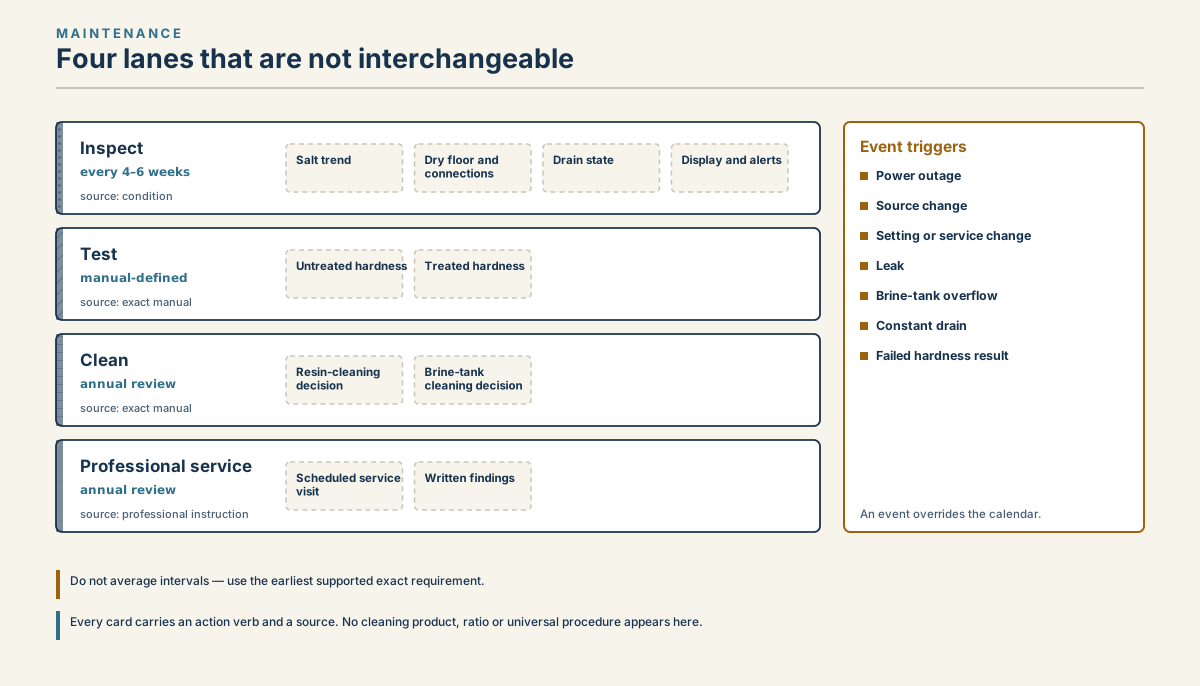
Water softener maintenance calendar with separate inspection, testing, cleaning, professional service, and event-trigger tasks linked to manual or source evidence.
Read diagram in text
- MAINTENANCE
- Four lanes that are not interchangeable
- Inspect
- every 4–6 weeks
- source: condition
- Salt trend
- Dry floor and
- connections
- Drain state
- Display and alerts
- Test
- manual-defined
- source: exact manual
- Untreated hardness
- Treated hardness
- Clean
- annual review
- source: exact manual
- Resin-cleaning
- decision
- Brine-tank
- cleaning decision
- Professional service
- annual review
- source: professional instruction
- Scheduled service
- visit
- Written findings
- Event triggers
- Power outage
- Source change
- Setting or service change
- Leak
- Brine-tank overflow
- Constant drain
- Failed hardness result
- An event overrides the calendar.
- Do not average intervals — use the earliest supported exact requirement.
- Every card carries an action verb and a source. No cleaning product, ratio or universal procedure appears here.
Monthly: salt and a quick look
EPA's maintenance checklist lists "check the salt level of your water softener and break up salt bridges" as a monthly task. Its water softener guide gives the details:
- keep the tank about half full of salt pellets;
- add salt once the salt level falls below the water level;
- never let it fall below one-quarter full;
- avoid filling to the top, which can cause bridging.
If the salt looks crusted, push a broom handle down through it (see the salt bridge guide). If the level has not moved in weeks, see softener not using salt. The salt guide covers which salt to buy.
While the lid is open, take a quick look around:
- Leaks at the valve, bypass, tank connections and drain hose. EPA recommends checking connection points, valves and drains periodically.
- Drain flow. Outside a regeneration, no water should be going to the drain. EPA's guide says a continuous trickle or flow to the drain could indicate a broken valve or other malfunction.
- Display. Correct time, no error code, no flashing reminder you have not dealt with.
Twice a year: test your water
Pentair's Whole House manual says to test the water at least twice a year with hardness test strips to make sure the system is performing. Test a cold softened tap and write down the result. Once a year, also test untreated water (with the softener in bypass, or from an unsoftened outdoor tap) in case your supply has changed; if it has, update the hardness setting.
The hardness testing guide covers strips versus drop-count kits and where to sample.
Clean the resin
The resin beads that do the softening slowly pick up iron and dirt. EPA's guide says they need cleaning annually to stay efficient, usually by pouring a manufacturer-recommended cleaner into the brine well and running a regeneration.
Whirlpool is more specific for its models. The WHES30/33 and WHES40/44 manuals recommend Whirlpool's WHE-WSC cleanser every four months:
- Lift the brinewell cover and pour in the whole 16 oz bottle.
- Hold the Recharge button for three seconds until "RECHARGE" flashes.
- The recharge takes about two hours.
- If you notice any taste, odor or discoloration afterward, run a second recharge, then run a cold tap downstream of the softener until the water is normal.
Some Whirlpool controls show a "CLEAN" reminder when four months have passed; pressing any button clears it. Use the cleaner your own manual names, and if it names none, ask the manufacturer before adding a product.
Clean the brine tank
Salt leaves some residue behind, and the tank can collect sludge or mold. EPA's home maintenance page says to clean the brine tank once a year; its guide says as needed and at least every few years; Pentair's 5600SXT manual says every three years.
EPA's method:
- Let the salt run down until the tank is nearly empty.
- Remove the leftover salt and water.
- Wash the tank with a warm soapy water mixture.
- Sanitize with a bleach solution, then rinse clean.
- Refill to about half with salt, and start a manual regeneration if the salt was fully used up.
Follow your manual where it differs, and use bleach only as its sanitizing steps describe. Whirlpool's sanitizing step, for example, uses about 3 oz of household bleach poured into the brinewell, followed by a recharge and then running 50 to 75 gallons, depending on the model, through a cold tap.
Clean the venturi or injector screen
The small nozzle and venturi (Whirlpool) or injector (Pentair) pulls brine out of the salt tank. Sand, silt or iron can clog it, and then the softener stops using salt. Whirlpool lists cleaning it under Routine Maintenance and gives owner steps; on other brands it may be a service job.
A salt level that does not change is a reason to verify completed cycles and brine draw, not proof of a clogged part. Use the exact manual's troubleshooting result to decide whether cleaning is appropriate and whether it is an owner or service task. The steps are in softener not using salt.
Yearly professional service
EPA's home maintenance page recommends hiring a professional to service the softener once a year. It is the time for the parts owners should leave closed, such as the valve seals and piston, the brine valve and the flow controls, which Pentair's troubleshooting tables assign to repair, and for checking the settings against your current water. Pentair's Whole House manual notes the regeneration valve may need cleaning and lubrication from time to time, depending on water quality and how often it regenerates.
Ask the technician to note what they checked, any settings they changed (old and new values) and a hardness result after the visit. The service checklist helps you prepare.
After a power outage, trip or repair
- Power outage: EPA says to check that the softener is still programmed correctly and reset the clock. Whirlpool notes that without a reset, regenerations may run at the wrong time of day.
- Long trip: EPA suggests vacation mode, bypass, unplugging, or turning off the water. See the vacation and bypass guide.
- Water-intensive outdoor use: EPA recommends putting the softener in bypass for lawn watering or filling a pool, then switching it back.
- Plumbing work or service: Whirlpool's manuals call for sanitizing after service. Check for leaks the next day.
Keep a simple log
A few lines per visit make every future problem easier to solve: date, salt added, anything unusual, test results, and any setting changes. The printable maintenance log has columns for all of it, and the editable maintenance schedule turns the table above into a checklist you can adapt to your manual.
Frequently asked questions
How often should I maintain a water softener?
Check the salt about once a month (EPA says every 4 to 6 weeks) and break up any crust. Test softened water at least twice a year. Clean the resin yearly, or every four months on Whirlpool models, clean the brine tank every year or few years, and have a professional service it once a year.
What can I safely do myself?
Adding salt, breaking salt bridges, testing water, cleaning the resin with the recommended cleaner, cleaning the brine tank, and resetting the clock are owner tasks in the EPA and manufacturer guidance. Some manuals also list cleaning the venturi. Leave valve seals, pistons, motors and wiring to a technician.
How do I clean a water softener resin bed?
Pour the cleaner your manual recommends into the brine well and start a regeneration. Whirlpool, for example, uses its 16 oz WHE-WSC cleanser every four months, followed by a two-hour recharge. EPA recommends cleaning the resin annually. If the water tastes or smells odd afterward, run a second regeneration and flush a cold tap.
How often should the brine tank be cleaned?
EPA's home maintenance page says once a year, its guide says at least every few years, and Pentair's 5600SXT manual says every three years. Clean it sooner if you see sludge, dirt or mold. Let the salt run low, remove what is left, wash with warm soapy water, sanitize with a bleach solution and rinse.
Sources
Sources were consulted on the dates shown. Intervals and cleaning products are model-specific, so confirm them in your current manual.
- U.S. Environmental Protection Agency WaterSense, Guide to Selecting and Maintaining a Water-Efficient Water Softener, May 2026; consulted September 24, 2026.
- U.S. Environmental Protection Agency WaterSense, Home Maintenance — Water Softeners, updated June 16, 2026; consulted September 24, 2026.
- U.S. Environmental Protection Agency WaterSense, Maintenance Checklist for a Water-Efficient Home, March 2024; consulted September 24, 2026.
- Pentair, Whole House Water Softening System Installation and Operation Manual; consulted September 24, 2026.
- Whirlpool Water Solutions, WHESFC Water Conditioner Installation and Operation Manual; consulted September 24, 2026.
- Whirlpool Water Solutions, Water Softener Installation and Operation Manual, document 7392301; consulted September 24, 2026.
- Pentair, Pentair 5600SXT manual; consulted September 24, 2026.
- Whirlpool Water Solutions, Whirlpool WHES40/44 manual; consulted September 24, 2026.
- Whirlpool Water Solutions, Whirlpool WHES18 manual; consulted September 24, 2026.
- Whirlpool Water Solutions, Whirlpool WHES48 manual; consulted September 24, 2026.