
Water Softener Service Checklist: Before, During and After
Sources last checked
A useful water softener service checklist records the exact equipment, official manual, reproducible symptom, water-test results, settings, regeneration events, salt/brine observations, leaks, errors and prior maintenance before the visit. During service, it captures the diagnosis, tests, parts, settings, written scope, exclusions, price and warranty. After service, it verifies safe return to operation, a completed cycle when applicable and a defined treated-water result.
Printable worksheet
Water Softener Service Checklist: Before, During and After
Prepare for water softener service with a printable checklist for model, symptoms, hardness, settings, cycles, quotes, repairs, warranties and acceptance.
Open the water softener service checklist: before, during and after (print sheet, US Letter)Print at 100% scale. Fits US Letter without cropping.
Use the printable service checklist to bring all of this to the visit. Share only what the technician needs for the work: keep account numbers, payment details and access codes off any copy you hand over or store online.
The checklist does not authorize a repair, chemical, setting change, manual stage advance, provider selection, contract or payment. The exact manual, qualified professionals, written agreement and applicable local requirements control the work.
Service rule: Preserve the pre-service baseline, agree on diagnosis evidence and acceptance criteria before work, and record every part or setting change. A visit is not complete merely because the error disappeared or the invoice says “fixed.”
Handle urgent safety conditions first
Do not wait for a routine appointment when there is:
- active leakage, overflow or rapidly increasing water;
- water near the plug, transformer, controller or wiring;
- a cracked, bulging or unstable tank or valve;
- unsupported or visibly damaged pressurized plumbing;
- burning odor, heat, arcing or a damaged cord;
- continuous unexplained drain flow;
- a regeneration that appears stalled and will not return to service;
- freeze, impact or unknown chemical/contamination evidence; or
- a private-well water-safety concern unrelated to hardness.
Record the visible condition and display from a safe position. Follow emergency/bypass guidance only for the exact installation and only within your competence. Do not touch wet electrical equipment, operate an unidentified valve or disconnect a pressurized/brine/drain line.
State the current safe condition when contacting service: operating, exact-manual bypass, power isolated by an authorized person, contained leak or unknown. Tell the provider if water must remain off or if vulnerable people depend on the supply.
EPA's private-well guidance makes clear that private well owners are responsible for household drinking-water safety. A softener-service visit does not establish microbiological or contaminant safety, and neither does a hardness result.
Identify the exact equipment and source documents
Photograph or transcribe labels without moving plumbing or opening covers. Record:
- brand and full model;
- controller/valve model, which may differ from the tank brand;
- partial serial/date code for the working copy, retaining the full number privately if needed for warranty;
- installation date and installer if documented;
- official manual URL, document number and revision/date;
- warranty source and purchase proof location;
- tank configuration and plumbing/bypass type; and
- salt product/chemistry and last addition.
Retrieve manuals from the manufacturer. Whirlpool provides an official product-manual portal, and Pentair maintains official product support and warranty sources. Do not rely on a procedure or warranty copied from a visually similar model.
If the proposed provider asks for the full serial number, send it through the provider's verified private channel, not a public post or shared editorial file. Store photographs in a controlled folder and remove location metadata when sharing beyond the service transaction.
Write a reproducible symptom record
Describe what happens, where, when and under what conditions. Avoid beginning with an assumed part failure.
Weak: “The valve is broken.”
Useful: “Treated hardness increased from the recorded criterion after two controller-confirmed completed cycles; sample point, method, settings and dates attached.”
Record:
- symptom and first observed timestamp;
- frequency or repeat pattern;
- affected fixtures/sample points;
- automatic versus manual event context;
- exact error/alert and displayed stage;
- recent outage, vacation, bypass, plumbing or water-source change;
- leak/drain/salt/brine observations;
- what was already tried and by whom; and
- what changed, what did not and the present safe state.
Keep “queued,” “requested,” “started,” “interrupted” and “completed” regeneration separate. Preserve errors and settings before resetting anything. Do not repeatedly regenerate or change several settings to create evidence.
Use the troubleshooting guide to identify the symptom branch. Use the not-regenerating guide or repair-or-replace guide when those match the documented task.
Gather water, settings, cycles and maintenance evidence
The technician can work faster when each input has a date, unit and source.
Water evidence
- untreated hardness: value, unit, method, sample point, date/time;
- treated hardness: same fields and comparable method;
- iron/manganese or other relevant professional/lab results;
- source-water type and known recent change; and
- treatment criterion or reason the system exists.
Hardness does not prove potability. Do not copy an old municipal average as the current inlet result without labeling its source/date.
Settings and controller evidence
- hardness/compensated hardness and source;
- usable capacity, salt dose/efficiency mode and their definitions;
- reserve, day override and regeneration mode;
- clock/day, remaining gallons/capacity and errors;
- meter/flow evidence during known treated-water use; and
- settings before every authorized change.
Maintenance and event evidence
- salt product, pounds and dates added;
- comparable salt/brine level observations;
- completed regeneration dates and manual requests;
- cleaning/service dates, products and exact-manual sections;
- leaks, continuous drain or abnormal cycle evidence; and
- parts/work previously performed and acceptance results.
EPA WaterSense recommends periodic professional service, salt checks, leak awareness and manufacturer/professional involvement in programming. Its 2026 softener guide emphasizes hardness, demand, capacity and maintenance context. These inputs belong in the handoff, but the article does not prescribe a setting or service cadence for every model.
Use the hardness-test guide and maintenance log to standardize records.
Prepare privacy-safe photos and safe access
Useful photographs can include:
- equipment/controller label with unnecessary identifiers masked in review copies;
- full installation and accessible plumbing orientation;
- controller display/error and timestamp reference;
- visible leak or salt/tank condition from a safe position;
- drain/air-gap arrangement without touching it; and
- prior part/work labels relevant to the diagnosis.
Do not photograph payment documents, mail, faces, access codes, alarm panels, utility account numbers or unrelated areas. Remove full address and geolocation metadata from files sent for general review. The provider may need private property/contact information for the appointment, but that operational record should remain separate from the reusable checklist.
Before arrival, clear safe access without moving the appliance or stressing pipes. Keep children and pets away. Tell the provider about confined space, stairs, standing water, electrical concerns, pest/chemical hazards or other access conditions. Do not remove covers or pre-disassemble the unit.
Ask for a written estimate and work order
The Federal Trade Commission's home-improvement guidance recommends checking applicable license/insurance, getting multiple written estimates and ensuring an estimate describes the work, materials, completion date and price. Requirements vary by state and locality, so verify them with the appropriate authority.
For softener service, ask the written estimate/work order to include:
- provider identity and applicable license/insurance evidence;
- quote date, expiration and expected schedule;
- diagnostic fee and whether it applies to work;
- symptom and diagnosed function/component;
- test supporting the diagnosis;
- exact parts/model and new/rebuilt status;
- labor, travel, shipping, tax and payment schedule;
- permits, code/plumbing/electrical work and responsible party;
- startup, sanitation, programming and disposal;
- exclusions, contingencies and change-order process;
- parts, workmanship and equipment warranty; and
- acceptance tests and documentation to be delivered.
Do not sign a document with blank scope or cost fields. Do not approve a verbal change without the revised scope, price and effect on warranty/schedule. This article does not select a provider or interpret local contract law.
If replacement is proposed, require current hardness/demand/flow inputs, exact performance data and installed scope. If repair is proposed, require the isolated failure, correct part and measurable outcome. List every quote in the same format so the alternatives stay comparable.
Document the on-site diagnosis and work
Before work begins, ask the technician to restate the symptom, test plan and safety state. During/after the visit, record:
- tests performed and measured results;
- diagnosed function/component and alternative causes excluded;
- part number, condition and disposition of removed part;
- settings before and after, with reason and authorizer;
- firmware/controller or configuration change;
- cleaning/chemical product, amount and exact authorization if used;
- valve, meter, brine, drain or electrical work completed;
- unexpected condition and written change order;
- warranty claim/reference and evidence supplied; and
- return-to-service procedure.
Do not shadow a technician in an unsafe work area or touch equipment during service. The record should say who performed internal/electrical/pressurized work; the checklist itself never authorizes the owner to perform it.
Manufacturer warranties can depend on model, component, proof, operation, approved parts and other terms. Pentair's warranty information, for example, separates coverage by model line/component and includes conditions/exclusions. Verify the exact warranty applicable to this product and date; do not infer coverage from the example.
Run acceptance checks before closing the visit
Define acceptance before authorizing work, then record pass/fail/not applicable:
- no active leak, overflow or continuous unexplained drain;
- equipment and surrounding area returned to a safe condition;
- display, clock, settings and error state documented;
- service/bypass position correct under the installation diagram;
- known treated-water flow registers when relevant;
- one documented regeneration or function test completes when required;
- brine fill/draw/drain behavior meets the exact manual when tested;
- treated hardness meets the agreed criterion at the defined sample point/time;
- parts/model/settings and work performed match the written order;
- manuals, receipts, warranty and follow-up instructions are received.
NSF/ANSI 44 covers capacity, rinse effectiveness, brine-system accuracy, structural integrity and user information among its technical requirements. An exact model's certification can be checked in the NSF listing search, but certification does not replace installed-system acceptance testing.
If a required acceptance check fails, write the result, keep the safe state and agree on the responsible person and follow-up date. Do not mark the work complete merely because an error disappeared or a cycle was requested.
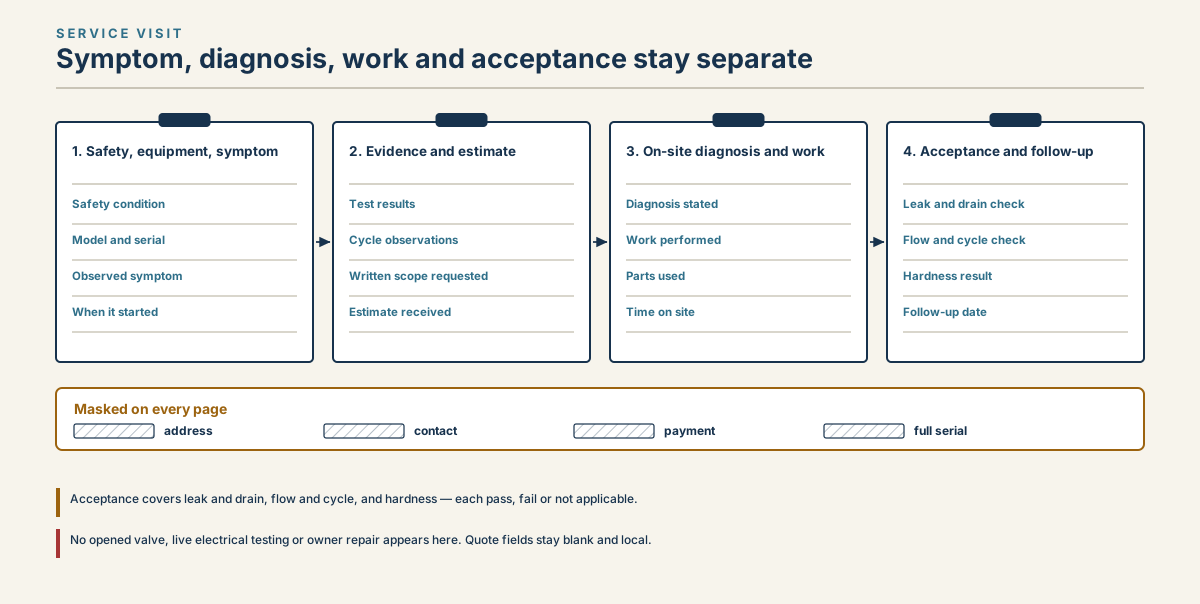
Four-stage water softener service checklist covering safety, evidence, written scope, work record and acceptance.
Read diagram in text
- SERVICE VISIT
- Symptom, diagnosis, work and acceptance stay separate
- 1. Safety, equipment, symptom
- Safety condition
- Model and serial
- Observed symptom
- When it started
- 2. Evidence and estimate
- Test results
- Cycle observations
- Written scope requested
- Estimate received
- 3. On-site diagnosis and work
- Diagnosis stated
- Work performed
- Parts used
- Time on site
- 4. Acceptance and follow-up
- Leak and drain check
- Flow and cycle check
- Hardness result
- Follow-up date
- Masked on every page
- address
- contact
- payment
- full serial
- Acceptance covers leak and drain, flow and cycle, and hardness — each pass, fail or not applicable.
- No opened valve, live electrical testing or owner repair appears here. Quote fields stay blank and local.
Store the service history and follow-up
Create two records:
- a private operational record containing full identifiers, provider/contact, agreement, payment and warranty information; and
- a minimized technical record containing model family, symptom, tests, settings, parts, results and dates without unnecessary PII.
Attach the minimized record to the maintenance log. Schedule only the follow-up required by the exact work/manual or provider warranty. At follow-up, repeat the defined test using the same sample point, unit and method. Record any new leak, drain, error, salt/cycle or performance change.
Do not delete the pre-service baseline. It supports warranty, recurrence analysis and future repair/replacement decisions. If a provider asks to change the story after a failed acceptance check, preserve the original work order and measurements.
Frequently asked questions
What should I tell a water softener technician first?
Start with the current safety state, the exact model and controller, a reproducible symptom, the error and event timeline, untreated and treated hardness, and what has already been tried. Useful photos include the installation, model label, display or error, any visible leak and the salt tank condition.
Should I reset the error before the appointment?
Preserve the exact display, code, time, settings and event state first, then follow only the exact manual or the provider's documented instruction. Keep queued, requested, started, interrupted and completed regenerations separate, and do not repeatedly regenerate or change several settings at once to create evidence.
How do I know the repair worked?
Use pre-agreed acceptance criteria: no active leak or continuous unexplained drain, a documented display and settings state, the correct bypass position, known treated-water flow registering, a completed cycle or function test when required, and a treated-hardness result at the defined sample point.
Should I pay before acceptance?
Follow the written agreement and applicable law. The FTC advises against paying the full project amount upfront and recommends waiting for completed, satisfactory work before final payment; it also recommends multiple written estimates describing work, materials, completion date and price. Verify local rules.
Sources
Sources were consulted on August 27, 2026. Warranties, certifications and contractor requirements change, so check them for your provider and state.
- U.S. Environmental Protection Agency WaterSense, Home Maintenance — Water Softeners, updated June 16, 2026; consulted August 27, 2026.
- U.S. Environmental Protection Agency WaterSense, Guide to Selecting and Maintaining a Water-Efficient Water Softener, May 2026; consulted August 27, 2026.
- Pentair, Pentair support FAQ; consulted August 27, 2026.
- Pentair, Whole House Water Softening System Installation and Operation Manual; consulted August 27, 2026.
- NSF, NSF/ANSI 44 Technical Requirements, March 8, 2025; consulted August 27, 2026.
- NSF, NSF listing search; consulted August 27, 2026.
- U.S. Federal Trade Commission, How To Avoid a Home Improvement Scam; consulted August 27, 2026.
- U.S. Environmental Protection Agency, Private Drinking Water Wells, updated August 25, 2026; consulted August 27, 2026.