
Estimate salt use from your own observation window, not a generic household average. Count only completed regenerations, document the salt dose associated with the exact model and settings, and divide the estimated salt used by the number of observed days. The calculator normalizes that rate to 30.4375 days per month and 365.25 days per year.
Calculator
Values are processed in your browser. Nothing you enter is stored or transmitted.
Cycle-and-dose mode
- Observed salt (lb) = completed regenerations × documented salt dose per cycle
- Monthly salt (lb) = observed salt ÷ observation days × 30.4375
- Annual salt (lb) = observed salt ÷ observation days × 365.25
- Cost = salt result × delivered price per pound
This is an estimate, not a fault diagnosis. A programmed or performance-sheet dose is an input assumption; it is not direct proof of the physical salt removed from the brine tank. Use the optional inventory balance as a separate cross-check, and retain both results when they differ.
Calculation rule: Count completed cycles over a defined window and pair them with the documented dose. Keep the inventory balance independent. When the two estimates disagree, report the gap and improve the measurement instead of forcing one result to match the other.
Calculate from your own observation window
Begin the record on a known date and time. Capture the controller's cycle count or note each completed regeneration using the same method throughout the period. A queued cycle, a canceled request or a cycle that never returned to service is not a completed cycle.
Record:
- period start and end;
- exact model and controller;
- programmed settings or performance-sheet dose used;
- the source and revision for that dose;
- completed cycle count at the start and end, when available;
- manually observed completed cycles;
- salt added during the period;
- estimated starting and ending salt inventory using the same method;
- delivered salt price, including required delivery/fees; and
- power loss, service, refill or setting changes that affect comparability.
A longer, stable observation period generally gives a more representative ownership rate than one short interval, but there is no universal minimum that makes a period “normal.” A household event, leak, guest visit, irrigation connection, source-water change or manual cycle can make one window unlike another. Preserve that context instead of deleting an inconvenient period.
Keep one row per observation window in the maintenance log or a spreadsheet. The calculator runs in your browser and does not ask for a name, address, account or water-utility identifier.
Inputs and formulas
Required cycle-and-dose inputs
observation_days must be greater than zero. completed_regenerations must be a whole number zero or greater. salt_dose_lb_per_cycle must be zero or greater and must identify its source.
The calculator keeps full precision internally and displays pounds and cost to two decimal places. It uses:
observed_salt_lb = completed_regenerations × salt_dose_lb_per_cycle
daily_salt_lb = observed_salt_lb ÷ observation_days
monthly_salt_lb = daily_salt_lb × 30.4375
annual_salt_lb = daily_salt_lb × 365.25
monthly_cost = monthly_salt_lb × delivered_price_per_lb
annual_cost = annual_salt_lb × delivered_price_per_lb
The monthly constant is exactly 365.25 ÷ 12. Do not calculate an annual result by multiplying a rounded displayed month by 12; both outputs come from the unrounded daily rate.
Price per pound is optional. Calculate it from the price actually paid divided by usable package weight, with delivery or mandatory fees included when relevant. Do not compare a delivered price with a store pickup price unless that difference is intentional.
What “salt dose per cycle” means here
Use an exact-model performance sheet or verified programmed setting that defines pounds per regeneration. Keep the capacity/dose pair together. Do not substitute the total bag weight, brine-tank capacity or an advertised maximum grain number.
EPA's water-efficient softener guide connects hardness, household water use, demand-initiated regeneration and efficiency. NSF/ANSI 44 technical requirements include brine-system accuracy. Those sources support disciplined inputs; they do not establish one normal dose or monthly total for every household.
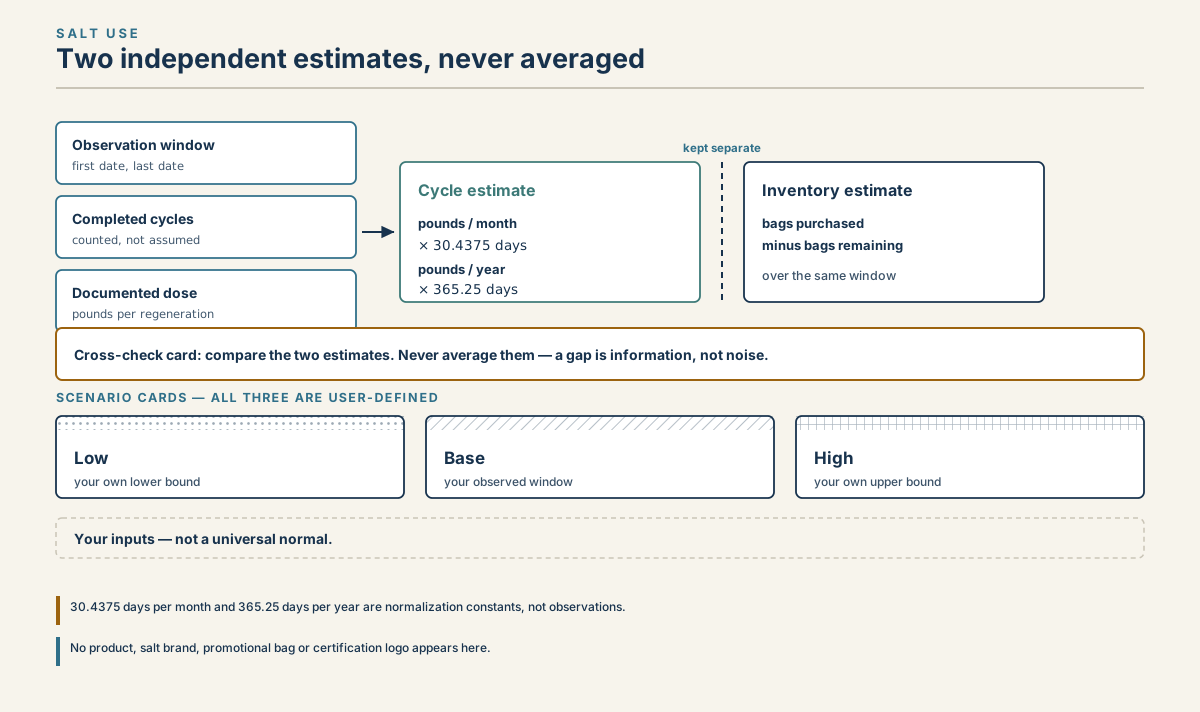
Salt-use calculator normalizing completed cycles and documented dose, with a separate inventory cross-check.
Read diagram in text
- SALT USE
- Two independent estimates, never averaged
- Observation window
- first date, last date
- Completed cycles
- counted, not assumed
- Documented dose
- pounds per regeneration
- Cycle estimate
- pounds / month
- × 30.4375 days
- pounds / year
- × 365.25 days
- Inventory estimate
- bags purchased
- minus bags remaining
- over the same window
- kept separate
- Cross-check card: compare the two estimates. Never average them — a gap is information, not noise.
- SCENARIO CARDS — ALL THREE ARE USER-DEFINED
- Low
- your own lower bound
- Base
- your observed window
- High
- your own upper bound
- Your inputs — not a universal normal.
- 30.4375 days per month and 365.25 days per year are normalization constants, not observations.
- No product, salt brand, promotional bag or certification logo appears here.
Optional inventory cross-check
Inventory mode estimates salt physically removed from the recorded stock:
inventory_salt_used_lb = starting_inventory_lb
                       + salt_added_lb
                       − ending_inventory_lb
Then normalize that result with the same day, month and year formulas. All inventory inputs must be zero or greater, and the calculated use cannot be negative. Use the same estimation method at the start and end, such as unopened package weights plus a consistent marked-level estimate. If the geometry, bridging or dissolving salt makes the estimate unreliable, mark the result low confidence rather than forcing it to match the cycle estimate.
Do not silently merge the two methods. Display:
- cycle-and-dose estimate;
- inventory-balance estimate;
- absolute difference; and
- difference as a percentage only when the chosen denominator is positive and labeled.
A mismatch can reflect measurement uncertainty, an incorrect dose assumption, partial bags, an incomplete cycle record, a setting change, salt bridging or another brine-system condition. It does not identify one cause by itself.
Build a sensitivity range
Low, base and high outputs should come from values you define, not an invented ±10% band. Create scenarios for the inputs that are genuinely uncertain:
- completed cycles expected in the chosen window;
- pounds per cycle supported by an exact performance sheet or setting;
- observation length for a planned budget period; and
- delivered price per pound.
Run the same formula once for each complete scenario. Label the assumptions alongside the results. For example, a low scenario may use fewer documented cycles, while a high scenario reflects an actual seasonal observation; neither should be presented as a probability unless you have evidence for that interpretation.
Reject a scenario when days are zero or negative, cycles are negative or fractional, dose/price is negative, or inventory use calculates below zero. Empty optional price fields should produce salt-use outputs with cost shown as “not calculated,” not zero cost.
Read the result without overdiagnosing
The calculated rate answers: “If this observation window continued at the same average rate, how many pounds and dollars would it represent per standardized month or year?” It does not answer whether the result is efficient, normal, excessive or safe without model and household context.
Compare like with like:
- same unit and formula version;
- same completed-cycle definition;
- same dose source;
- similar household occupancy and water use;
- comparable incoming hardness and source conditions;
- stable settings, meter and reserve behavior; and
- same salt-inventory method.
Cation-exchange regeneration consumes salt and water to restore capacity, as EPA's softener overview explains. Compare documented periods and exact-model performance, not your result and an unattributed online average.
The calculator does not determine drinking-water safety, verify contaminant removal, select salt type, or certify a model. An exact certification listing and manufacturer documentation control product claims.
Investigate a high or changing result
First confirm the arithmetic and record before changing the equipment:
- Recalculate observation days from timestamps.
- Reconcile start/end cycle counters and manual cycles.
- Confirm that every counted cycle completed.
- Verify the dose and capacity pair against the exact current setting/manual.
- Check whether salt was added or removed outside the log.
- Note changes in household water use, guests, fixtures or leaks.
- Recheck incoming hardness if the supply or source can change.
- Compare controller status and recent errors with the exact manual.
Use the settings guide to document programming, the regeneration guide for cycle context, the manual regeneration guide for a controlled one-time request, and the troubleshooting checklist to preserve symptoms.
Do not lower salt dose, capacity, reserve or hardness settings solely to make the calculator output smaller. An arbitrary change can reduce delivered capacity or create hard-water breakthrough. Exact-model performance data and competent review should control programming.
Reduce uncertainty before changing settings
Use at least two comparable periods when practical. Keep raw counts, dates and inventory notes rather than only the normalized monthly figure. A trend is more useful when its calculation and context are reproducible.
If cycle and inventory estimates disagree, improve one measurement at a time. Mark unopened bags by weight, use consistent inventory reference points, photograph the controller counter, and avoid changing settings mid-period. Do not reach into or dismantle the brine system to improve an estimate.
For cost planning, preserve package size and total delivered price. If salt prices change, rerun price while leaving physical-use assumptions unchanged; this separates consumption from purchasing cost.
The calculator is checked against a fixed set of test cases, including zero use, typical households, optional salt prices, inventory counts and invalid inputs. Your values stay in the browser, and the reset button clears them.
Frequently asked questions
How much salt should my water softener use per month?
There is no single defensible amount for all homes and models. Count only regenerations that started, completed and returned to service, pair them with an exact documented dose, and normalize to the standardized month of 30.4375 days. Then compare stable periods against the model's documentation, not an unattributed online average.
Is the programmed dose the same as actual salt consumed?
Not necessarily. It is a documented calculation input, not proof of the physical salt removed from the brine tank. An inventory balance provides an independent but imperfect cross-check. Keep both values with their confidence notes, and report the gap instead of forcing one estimate to match the other.
Can I estimate cost from the price of one bag?
Yes. Divide the total delivered price by the usable pounds in the package, then multiply by the unrounded estimated pounds. Record delivery and mandatory fees consistently, and do not compare a delivered price with a store pickup price unless that difference is intentional.
Does high calculated use mean the softener is broken?
No. Confirm the record, demand, hardness, settings, manual cycles and inventory method first. The rate alone cannot distinguish normal demand from a leak, a programming issue or an equipment fault. Do not lower a setting solely to make the calculator output smaller.
Sources
Sources were consulted on August 27, 2026. Performance sheets and certification listings are model-specific; results here are estimates from your inputs.
- U.S. Environmental Protection Agency WaterSense, Cation Exchange Water Softeners, updated May 8, 2026; consulted August 27, 2026.
- U.S. Environmental Protection Agency WaterSense, Guide to Selecting and Maintaining a Water-Efficient Water Softener, May 2026; consulted August 27, 2026.
- U.S. Environmental Protection Agency WaterSense, Home Maintenance — Water Softeners, updated June 16, 2026; consulted August 27, 2026.
- NSF, NSF/ANSI 44 Technical Requirements, March 8, 2025; consulted August 27, 2026.
- Pentair, Pentair 5600SXT manual; consulted August 27, 2026.
- Whirlpool Water Solutions, Whirlpool WHES18 manual; consulted August 27, 2026.
- NSF, water-treatment standards overview; consulted August 27, 2026.