
Water Softener Cost: Build a First-Year Budget
Jump to budget calculator · See observed equipment prices
Content updated
Sources last checked
A whole-house salt softener costs about $500 to $1,500 for the equipment alone, according to Penn State Extension. Installed, HomeAdvisor reports a $1,500 average, with most homeowners paying $200 to $6,000; Fixr puts the usual range at $1,100 to $3,000. On October 14, 2026, The Home Depot listed two Rheem models at $489 (32,000 grains) and $689 (42,000 grains). Your own total depends on the system and the plumbing and electrical work it needs, so the calculator below starts from your written quote and adds the first year of salt, water, power and upkeep.
Calculate your first-year budget
Enter your own installed quote and twelve months of operating costs. Leave a field blank when it is unknown; enter 0 only when you have confirmed that no cost applies. Amounts are in US dollars.
Include equipment and installation once in the installed amount. Use the water and sewer charges that apply to regeneration, excluding unrelated fixed fees. Financing means first-year interest and fees, excluding principal already counted in the installed amount. The contingency reserve stays separate from expenses.
Use the printable first-year budget worksheet if the interactive calculator is unavailable.
The calculation uses only the amounts you enter. It does not predict repairs, recommend a product, or estimate savings. Inputs are processed in your browser without saving or sending them; the CSV download is yours to keep.
Observed equipment prices
These are dated seller observations for the same six-model sample used in our capacity comparison. They are equipment prices, not installed quotes or a national average. Confirm the amount and availability for your location before budgeting.
| Model | Equipment price (USD) | Seller and consultation date |
|---|---|---|
| WHES30 | Not verified | Lowe's October 14, 2026 |
| WHES40 | Not verified | Lowe's October 14, 2026 |
| RHS32 | $489 | The Home Depot October 14, 2026 |
| RHW42 | $689 | The Home Depot October 14, 2026 |
| AO-WH-SOFT-350C | Not verified | Lowe's October 14, 2026 |
| AO-WH-SOFT-450T | Not verified | Lowe's October 14, 2026 |
We checked these U.S. retailer pages on October 14, 2026. The Home Depot pages displayed $489 for RHS32 and $689 for RHW42, a $200 difference between two equipment offers. No store or ZIP code was selected. These observations are a small sample, not an average market price, a national price range, or a recommendation to buy either model. Prices and local availability can change.
The amounts are not installed quotes. Shipping, sales tax, plumbing changes, installation, salt, maintenance, and financing need their own amounts before you can compare complete ownership costs. We excluded the lower prices conditional on opening a retailer credit card. The budget tool lets you enter a complete installed quote and the recurring costs that apply to your home.
The other four prices remain unknown. The observed Lowe’s pages for WHES30, WHES40, and AO-WH-SOFT-350C said they no longer sell those items; that does not establish that the manufacturer discontinued them. We could not verify a current AO-WH-SOFT-450T price from the retailer page. A blank amount in the CSV means unknown, never $0.
What each offer includes and what remains unknown
- WHES30: No verifiable offer. Observed retailer page says this item is no longer sold on Lowes.com; no verifiable price. This does not establish manufacturer discontinuation.
- WHES40: No verifiable offer. Observed retailer page says this item is no longer sold on Lowes.com; no verifiable price. This does not establish manufacturer discontinuation.
- RHS32: Displayed equipment price; not an installed quote. Retailer page content opened on consultation date; shipping and tax need local confirmation
Shipping: Unknown; no destination or delivery charge shown. Tax: Unknown; no checkout tax shown. Installation: Unknown; no installation amount or installed offer shown. Card-opening discounts excluded; plumbing changes; salt; maintenance; tax and shipping amounts unverified. - RHW42: Displayed equipment price; not an installed quote. Retailer page content opened on consultation date; shipping and tax need local confirmation
Shipping: Unknown; no destination or delivery charge shown. Tax: Unknown; no checkout tax shown. Installation: Unknown; no installation amount or installed offer shown. Card-opening discounts excluded; plumbing changes; salt; maintenance; tax and shipping amounts unverified. - AO-WH-SOFT-350C: No verifiable offer. Observed retailer page says this item is no longer sold on Lowes.com; no verifiable price. This does not establish manufacturer discontinuation.
- AO-WH-SOFT-450T: No verifiable offer. Current retailer page inaccessible (403). Older item 1000572981 asks for pricing and availability without an amount; no current verifiable price.
Use the worksheet
Printable first-year water softener budget with a blank worksheet, formulas, a worked example with sample numbers, and a CSV download.
Open first-year water softener budget worksheet · Download CSV worksheet
A water softener budget has three totals: equipment, installed cost, and first-year ownership cost. An equipment price leaves out site work and ongoing expenses. Use the published ranges and dated seller prices as benchmarks, then use written local quotes and your own operating inputs to complete the budget.
- Equipment subtotal: the exact treatment equipment and accessories delivered to the site.
- Installed subtotal: equipment plus labor, plumbing, drain, electrical, permits, startup and other written scope.
- First-year total: installed subtotal plus the first twelve months of salt, regeneration water, electricity, maintenance and model-specific consumables.
Record the location, source and date for every dollar amount in the first-year budget worksheet. A price without scope cannot be compared, and a national range is a starting point, not a local quote.
Budget rule: Compare three totals, not one advertised price. Use current quotes for equipment and installation, then calculate first-year operating cost from the exact model, local tariffs and a documented household load.
Use three totals, not one price
“Water softener price” can refer to a box on a shelf, a delivered system, a plumbing proposal or a year of ownership. Put each number in the correct total.
| Total | Include | Keep separate or flag |
|---|---|---|
| Equipment | Base softener, required pretreatment, accessories, bypass if separate, controller/connectivity option, delivery, tax, documented discount | Optional upgrades, extended service plans and consumables not required at startup |
| Installed | Equipment plus assessment, labor, pipe/fittings, loop or reroute, drain/air gap, outlet/electrical work, grounding continuity work, permit/inspection, restoration, disposal and commissioning | Allowances, unknown site work and change orders |
| First year | Installed subtotal plus twelve months of salt, water/sewer attributable to regeneration, electricity, planned service, required consumables and financing cost if used | Emergency repairs, contingency reserve and optional products unless intentionally budgeted |
Do not add a line item twice. If a turnkey proposal already includes the bypass, permit and startup, mark those fields “included in quoted total” instead of entering them again.
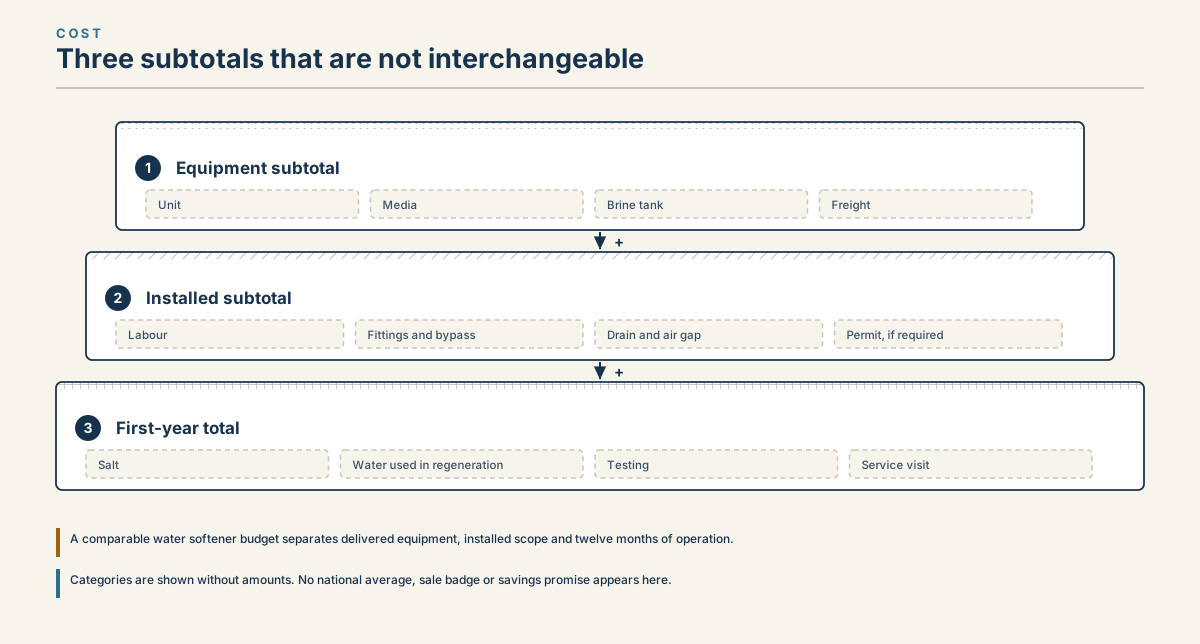
Three-layer budget diagram adding equipment, installation and first-year operating cost categories.
Read diagram in text
- COST
- Three subtotals that are not interchangeable
- 1
- Equipment subtotal
- Unit
- Media
- Brine tank
- Freight
- +
- 2
- Installed subtotal
- Labour
- Fittings and bypass
- Drain and air gap
- Permit, if required
- +
- 3
- First-year total
- Salt
- Water used in regeneration
- Testing
- Service visit
- A comparable water softener budget separates delivered equipment, installed scope and twelve months of operation.
- Categories are shown without amounts. No national average, sale badge or savings promise appears here.
Equipment cost fields
Begin with the treatment requirement, not the advertised price.
Exact softener
Record:
- manufacturer, trade name and complete model;
- certified hardness-reduction claim;
- rated service flow and pressure drop;
- usable capacity at the salt dose being quoted;
- water and salt efficiency at the relevant setting;
- resin/media volume when documented;
- warranty by component, labor and transfer status; and
- what is physically included in the box or package.
The NSF/ANSI 44 technical summary explains that certification can address hardness reduction, structural integrity, pressure drop, softening capacity, rinse effectiveness and brine-system accuracy. Verify the exact model and claims in a current database such as the NSF Standard 44 listings.
A lower equipment price is not necessarily a lower delivered cost if the quote omits a bypass, connectors, drain materials, startup or required pretreatment.
Pretreatment and exclusions
Do not add equipment for iron, sediment, chlorine, microbiology or another concern without appropriate water data and a defined treatment goal. A softener primarily addresses hardness; it should not be assumed to make unknown or microbiologically unsafe water safe.
If a provider requires pretreatment, ask for:
- the measured input that triggered it;
- the exact equipment and performance claim;
- installation sequence;
- pressure-drop and flow implications;
- maintenance and replacement schedule; and
- separate equipment and labor price.
Delivery, tax and returns
Record shipping, lift-gate or placement service, sales tax, restocking conditions, return shipping and damage inspection. A refundable purchase and a made-to-order nonreturnable system create different financial risk even at the same price.
Installation and commissioning fields
Installation varies because homes and models are different. The cited Pentair whole-house manual, for example, discusses inlet/outlet plumbing, bypass, drain and air-gap arrangements, electrical continuity across nonmetallic components and model-specific setup. Use the manual for the proposed model and local requirements.
Ask each quote to identify:
- site assessment and water testing;
- removal or protection of existing equipment;
- main-line location and pipe material/size;
- new loop, reroute, shutoff and bypass;
- adapters, flexible connectors and isolation provisions;
- drain and overflow routes, air gap and discharge point;
- electrical outlet or other approved power work;
- grounding/bonding evaluation where applicable;
- permit, inspection and code responsibility;
- wall, floor, landscape or cabinet restoration;
- old-equipment disposal;
- programming and initial regeneration if required;
- leak, flow and hardness acceptance tests; and
- owner orientation, documents and warranty registration.
The installation quote guide explains how to define and accept the work. Here, carry its resolved installed amount into the ownership budget. Mark each line included, excluded, allowance or not applicable before comparing totals.
First-year operating cost formula
Cation-exchange softeners use salt and water during regeneration. EPA's WaterSense softener overview recommends considering water and salt efficiency. The amount used by one home depends on model performance, settings, measured hardness, actual softened-water demand and regeneration history.
Use observed or documented inputs:
Salt
annual salt cost = expected pounds per year × delivered price per pound
Derive pounds per year from the quoted salt dose and expected cycles, or replace the estimate with actual purchase records after installation. Include delivery fees and tax consistently.
Regeneration water and sewer
annual regeneration volume = gallons per cycle × expected cycles per year
annual water/sewer cost = annual regeneration volume ÷ billing unit × applicable marginal rate
Use the model's performance data and the local utility bill. Some utilities bill water and sewer in different units or tiers. Record which marginal rate was used; do not multiply by the entire household bill.
Electricity
annual electricity cost = documented annual kWh × local price per kWh
If the manufacturer does not provide a defensible annual-use figure and measurement is unavailable, leave this line “not measured” rather than inserting a generic estimate.
Maintenance and consumables
Add only documented items:
- planned professional service;
- manufacturer-required cleaner or treatment, if applicable;
- filters or pretreatment media assigned to this system;
- test supplies used for verification; and
- delivery or service-call fees.
EPA's home-maintenance guidance recommends professional service once a year. That supports including a service-planning field; it does not establish a national service price.
Formula
first-year total = installed subtotal + salt + regeneration water/sewer + electricity + planned maintenance + required consumables + financing cost (if used)
Keep a contingency reserve beside the total, not disguised as a known expense. If it is spent, reclassify it under the actual item. A blank material input means a partial subtotal, not zero cost. Compare final totals only when both options have complete inputs for the same scope and period.
Build three quote-based scenarios
Create minimum, expected and maximum scenarios from written evidence—not arbitrary percentages.
| Scenario | Use these inputs | Purpose |
|---|---|---|
| Minimum documented | Lowest complete quote plus the lowest supported use case and no unapproved optional work | Shows the floor if all assumptions hold |
| Expected | Preferred complete quote, expected household load and normal planned maintenance | Working budget |
| Maximum documented | Highest complete quote or explicit allowances/change-order caps plus supported high-use case | Cash planning for identified uncertainty |
Every difference must point to a changed input: a different model, additional loop work, higher cycle count, permit allowance or another named item. Do not create the maximum by adding a generic “20%” unless that percentage is an explicit project contingency chosen by the owner and labeled as such.
Costs that are often omitted
Review these before signing:
- water analysis beyond hardness;
- site visit or diagnostic fee;
- shipping, placement and removal;
- pipe-size transition or main-line reroute;
- drain access, air gap and overflow route;
- suitable unswitched outlet or electrical work;
- grounding/bonding evaluation on metallic plumbing;
- permit and inspection;
- wall, floor or landscape restoration;
- bypassed outdoor or drinking-water branches;
- startup salt and test supplies;
- commissioning and post-installation test;
- warranty labor, travel and service-call exclusions;
- financing fees and interest; and
- taxes on equipment, labor or consumables as applicable.
An omitted item is not automatically required. Mark it “not applicable” only after the proposed model, site and responsible installer support that conclusion.
Compare quotes on the same scope
Normalize every proposal into the same worksheet. Then compare:
- treatment objective and water inputs;
- exact model and certified performance;
- usable capacity and salt dose;
- service flow and pressure drop;
- included installation work;
- commissioning and acceptance evidence;
- warranty, labor and response terms;
- estimated first-year operating inputs; and
- exclusions, allowances and change-order rules.
If one quote is much lower, identify the missing or different field before calling it a saving. If a seller cannot provide a model, performance sheet or written scope, the offer is not ready for financial comparison.
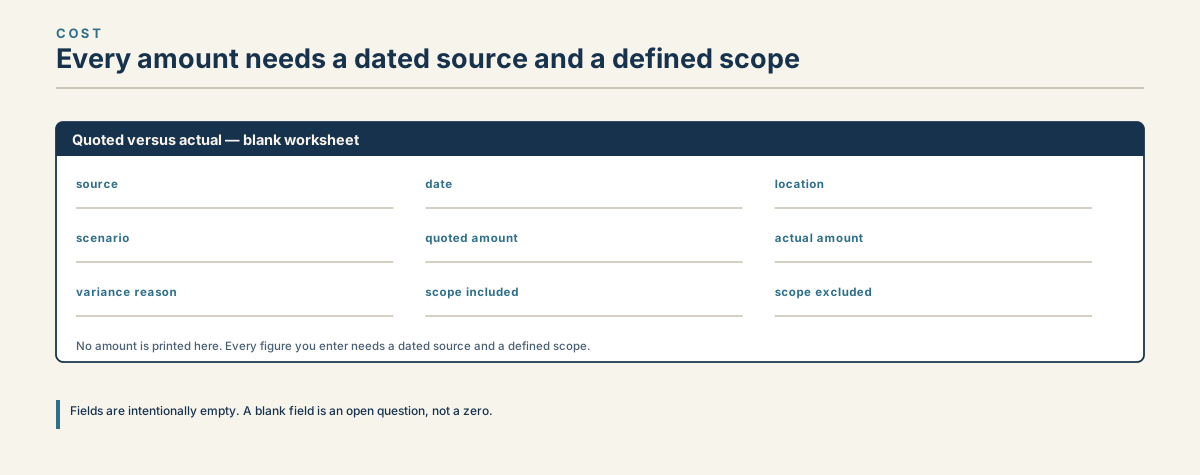
Blank worksheet comparing quoted and actual water softener costs with source and date fields.
Read diagram in text
- COST
- Every amount needs a dated source and a defined scope
- Quoted versus actual — blank worksheet
- source
- date
- location
- scenario
- quoted amount
- actual amount
- variance reason
- scope included
- scope excluded
- No amount is printed here. Every figure you enter needs a dated source and a defined scope.
- Fields are intentionally empty. A blank field is an open question, not a zero.
Track actual cost after installation
On the commissioning date, start an actual-versus-budget log:
- final invoice and change orders;
- salt purchase date, quantity and delivered cost;
- cycle count and water per cycle when available;
- applicable utility tariff and billing unit;
- maintenance, service and parts;
- untreated and treated hardness; and
- setting or household-demand changes.
Review after 90 days and twelve months. Replace assumptions with observations, but preserve the original budget so variance can be explained.
The salt-usage calculator estimates salt from dose and cycles.
Frequently asked questions
What is the average water softener cost?
Penn State Extension gives about $500 to $1,500 for the hardware alone. Installed, HomeAdvisor reports a $1,500 average with most homeowners paying $200 to $6,000, and Fixr reports $1,100 to $3,000 with a $2,500 national average. HomeAdvisor attributes the spread to home size, system type and capacity, labor, and plumbing or electrical changes, so budget from written local quotes.
Is equipment price the largest cost?
Not in every project. Existing plumbing, drainage, electrical work, pretreatment and restoration can materially change the installed total, and a lower equipment price is not a lower delivered cost when the quote omits a bypass, connectors, drain materials, startup or required pretreatment. Obtain a site-specific breakdown.
Should I include salt and water in the purchase decision?
Yes. Cation-exchange softeners use salt and water during regeneration, so compare model-specific salt and water efficiency using the quoted usable capacity and salt dose against your expected household load. Do not substitute an unrelated household average for the model's own performance data.
Can I count appliance savings to justify the purchase?
Only with a defensible, separately documented analysis. Do not assume a softener pays for itself, and do not write guaranteed future savings into the base budget. Keep any such estimate beside the total as its own line, with the evidence and date supporting it.
Sources
The technical sources below retain their consultation dates. Seller-price observations carry separate dates, scope and exclusions in the price table. They are equipment benchmarks; your installed and first-year budget still needs local quotes, bills and documented operating inputs.
-
Penn State Extension, Water Softening, updated September 8, 2025; consulted October 14, 2026.
-
HomeAdvisor, How Much Does a Water Softener System Cost to Install in 2025?, updated June 17, 2026; consulted October 14, 2026. Third-party cost guide.
-
Fixr, How much does it cost to install a water softener?, updated January 31, 2025; consulted October 14, 2026. Third-party cost guide.
-
U.S. Environmental Protection Agency WaterSense, Cation Exchange Water Softeners, updated May 8, 2026; consulted August 27, 2026.
-
U.S. Environmental Protection Agency WaterSense, Guide to Selecting and Maintaining a Water-Efficient Water Softener, May 2026; consulted August 27, 2026.
-
NSF, NSF/ANSI 44 Technical Requirements, March 8, 2025; consulted August 27, 2026.
-
NSF, Official NSF/ANSI 44 Product Listings; consulted August 27, 2026.
-
Pentair, Whole House Water Softening System Installation and Operation Manual; consulted August 27, 2026.
-
U.S. Environmental Protection Agency WaterSense, Home Maintenance — Water Softeners, updated June 16, 2026; consulted August 27, 2026.
-
Lowe's, listing for WHES30; consulted October 14, 2026. No current price verified.
-
Lowe's, listing for WHES40; consulted October 14, 2026. No current price verified.
-
The Home Depot, listing for RHS32; consulted October 14, 2026. Equipment offer observed; total delivered and installed cost unknown.
-
The Home Depot, listing for RHW42; consulted October 14, 2026. Equipment offer observed; total delivered and installed cost unknown.
-
Lowe's, listing for AO-WH-SOFT-350C; consulted October 14, 2026. No current price verified.
-
Lowe's, listing for AO-WH-SOFT-450T; consulted October 14, 2026. No current price verified.