
Water Softener Salt Guide
Content updated
Sources last checked
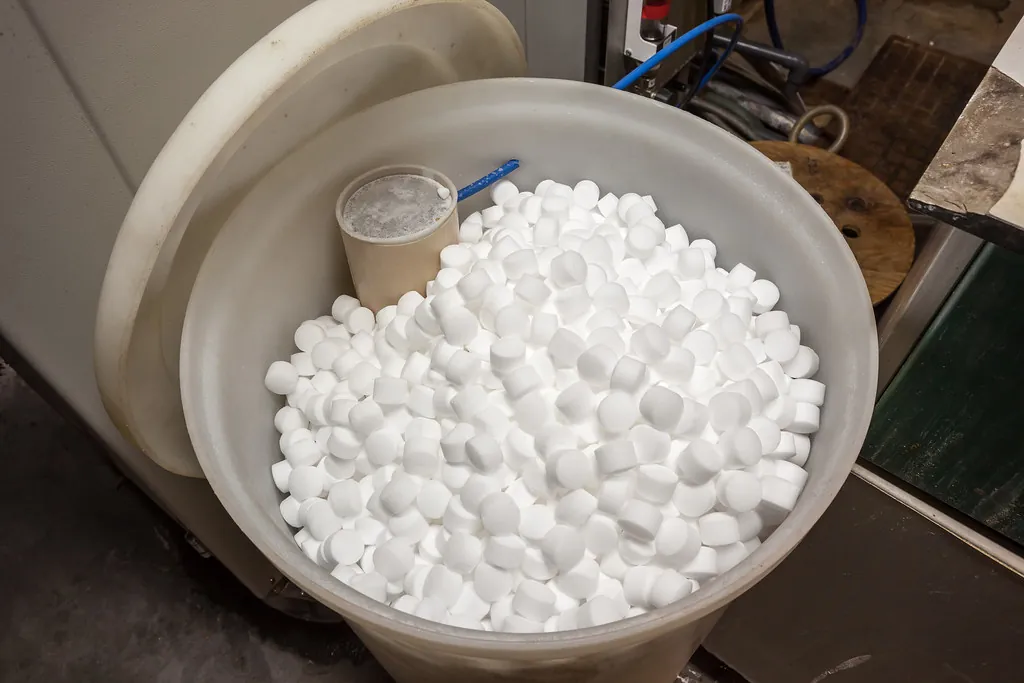
Start with the salt specified in your exact manual. EPA recommends salt pellets made for water softeners, and the Whirlpool and Pentair examples below show where acceptable forms differ. Coarse solar salt and nugget salt also work in many units: Whirlpool recommends nugget, pellet or coarse solar salt with less than 1% impurities. Avoid rock salt, road or ice-melting salt, table salt and granulated salt, which Whirlpool and EPA both advise against. Block salt splits the manuals: Pentair's Whole House manual recommends it, Whirlpool does not.
Potassium chloride is an alternative for people who want to avoid adding sodium, but only if your softener's manual allows it, and it usually means changing a setting and filling the tank less.
Fill the brine tank about half full and check it every 4 to 6 weeks, as EPA suggests. Add salt when the salt drops below the water level, and never let it fall below one-quarter full.
Salt rule: Use the salt your manual names, in the form it names. If it names more than one, buy by price per usable pound, and switch products only if one keeps caking or leaving residue in your tank.
Salt types compared
| Salt | What it is | Use it in a softener? |
|---|---|---|
| Pellets | Compressed sodium chloride made for softeners | Yes. EPA recommends salt pellets made for softeners; Pentair's 5600SXT accepts only sodium chloride pellets |
| Coarse solar salt | Crystals made by evaporating salt water | Usually. Whirlpool recommends coarse solar salt with less than 1% impurities; Pentair's Whole House manual accepts pellet or solar salt |
| Nugget salt | Larger compressed pieces | Where the manual lists it, as Whirlpool's does |
| Potassium chloride pellets | Sodium-free regenerant | Only if the manual allows it and the controller is set for it |
| Rock salt | Mined salt, which Whirlpool describes as high in impurities | No. Whirlpool lists it as not recommended; EPA says to avoid it |
| Road or ice-melting salt | Deicing product, often with additives | No |
| Table or granulated salt | Fine salt for food use | No. Whirlpool and EPA advise against it |
| Block salt | Large pressed blocks | Only if your manual names it. Pentair's Whole House manual recommends block salt; Whirlpool lists it as not recommended |
Sources: Whirlpool WHES48 manual, EPA water softener guide, Pentair 5600SXT manual, Pentair Whole House manual.
Buy salt labeled for water softeners. The bag should name the chemical (sodium chloride or potassium chloride) and the form. Brand matters less than those two lines and how the product behaves in your tank.
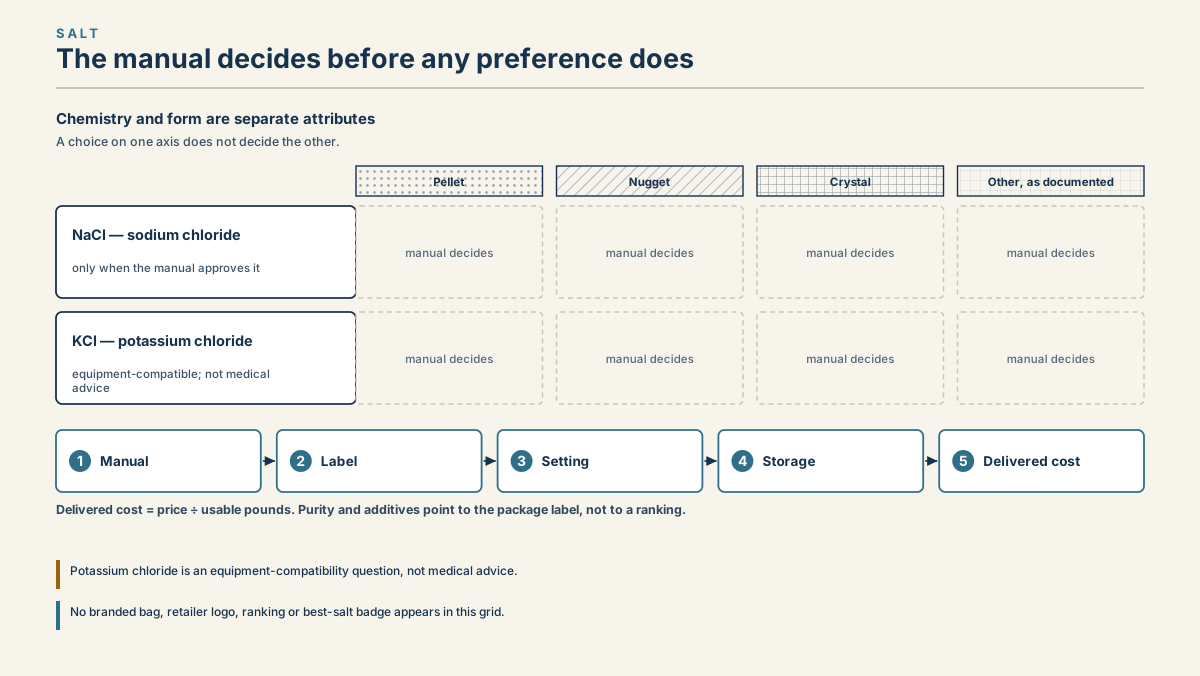
Model-first decision grid for water softener salt chemistry, form, label, setting, storage and cost.
Read diagram in text
- SALT
- The manual decides before any preference does
- Chemistry and form are separate attributes
- A choice on one axis does not decide the other.
- Pellet
- Nugget
- Crystal
- Other, as documented
- NaCl — sodium chloride
- only when the manual approves it
- manual decides
- manual decides
- manual decides
- manual decides
- KCl — potassium chloride
- equipment-compatible; not medical
- advice
- manual decides
- manual decides
- manual decides
- manual decides
- 1
- Manual
- 2
- Label
- 3
- Setting
- 4
- Storage
- 5
- Delivered cost
- Delivered cost = price ÷ usable pounds. Purity and additives point to the package label, not to a ranking.
- Potassium chloride is an equipment-compatibility question, not medical advice.
- No branded bag, retailer logo, ranking or best-salt badge appears in this grid.
What your manual may say
Look in the maintenance or "adding salt" section of your manual. The manuals read for this guide differ more than you might expect:
- Pentair Fleck 5600SXT: the acceptable salt is sodium chloride pellet salt. Its maintenance notes add that rock or snow-melting salt contains dirt and chemicals that affect the softener.
- Pentair Whole House: its specifications list sodium chloride pellet or solar salt, and its maintenance section recommends block salt or solar salt, describing block salt as low in impurities and not caking in the salt container.
- Whirlpool WHES40/44 and WHES48: nugget, pellet or coarse solar salt with less than 1% impurities; potassium chloride allowed with a salt-type setting and fill limits.
If your manual lists specific forms, stick to them. If it does not mention salt at all, pellets made for softeners are the choice EPA recommends.
Sodium or potassium chloride
Softeners work by swapping the calcium and magnesium in hard water for sodium or potassium, as EPA's cation-exchange overview explains, and NSF/ANSI 44 covers softeners regenerated with either one. Whirlpool's WHES40/44 manual says potassium chloride may be used if someone in the home is on a sodium-restricted diet and is concerned about sodium in the water. Whether that matters for a particular person is a question for their doctor; this guide does not assess diets.
If your manual allows potassium chloride, it usually asks for more than a different bag:
- Change the salt-type setting. On the WHES40/44 it is a menu item that toggles between NaCl and KCl; on the WHES48, Setup, Advanced Setup, Set Salt Type. Whirlpool says selecting KCl increases fill and brine rinse times.
- Raise the hardness setting where the manual says so. Whirlpool's WHES18 manual says to increase it by 25% with potassium chloride (20 gpg becomes 25). See how to set the hardness.
- Fill less. The WHES40/44 manual says to add one bag at a time and keep no more than 60 pounds in the tank; both Whirlpool manuals say not to fill above level 4 on the brinewell scale.
- Watch for hardening. Whirlpool warns that potassium chloride may harden in rooms with high humidity or large temperature swings, and says to check the brine tank and brinewell monthly, loosening any hardened areas with small amounts of warm water.
Pentair's 5600SXT manual lists only sodium chloride, so do not switch that unit to potassium without the manufacturer's approval.
How full to fill the tank
EPA's guide gives a clear routine: fill the brine tank about half full with pellets, check every 4 to 6 weeks, add salt once the salt level falls below the water level, and do not let it drop below one-quarter full. Filling to the top is a common mistake: EPA says the extra weight can cause salt bridging, and Pentair's 5600SXT manual says pellets may bridge if the tank is filled more than half full.
Whirlpool suggests checking every two or three weeks until you know how fast your household uses salt, and keeping the level lower in humid areas. The salt bridge guide covers what to do if the salt cakes.
How much salt you use depends on your hardness, water use and the softener's salt dose per cycle; the salt usage calculator estimates it from those inputs.
Adding salt step by step
- Look inside first. Lift the lid and check for a crust, standing water above the salt, or sludge at the bottom. Break up any crust before adding more (see the salt bridge guide).
- Check the bag. Same chemical as the controller's salt-type setting, and a form your manual accepts.
- Pour to about half full, keeping salt away from the inside of the brinewell tube. Put the brinewell cover back on, as Whirlpool's manuals instruct.
- Close the lid. It keeps out moisture and debris.
- Note it in your maintenance log: date, pounds added and product.
You do not need to regenerate after a routine top-up. If the tank had run completely empty, start a manual regeneration so the resin is recharged sooner.
Comparing price
Compare cost per usable pound rather than price per bag, since bags come in different weights:
delivered_cost_per_lb = (bag_price + mandatory_delivery + mandatory_fees) / usable_package_lb
estimated_period_cost = observed_salt_used_lb * delivered_cost_per_lb
Include delivery or required fees in the bag price, and compare the same chemical and form. Potassium chloride is a different product, so compare it against other potassium chloride, not against sodium pellets. A cheaper product that keeps caking in your tank may cost more over time in cleanup, so note in the log how each product behaves.
Problems that point to the salt
| What you see | Possible salt cause | What to try |
|---|---|---|
| Hard crust with a gap under it | Humidity, overfilling or fine salt | Break it up; refill to half; switch to pellets |
| Sludge or "mush" at the bottom of the tank | Salt breaking down in the tank | Let the salt run down and clean the tank; try a different pellet product |
| Dirt or residue left in the tank | Rock salt or high-impurity salt | Clean the tank; buy pellets with a stated purity |
| Potassium chloride caked around the brinewell | Humidity or temperature swings | Loosen with small amounts of warm water, as Whirlpool advises; check monthly |
EPA recommends cleaning the brine tank as needed, at least every few years, by letting the salt run down, removing leftover salt and water, washing with warm soapy water, sanitizing with a bleach solution and rinsing. Its home maintenance page suggests once a year. The maintenance guide has the schedule.
If the salt level stops dropping, confirm whether cycles were due and completed before blaming a part. Low demand, settings, a bridge or brine-path trouble can require different checks: see why a softener stops using salt.
Frequently asked questions
What kind of salt should I put in my water softener?
Use sodium chloride pellets made for water softeners unless your manual names something else. Coarse solar or nugget salt work in many units, including Whirlpool softeners, when purity is high. Avoid rock salt, road or ice-melting salt, table salt and granulated salt, which Whirlpool and EPA advise against. Use block salt only if your manual names it.
Can I use potassium chloride instead of sodium chloride?
Only if your softener's manual allows it. You will usually need to change the salt-type setting, and some manuals, such as Whirlpool's WHES18, ask you to raise the hardness setting by 25%. Fill the tank less and check for hardening in humid rooms. Pentair's 5600SXT manual lists sodium chloride pellets only.
How full should the salt tank be?
EPA suggests filling the brine tank about half full, checking every 4 to 6 weeks, and adding salt once it falls below the water level, never letting it drop below one-quarter full. Filling to the top adds weight that can cause salt bridges, and some potassium chloride manuals set a lower maximum.
Is rock salt okay for a water softener?
No. Whirlpool describes rock salt as high in impurities and lists it as not recommended, EPA says to avoid it, and Pentair's 5600SXT manual warns that rock and snow-melting salts contain dirt and chemicals that affect the softener. Leftover material can build up in the brine tank and mean more cleaning.
Sources
Sources were consulted on the dates shown. Salt formulations and package claims change, so check the current bag label and your manual's salt requirements.
- NSF, NSF/ANSI 44 Technical Requirements, March 8, 2025; consulted August 27, 2026.
- U.S. Environmental Protection Agency WaterSense, Cation Exchange Water Softeners, updated May 8, 2026; consulted August 27, 2026.
- Pentair, Pentair 5600SXT manual; consulted September 24, 2026.
- Whirlpool Water Solutions, Whirlpool WHES48 manual; consulted September 24, 2026.
- Whirlpool Water Solutions, Whirlpool WHES40/44 manual; consulted September 24, 2026.
- U.S. Environmental Protection Agency WaterSense, Guide to Selecting and Maintaining a Water-Efficient Water Softener, May 2026; consulted September 24, 2026.
- U.S. Environmental Protection Agency WaterSense, Home Maintenance — Water Softeners, updated June 16, 2026; consulted September 24, 2026.
- Pentair, Whole House Water Softening System Installation and Operation Manual; consulted September 24, 2026.
- Whirlpool Water Solutions, Whirlpool WHES18 manual; consulted September 24, 2026.