
Water Softener for City Water: Decide From Evidence
Content updated
Sources last checked
City water does not automatically need a softener. EPA's water softener guide gives reference points: water above 120 mg/L (about 7 gpg) is generally considered hard and may benefit from softening, and softeners are often recommended above 180 mg/L (about 10 gpg). Below those levels, decide from measured conditions, the problem you want to solve, local rules and professional advice where needed; neither threshold is an order to buy equipment.
Your utility's annual water quality report, the Consumer Confidence Report, is the place to start. Hardness is not always listed, because the report focuses on regulated contaminants; if it is missing, ask the utility or test a cold tap yourself. A softener only addresses hardness, so treat anything else in the report as a separate question.
Use this sequence:
- identify the water system serving the address;
- obtain the current report and utility contacts;
- find the utility's hardness data or measure at the home;
- separate hardness from contaminants and other concerns;
- decide which fixtures, if any, should receive softened water; and
- size and verify an exact model from documented inputs.
Short answer: Check your actual water hardness. Above about 7 gpg (120 mg/L) a softener may help; above about 10 gpg (180 mg/L) EPA says softeners are often recommended. The right decision also depends on the treatment goal, local rules and the home.
City water does not automatically need a softener
Public suppliers can deliver water with different hardness because geology, source and treatment differ. “City water” describes the supplier type, not one calcium/magnesium concentration.
Hardness is primarily a measure of dissolved calcium and magnesium. The USGS hardness guide uses these general classifications in milligrams per liter as calcium carbonate:
| Hardness as CaCO3 | USGS class | What the class tells you |
|---|---|---|
| 0–60 mg/L | Soft | General classification, not a requirement to avoid or install treatment |
| 61–120 mg/L | Moderately hard | Measure and consider the household's actual goal |
| 121–180 mg/L | Hard | Hardness effects may be more relevant; still define need and scope |
| More than 180 mg/L | Very hard | Strong reason to evaluate hardness management, not proof of another contaminant |
These bands describe hardness. They do not declare drinking water safe or unsafe and do not choose a product for you.
If the measured result is low and the home has no hardness-related objective, “no softener” is a valid decision. If the result is moderate or higher, the owner can weigh scale, cleaning, soap behavior, appliance instructions, salt/water use, discharge, maintenance and cost.
Find the correct water system and CCR
EPA requires community water systems to provide customers a Consumer Confidence Report, also called an annual drinking water quality report. Its consumer information page explains that reports include the water source, detected regulated contaminants, violations and utility contacts. EPA's CCR hub provides a route to find local reports.
Before reading a report, match it to the service address:
- utility or community water system name;
- public water system ID if shown;
- cities or service area covered;
- report year and monitoring period;
- source type and named sources;
- wholesale supplier, purchased water or blended source; and
- contact for water-quality questions.
A mailing city, apartment manager or billing company is not always the actual public water system. If uncertain, ask the entity billing for water to identify the system and PWS ID.
Keep the report URL or PDF and the date accessed. If the EPA locator does not have the current copy, contact the utility or applicable state, Tribal or territorial authority.
Extract source, results, notices and contacts
Use the CCR to record:
- the source or sources of the water;
- regulated contaminants detected and the units used;
- comparison values and any reported violation or action-level information;
- required health or source-water notices;
- treatment and system contacts; and
- where the utility publishes operational water-quality data.
Do not convert “meets applicable standards” into “contains nothing.” A CCR reports under defined regulatory and monitoring rules. It also does not necessarily describe every condition at an individual fixture or every nonregulated aesthetic parameter.
If a violation, action notice, boil notice or other safety communication is active, follow the water system and public-health instructions. Do not use a hardness softener to override that direction.
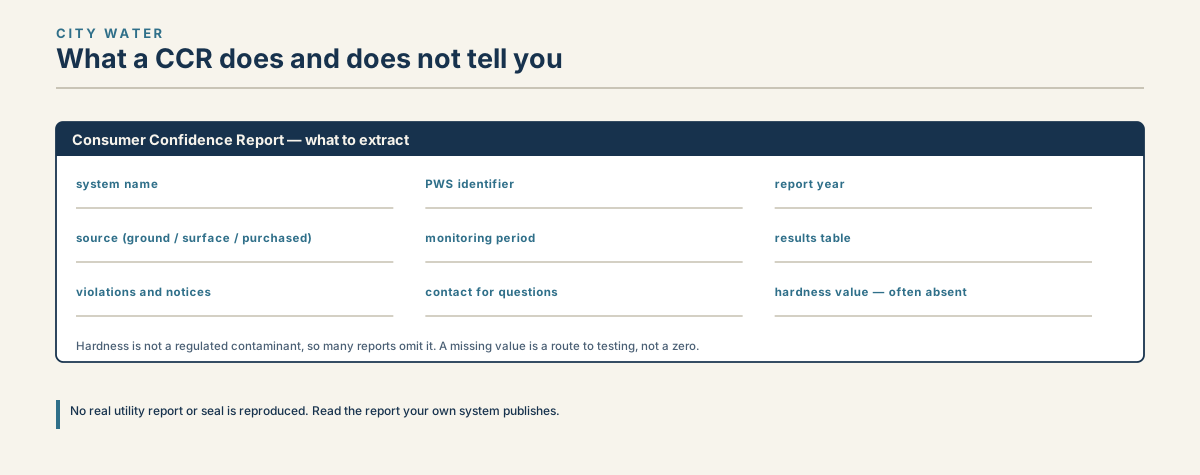
Water report worksheet highlighting system, source, monitoring period, notices, contact and missing hardness route.
Read diagram in text
- CITY WATER
- What a CCR does and does not tell you
- Consumer Confidence Report — what to extract
- system name
- PWS identifier
- report year
- source (ground / surface / purchased)
- monitoring period
- results table
- violations and notices
- contact for questions
- hardness value — often absent
- Hardness is not a regulated contaminant, so many reports omit it. A missing value is a route to testing, not a zero.
- No real utility report or seal is reproduced. Read the report your own system publishes.
Find or measure hardness
Hardness may be absent from the CCR because the standard report focuses on required drinking-water information. Absence is not zero.
Use this evidence order:
- Look for hardness in the CCR, utility water-quality page or published technical report.
- Ask the utility for the recent hardness value or range, unit, sampling location and whether sources change or blend.
- If the utility value is missing, broad or not representative of the service address, test the home's incoming water.
- Record method, unit, sample point, date and recent source/operational context.
- Repeat when the utility reports seasonal sources, the measured value conflicts with documentation or settings require a conservative design input.
Use the water hardness guide to interpret units and the hardness testing guide to preserve a reproducible sample. The hardness calculator converts units; it does not judge water safety.
For sizing, keep the value as reported. Do not round away meaningful variation or replace a measured local result with a national map. If the supply has a documented range, the design and settings review should explain which value is used and why.
Separate hardness from other concerns
The EPA WaterSense treatment guide starts with the water-quality concern and then matches a technology. Cation-exchange softening is designed around hardness reduction; it is not a blanket solution for taste, odor, chlorine, lead, microorganisms, PFAS or any other named concern.
Use this routing table:
| Evidence or concern | Correct next question | Do not assume |
|---|---|---|
| Measured calcium/magnesium hardness | Would lower hardness address the owner's defined objective? | That hardness means the water is unsafe |
| Utility disinfectant or taste/odor concern | What substance and outcome are documented? | That a softener is certified to reduce it |
| Lead or another regulated contaminant concern | What does the CCR/utility say, and is home-specific testing appropriate? | That hardness removal equals contaminant reduction |
| Active violation or public notice | What action does the utility/public-health authority require? | That installing or bypassing a softener resolves the notice |
| Building-specific color, particles or plumbing issue | Is the issue at the main, building plumbing or one fixture? | That the utility report diagnoses the premises |
| Unknown treatment goal | Which measurement or observation would define it? | That a sales demonstration is a complete water analysis |
If a product claims reduction of a specific contaminant, verify the exact model, standard, claim, capacity, use conditions and maintenance in a current certification listing. A hardness-reduction certification does not create an unlisted contaminant claim.
Decide whether and where to soften
Use the evidence to choose one path:
Do not add treatment yet
Choose this when the correct source is not identified, hardness is unknown, the goal is vague or a different concern is driving the decision. Get the missing evidence first.
No softener for the current goal
This is reasonable when measured hardness and owner priorities do not justify the water, salt, installation, maintenance and cost of a system. Preserve the result and reassess if supply or needs change.
Evaluate whole-home or selected-branch softening
This path fits a verified hardness objective. Decide which uses need softened water. Outdoor irrigation, hose bibbs, pools and other high-volume uses may not benefit and can unnecessarily increase regeneration load. Plumbing feasibility and owner preferences determine the final route.
Investigate a different or additional treatment goal
When the evidence concerns a contaminant, taste/odor, sediment or a building-specific issue, define that problem separately. Do not let a combined “treatment package” hide which component has which verified claim.
Also check local restrictions on softener installation or discharge before purchase. The decision should include sewer/septic context, drain route and the authority consulted.
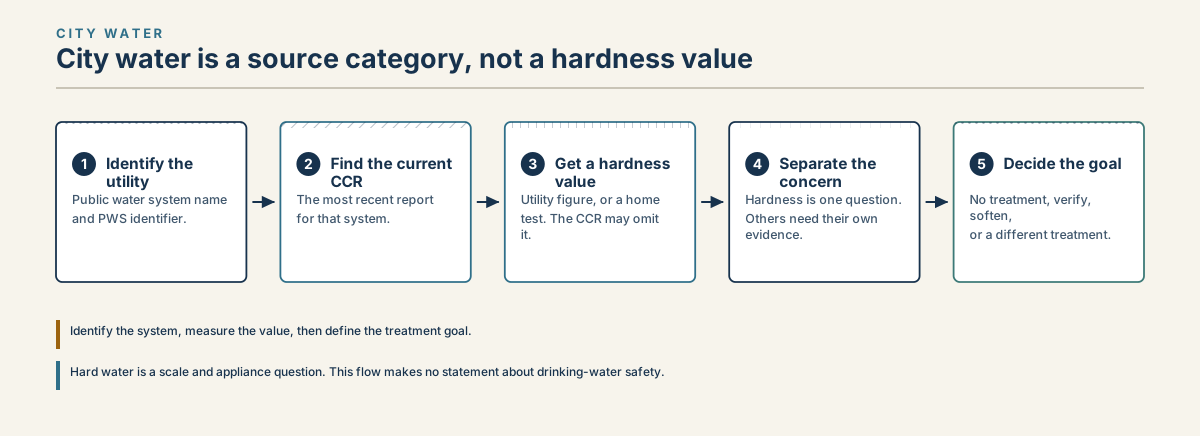
Decision flow from city water system and CCR to hardness measurement and treatment choice.
Read diagram in text
- CITY WATER
- City water is a source category, not a hardness value
- 1
- Identify the
- utility
- Public water system name
- and PWS identifier.
- 2
- Find the current
- CCR
- The most recent report
- for that system.
- 3
- Get a hardness
- value
- Utility figure, or a home
- test. The CCR may omit
- it.
- 4
- Separate the
- concern
- Hardness is one question.
- Others need their own
- evidence.
- 5
- Decide the goal
- No treatment, verify,
- soften,
- or a different treatment.
- Identify the system, measure the value, then define the treatment goal.
- Hard water is a scale and appliance question. This flow makes no statement about drinking-water safety.
Size and compare an exact model
The EPA softener guide recommends using hardness, household water demand and model performance rather than selecting by a large advertised grain number alone. Use the sizing calculator only after the input record is complete.
For every proposed model, collect:
- exact manufacturer, trade name and model;
- verified hardness-reduction claim;
- rated service flow and pressure drop;
- capacity at each documented salt dose;
- selected usable capacity-and-dose pair;
- demand-initiated regeneration and reserve behavior;
- gallons per regeneration or efficiency data as documented;
- salt efficiency;
- incoming-water and installation limits;
- warranty, service and parts support; and
- required maintenance and consumables.
NSF/ANSI 44 covers residential cation-exchange softener requirements including capacity, rinse effectiveness, structural integrity, pressure drop and brine-system accuracy. Verify the exact model and claim in the NSF product listings or another applicable certifier database.
Water softeners are not currently eligible for the WaterSense product label. EPA publishes efficiency guidance, but general WaterSense information is not a model-specific label.
Verify after installation
Agree on acceptance evidence before signing:
- installed model and serial match the proposal;
- inlet/outlet, bypass and untreated branches are labeled;
- settings record shows hardness, units, capacity/dose, reserve and regeneration mode;
- drain, overflow and power are checked under the exact manual and local requirements;
- installation has no active leak or unsafe condition;
- untreated and treated samples are taken at defined points with the same method;
- results, date and cycle context are saved; and
- owner receives the manual, performance sheet, warranty, service contact and maintenance schedule.
A treated result that does not meet the written criterion should trigger diagnosis, not repeated undocumented setting changes.
Frequently asked questions
Does the city already soften my water?
Some systems treat hardness or publish hardness data; others do not. "City water" describes the supplier type, not one calcium and magnesium concentration, because geology, source and treatment differ between suppliers. Ask the utility and verify the current report or technical information for your exact service address.
Why is hardness missing from my CCR?
A Consumer Confidence Report focuses on specified drinking-water information, so absence is not zero. Ask the utility for its hardness value or range, or measure a representative incoming sample. Use a documented value for the service address that accounts for source blending or seasonal change.
Is city water safer after a softener?
Hardness reduction is not a general safety determination. Follow the utility and public-health authority for violations, boil notices and other required actions, and verify each separate treatment claim against a current certification listing for the exact model. Do not use a softener to override that direction.
Should I soften drinking water?
That is a design and preference decision affected by water chemistry, household needs, appliance instructions and plumbing. Define which branches receive treated water and which stay untreated, and obtain competent advice for sensitive concerns rather than treating a sales demonstration as a complete water analysis.
Sources
Sources were consulted on the dates shown. Utility reports and water sources change from year to year, so check the current Consumer Confidence Report for your address before you buy.
- U.S. Environmental Protection Agency, CCR Information for Consumers; consulted August 27, 2026.
- U.S. Geological Survey, Hardness of Water, updated August 24, 2026; consulted August 27, 2026.
- U.S. Environmental Protection Agency WaterSense, Cation Exchange Water Softeners, updated May 8, 2026; consulted August 27, 2026.
- U.S. Environmental Protection Agency, EPA WaterSense treatment guide; consulted August 27, 2026.
- NSF, NSF/ANSI 44 Technical Requirements, March 8, 2025; consulted August 27, 2026.
- U.S. Environmental Protection Agency WaterSense, Guide to Selecting and Maintaining a Water-Efficient Water Softener, May 2026; consulted September 24, 2026.